


1. Introduction
Hydrogen peroxide, H2O2, is a versatile chemical substance that holds significant importance as an oxidizing agent, reducing agent, and bleaching agent [1-3]. Its applications span across diverse fields such as chemical industry, environmental protection, and healthcare [4-6]. Whether it is in chemical production, food processing, paper pulp bleaching, or water treatment, the demand for H2O2 continues to rise steadily [7-9]. However, the traditional processes for H2O2 production are fraught with challenges like high energy consumption, numerous side reactions, and significant risks associated with transportation and storage, which have long been pain points in the industry [10,11]. By contrast, photocatalytic technology presents a promising and innovative alternative [12-14]. It leverages solar energy to drive photocatalytic reactions, directly converting H2O and O2 into H2O2 [15]. This process eliminates the need for high-temperature and high-pressure conditions, thereby reducing carbon emissions and environmental pollution at the source [16-18]. In other words, it achieves green chemical production in a more environmentally friendly manner [19-21]. More than that, this cutting-edge technology addresses the long-standing issue of on-site preparation and immediate application of H2O2 [22]. It paves the way for sustainable development and the construction of a low-carbon society by offering an eco-friendly production method.
Titanium phosphate, Ti(HPO4)2, thanks to its unique layered crystal structure and suitable band gap energy, has found extensive applications in many fields, especially in photocatalytic systems [23-27]. Currently, the generation of H2O2 relies primarily on two routes: the oxygen activation mechanism and the water oxidation mechanism. Because the single-electron water oxidation reaction (H2O + h+ → ·HO + H+, 2.73 V vs. NHE) exhibits extremely strong thermodynamic advantages, it is quite challenging to precisely control the reaction conditions for achieving highly selective generation of H2O2 via the water oxidation mechanism with water as the sole reactant [28-30]. In contrast, the oxygen activation mechanism can be further subdivided into direct oxidation and indirect oxidation mechanisms. [31]. Although the indirect oxidation mechanism must generate the thermodynamically challenging superoxide radical (·O2-), its 2e- tandem reaction mode enjoys distinct kinetic advantages. Additionally, the band positions of Ti(HPO4)2 are approximately −0.5 eV and +3.0 eV, which fully meets the requirement for the effective activation of O2 [25,26]. Therefore, using Ti(HPO4)2 as the mediator and selecting the 2e- indirect oxygen activation mechanism to synthesize H2O2 via photoreaction of O2 and H2O represents a promising candidate. Unfortunately, at present, the photocatalytic performance of Ti(HPO4)2 for H2O2 photosynthesis still has much room for improvement in terms of sluggish oxygen activation kinetics and short electron lifetime.
Ti3+ sites play a vital role in the activation of O2, and their unique electronic structures and chemical properties enable them to exhibit positive promotional effects in numerous chemical reactions [32]. The electron spin state of Ti3+ sites can effectively lower the activation energy barrier of O2 [33]. Their unpaired e- strongly interact with the molecular orbitals of O2 to form stable transition states. This interaction reduces the electron cloud density in the antibonding orbitals of O2, weakens the O=O bond strength, and makes O2 more prone to decomposition into reactive oxygen species [34,35]. In Ti(HPO4)2, all Ti sites are present as +4-valence state, rendering the enhancement of Ti3+ content a critical research priority [23]. The Ti4+ sites in Ti(HPO4)2 are coordinated with strongly electronegative oxygen atoms (forming a Ti4+-O-P configuration), where the high electronegativity of oxygen induces an electron-withdrawing effect, leaving Ti4+ sites in a persistent electron-deficient state. To address this, oxygen vacancy engineering can be strategically employed to modulate the local oxygen environment. By introducing oxygen vacancies (Ov), a reconstructed Ti3+-Ov-P structures coordination structure is formed, which increases electron density at Ti sites by leveraging push-pull electronic effects. Simultaneously, to preserve charge neutrality, a portion of Ti4+ is reduced to Ti3+. The newly generated Ti3+-Ov-P structures not only enhance O₂ adsorption capacity and electron-donating ability (via Ti3+-to-O2 electron transfer) but also introduce impurity energy levels within the band structure. These impurity levels effectively narrow the bandgap, broaden the light absorption range, and facilitate the separation of photogenerated charge carriers [36,37]. This dual modulation of electronic and structural properties provides a robust mechanism to optimize the photocatalytic performance of Ti(HPO4)2-based materials for applications.
A core challenge in Ti(HPO4)2 is achieving efficient charge separation while retaining strong redox capabilities. The S-scheme heterojunction offers a novel solution [38-41]. Its unique band-engineering creates an interface internal electric field and band bending, enabling electron transfer between the valence and conduction bands with weak redox potential [42,43]. This boosts carrier separation efficiency and preserves the intrinsic redox abilities of each component: high-reduction-potential e- in the negative conduction band and high-oxidation-potential h+ in the positive valence band [40]. Unlike traditional II-type heterojunctions, it prevents redox capability loss. Compared to Z-scheme heterojunctions, it self-drives charge transfer without external cocatalysts or bias [44,45]. These advantages give S-scheme heterojunctions great potential in photocatalytic applications and pave the way for new-type efficient and stable photocatalytic material systems.
Guided by the band alignment of Ti(HPO4)2, we rationally selected WO3 as a complementary oxidative cocatalyst to construct an S-scheme heterojunction (WO/TPOv) for photocatalytic H2O2 synthesis in a pure H2O/O2 system without sacrificial agents. The optimized WO/TPOv exhibited a remarkable 15-fold activity enhancement over pristine TPO, achieving a solar-to-chemical conversion (SCC) efficiency of 0.75%. Oxygen vacancy engineering facilitated the generation of Ti3+-Ov-P structures, which synergistically enhanced O2 adsorption and activation. The S-scheme charge transfer pathway was confirmed to suppress carrier recombination, extending charge lifetime by 4.0-fold. Mechanistic studies combining in-situ spectroscopy and DFT calculations revealed a reconstructed Ti3+-Ov-P structures mediated 2e- indirect oxygen activation mechanism. This study pioneers a defect and heterojunction engineering strategy for synchronously optimizing carrier lifetime and surface reactivity, while establishing a robust framework for probing electron flow dynamics in complex photocatalytic systems.
2. Experimental section
2.1 Synthesis of Ti(HPO4)2 photocatalyst
In a jacketed vessel kept at 0 °C, 4 mL of titanium (IV) butoxide was introduced in a slow, dropwise fashion to 4 mL glacial acetic acid pre-diluted with 20 mL absolute ethanol, and the resulting blend was agitated for 0.5 h to afford a homogeneous stock (labelled A). Meanwhile, 6 mL orthophosphoric acid, 12 mL dilute HCl and 14 mL absolute ethanol were combined and subsequently poured into A. After 12 h of continuous stirring, the sol was decanted into a 100 mL autoclave and heated at 180 °C for 4 h. After the reaction mixture cooled to room temperature, 1.740 g of P123 was added and stirred for another 12 h until the P123 was completely dissolved. The sol was poured back into reaction kettle and subjected to secondary heat treatment at 180 °C for 8 h. After completion of the solvothermal reaction, the solid product was collected by centrifugation, cyclically rinsed with H2O and ethanol sequentially, and dried overnight at 80 °C. To thoroughly remove residual structure-directing agents, the powder was finally immersed in 150 mL of boiling ethanol and refluxed for 24 h. The purified product was named TPO.
2.2 Synthesis of oxygen defect Ti(HPO4)2 photocatalyst
The TPO were then placed in a tubular furnace under a hydrogen atmosphere and calcined at 400 °C for different durations (1 h, 2 h, and 3 h). After cooling to room temperature, Ti(HPO4)2 nanosheets with varying oxygen defect concentrations were obtained and named TPOvx, with x representing the heat treatment time.
2.3 Synthesis of WO3-modified oxygen defect Ti(HPO4)2 S-scheme photocatalyst
10 mmol of TPOv2 was dispersed in 40 mL of ethanol, and 1.5 mL of ethylene glycol was added with stirring until a clear solution formed. Then, WCl6 was added, and the mixture was stirred until a yellow clear solution was obtained. The mixture was heated in an autoclave at 110 °C for 4 h. After cooling, the sample was centrifuged, washed, and dried to produce WO3-modified oxygen-deficient TPO nanosheet samples named yWO/TPOv2. Herein, y denotes the molar ratio of WO3 to Ti(HPO4)2. As illustrated by the case of 3WO/TPOv2, quantification via inductively coupled plasma mass spectrometry (ICP-MS) indicated that the 100 mg/L WO/TPOv2 sample contained W at a concentration of 2.11 mg/L. Meanwhile, the Ti content in this identical sample was quantified as 6.86 mg/L. A visual and comprehensive depiction of the process is available in Figure 1a.
3. Results and discussion
The high-magnification electron microscopy images in Figure 1b, 1c and S1 clearly show that the Ti(HPO4)2 (TPO) samples prepared by the stepwise method exhibit highly uniform micro-morphological characteristics-ordered arrangements of uniform nanosheet structures, with statistically analyzed lateral dimensions all maintained within the range of 400±20 nm. This dimensional uniformity reflects the precise controllability of the synthetic process. When the samples undergo hydrogen reduction treatment, the obtained oxygen vacancy-rich TPO (TPOv) material demonstrates excellent structural stability, as no obvious curling or collapse is observed at the edges of the nanosheets, indicating that the introduction of oxygen vacancies does not induce destruction of TPO crystalline structure. In the transmission electron microscopy image of Figure 1d-f, TPOv nanosheets are uniformly decorated with WO3 nanosheets featuring an average diameter of ~50 nm., forming a "sheet-sheet" composite structure. High-resolution TEM (Figure 1f inset) analysis reveals more detailed interfacial features: the TPOv lamellae sheet exhibit a lattice spacing of 0.250 nm (corresponding to the (020) crystal plane), while the WO3 nanosheets show lattice fringes of 0.260 nm (corresponding to the (202) crystal plane) [27,46]. In the corresponding EDX elemental mapping (Figure 1g), the yellow distribution cloud of W element highly overlaps with the green cloud of Ti element in the TPOv, further confirming the uniformity of the heterostructure. In-depth characterization data show that the introduction of oxygen vacancies has minimal impact on the intrinsic properties of TPOv all diffraction peaks in the XRD pattern (Figure S2a) perfectly match those of α-phase Ti(HPO4)2 (JCPDS No. 83-0109), confirming the complete maintenance of the crystal phase structure [27]. The DRS spectrum (Figure S3a) reveal that there is no shift in its absorption threshold, almost identical to that of the original TPO, indicating that the optical bandgap is basically stable. For the WO/TPOv composite material, although no characteristic diffraction peaks of WO3 are observed in the XRD (Figure S2b) (attributed to its low loading < 5wt%), the XRD pattern of the separately prepared WO3 sample matches with the monoclinic standard card (JCPDS No.83-0950), and the optical absorption edge (Figure S3b) also highly coincides with the theoretical value [46,47]. Comprehensive characterization results show that this synthetic strategy successfully achieves the regulation of oxygen vacancy concentration through hydrogen reduction and the construction of uniformly distributed WO3 nanosheets on the surface of lamellae using in-situ hydrothermal method without destroying the intrinsic crystal structure and optical properties of TPO. The formed heterostructure has both interfacial matching and functional synergy, providing an ideal material model for applications in photocatalysis and other fields.
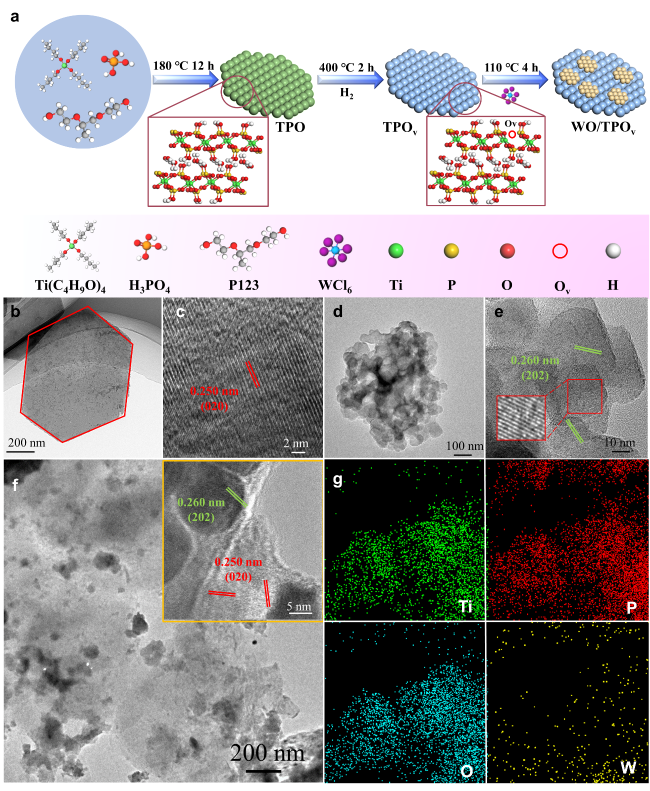
Figure 1. (a) Flowchart for the preparation of WO/TPOv composite samples. (b) TEM and (c) HRTEM images of TPOv. (d) TEM and (e) HRTEM images of WO. (f) TEM with HRTEM inset and (g) EDX images of WO/TPOv. |
For the detection of H2O2 production, the iodometric method was employed. As evidenced by the standard curve (Figure S4), the iodometric method demonstrated superior performance in quantifying H2O2 production, featuring both remarkable detection efficacy and extremely high accuracy, thus providing reliable data support for our study. With oxygen and water employed as the reactants, the photocatalytic H2O2 production activity achieved a leapfrog improvement after hydrogen reduction and WO3 modification, showing a gratifying trend of "two consecutive enhancements". Among them, the most outstanding 3WO/TPOv2 sample exhibited H2O2 photosynthetic performance 15-fold higher than TPO and 3.4-fold greater than TPOv2 (Figure 2a), fully demonstrating the critical role of the treatment process in enhancing sample performance. It should also be noted that when TPO samples were modified with the same proportion, the performance of 3WO/TPO materials increased by about 10 times compared with TPO. This indicates that when both oxygen vacancies and heterojunctions contribute to the enhancement of H2O2 photosynthesis, the heterojunction mechanism still plays a dominant role. Additionally, as a competitive reaction to photocatalytic H2O2 synthesis, the hydrogen evolution reaction was also characterized. As shown in Figure S5a, the H2 production rate of the 3WO/TPOv2 sample with the best performance is less than 7 μmol/g/h, accounting for only about 4% of the total products. This indicates that the hydrogen evolution reaction is almost completely suppressed in this system, and photogenerated e- are mainly directed to the 2e- oxygen reduction for H2O2 generation rather than proton reduction for hydrogen production. This further confirms that 3WO/TPOv2 can selectively adsorb and activate O2, thereby highly selectively driving the H2O2 synthesis pathway. Taking the 3WO/TPOv2 sample as an example, we conducted an in-depth evaluation of its stability during the photocatalytic reaction (Figure S5b) and basic intrinsic properties (Figure S6). After a continuous 20-hour cycle test, the H2O2 photosynthetic performance of this sample remained stable without obvious degradation, strongly confirming that the 3WO/TPOv2 sample possesses excellent performance recyclability and structural stability, which paves a solid way for its industrial application. More notably, the SCC efficiency of the 3WO/TPOv2 sample peaked at 0.75% (Figure 2b), which is a remarkable level in the field of photocatalysis. When using SCC efficiency as the evaluation index for the H2O2 photosynthetic performance of photocatalysts, 3WO/TPOv2 even outperformed most relevant photocatalysts documented recently under comparable experimental conditions (Figure 2c and Table S1), making it stand out among numerous photocatalysts and demonstrating great application potential.
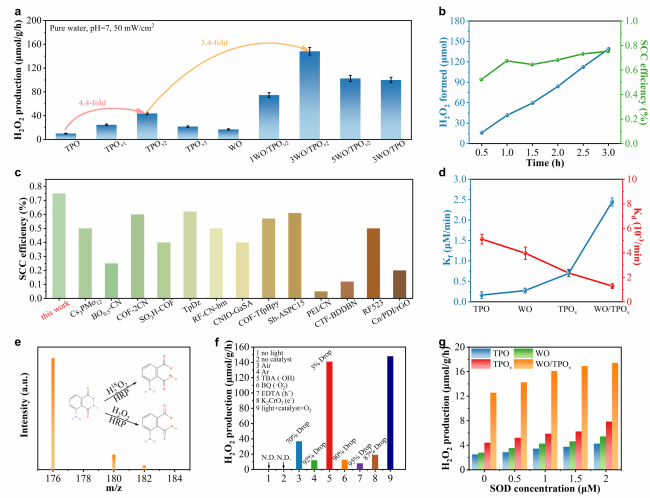
Figure 2. (a) Photocatalytic performance of different samples towards H2O2 production with pure water under light irradiation of 1h. (b) H2O2 yields and SCC efficiencies of WO/TPOv under simulated sunlight irradiation. (c) Comparison of the SCC efficiencies of WO/TPOv and relevant materials. (d) The H2O2 formation rate constant (Kf) and decomposition rate constant (Kd) corresponding to tested catalysts. (e) Mass spectra of luminol oxidized by H2O2 produced via photocatalytic reactions with H218O over WO/TPOv. (f) H2O2 generation efficiencies of the tested samples under varying gas conditions or distinct sacrificial agents under light irradiation of 1h. (g) H2O2 production rates of tested materials at varying superoxide dismutase (SOD) concentrations under light irradiation of 1h. |
The process of photocatalytic H2O2 production is considered a complex dynamic process involving two competing steps: H2O2 generation and H2O2 decomposition. Given that H2O2 may react with the e- or h+, leading to further decomposition of the generated H2O2, we deeply investigated the H₂O₂ degradation behavior of tested photocatalysts including TPO, TPOv, WO3, and WO/TPOv. As is evident from Figure S7, tested materials presented low H2O2 degradation activity, suggesting that H2O2 maintains excellent stability and is not prone to decomposition, thus providing a strong guarantee for the effective accumulation of H2O2. For the purpose of thoroughly investigating this dynamic H2O2 transformation process, we accurately calculated the H2O2 generation rate constant (Kf) and decomposition rate constant (Kd) based on the data in Figure S7, where Kf adheres to zero-order reaction kinetics, while Kd follows first-order reaction kinetics. As distinctly revealed in Figure 2d, WO/TPOv not only had the minimum Kd, which reflects its excellent performance in inhibiting H2O2 decomposition, but also possessed the maximum Kf, implying its significant advantage in promoting H2O2 generation. These two outstanding performances collectively confirm that the WO/TPOv composite material exhibits the best photocatalytic H2O2 activity, holding great application value in the field of photocatalytic H2O2 production.
Furthermore, we conducted an H218O isotope experiment (Figure 2e) under identical conditions to H216O. Luminol was introduced as a probe into the photoreaction system to trace the origin of H2O2 generated over 3WO/TPOv2. Upon adding luminol solution and horseradish peroxidase (HRP) into the 3WO/TPOv2 suspension under light irradiation, an isotope peak corresponding to luminol oxide-16O was detected, accompanied by a weaker peak for luminol oxide-18O. This result strongly confirms that the as-synthesized H2O2 is predominantly derived from O2 reduction, elucidating the core pathway for photosynthesis H2O2. To further validate the above conclusions, we investigated the effects of various factors on H2O2 photosynthesis (Figure 2f) [48-50]. The experiments showed that H2O2 was not produced in the system when light or photocatalyst was absent, fully demonstrating that light and photocatalyst are two indispensable key factors for H2O2 photosynthesis. Additionally, if the H2O2 photosynthetic process in the WO/TPOv system fully followed the oxygen activation mechanism, then the H2O2 photosynthetic performance would have decreased by approximately 80% and 100% when O2 was replaced. This is significantly higher than the experimental results, which were 70% and 92%, respectively. This clearly indicates that although the oxygen activation mechanism serves a pivotal function during the H2O2 generation process, there are still other auxiliary H2O2 photosynthetic pathways, and the contribution of the water activation mechanism to H2O2 photosynthetic performance is about 8%. The analysis of the effects of various radicals revealed that the impact of ·OH on H2O2 photosynthesis is relatively minor, indicating that the reaction pathway for H2O2 formation via ·OH coupling hardly occurs. Considering the combined effects of e- and ·O2-, the changes in H2O2 photosynthetic performance after capturing these two species show essential consistency, suggesting that e- almost entirely follow the tandem reaction pathway of O2 + e- → ·O2-, ·O2- + e- + H⁺ →H2O2. Most importantly, after quenching h⁺ in the system, the H2O2 photosynthetic performance plummeted sharply. In conjunction with the changes in performance due to gas replacement, we can determine that the direct activation of water by h⁺ to produce H2O2 accounts for 5% of the total performance, while more h⁺ is used to oxidize water to supply H⁺ for the oxygen activation mechanism to produce H2O2. This finding provides a key clue for our in-depth understanding of the mechanism of photocatalytic H2O2 production. To further explore the role of ·O2- in the H2O2 photosynthetic process, we used nitroblue tetrazolium (NBT, Figure S8) to verify the oxygen activation capability and superoxide dismutase (SOD, Figure 2g) to investigate the accelerating effect of ·O2- on H2O2 photosynthetic performance [51,52]. The experimental results corroborated the aforementioned conclusions, thus confirming that ·O2- generation exerts a decisive effect on boosting photocatalytic H2O2 synthesis and is one of the core factors for achieving efficient photocatalytic H2O2 production.
Efficient charge transfer mechanisms are crucial for enhancing material performance. We focus on the heterojunction of TPOv and WO. Through a series of rigorous and comprehensive experiments and analyses, we explore its unique charge transfer pathway. Using two characterization methods (Figure S9), the band positions of TPOv and WO were precisely quantified. As shown in the results, the band positions of TPOv range from -0.48 V to 2.93 V, while those of WO ranges from 0.13 V to 3.19 V. These two sets of data indicate that the band positions of TPOv and WO are staggered. This unique band structure provides an essential basis for the S-scheme charge transfer mechanism [53-55].
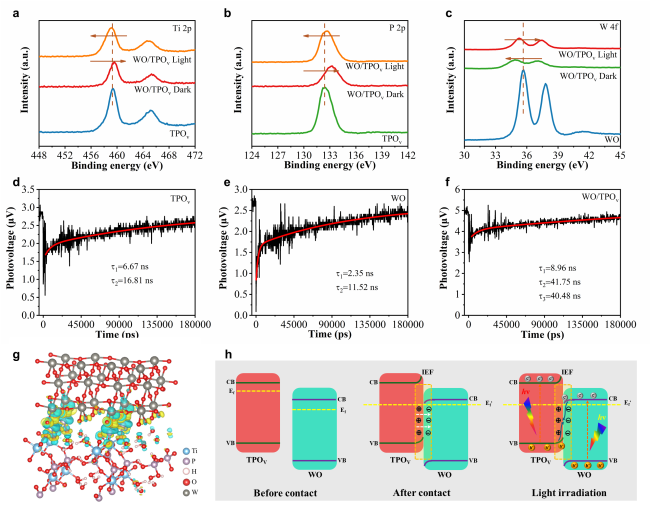
Figure 3. XPS spectra of (a) Ti 2p and (b) P 2p for TPOv and WO/TPOv, and (c) W 4f for WO and WO/TPOv. TPV spectra corresponding to (d) TPOv2, (e) WO, and (f) 3WO/TPOv2. (g) Electron density differences for WO/TPOv heterojunction. (h) The formation of advantage sample S-scheme heterojunction, and the proposed charge transfer and separation mechanism. |
To gain deeper insight into the S-scheme charge transfer pathway of WO/TPOv, we designed a series of XPS detection experiments (Figure 3a-c, Figure S10). Among the detection results of many elements, the data of Ti 2p, P 2p and W 4f are the most prominent. After the formation of the heterojunction, the binding energies of Ti and P, the two key elements of TPOv, show a significant positive shift. This is attributed to the lower work function and higher Fermi level of TPOv (Figure S11). Per semiconductor physics principles, electron transfer occurs from TPOv to WO upon their contact, accompanied by an opposite trend in the W 4f binding energy. Fermi level alignment between the two semiconductors following contact induces band bending in both materials. The bending of the energy band promotes the interaction and recombination between the e- of WO and the h+ of TPOv, and constructs the depletion region and accumulation region of e- at the heterojunction interface, so that WO is negatively charged and TPOv is positively charged, so as to establish the built-in electric field (BIEF) between them. This BIEF plays a key function in enhancing the separation efficiency and accelerating the carriers transfer, and is the key factor to achieve efficient charge transfer. When WO/TPOv is exposed to light, the BIEF induces the directional transfer of e- from WO to TPOv, which is corroborated by the inverse shifts in the XPS spectra of Ti 2p, P 2p, and W 4f. This achieves the directional migration of photogenerated charges following the S-scheme charge transfer mechanism [56-58].
Transient photovoltage spectroscopy is a key means to explore the photogenerated charge separation characteristics of materials. In-depth analysis of TPV spectra via detailed exponential fitting facilitates the extraction of charge lifetime information during different separation processes [59-61]. In the fitting process, τ1 is mainly used to describe the life of the charge initial separation stage, which reflects the initial dynamic process of the separation of photogenerated electron hole pairs. For a single photocatalyst system, τ2 reflects the material surface charge life, that involves many factors such as the recombination and transfer of charge on the surface and interaction with surface defect states. In the composite photocatalyst, τ2 more reflects the charges directional transfer between material interfaces, which is affected by many factors, such as material band matching, interface contact quality and BIEF. As for τ3, it mainly appears in the composite photocatalyst system to reflect the effective life of photogenerated charge on the material surface. Based on the comprehensive experimental results systematically presented in Figure 3d-f, both TPOv and WO exhibit distinct dynamic characteristics that are well consistent with the mathematical model of a second-order exponential equation, further confirming their similar charge carrier relaxation behaviors. This indicates that charge dynamics are relatively straightforward, primarily involving charge intrinsic separation in the bulk phase and subsequent diffusion on the surface. During the intrinsic separation process, photogenerated electron hole pairs begin to separate under the effect of electric field or carrier concentration gradient in the material, forming free moving carriers. In the process of surface diffusion, these carriers diffuse near the surface of the material until they are combined or captured by the active sites on the surface. However, in the WO/TPOv heterojunction system, the effective lifetime of photogenerated charge is significantly prolonged, showing the characteristics of third-order exponential equation, in which τ3 is as high as 40.48 ns. This significant result underscores the existence of a highly efficient charge transfer mechanism in the heterojunction system. When the photogenerated charge is formed at the interface of the heterojunction, the BIEF will induce the photogenerated e- to migrate from one material to another, while the h+ migrate in the opposite direction. This oriented charge transfer effectively suppresses charge recombination, prolongs carrier lifetime, and significantly elevates charge separation efficiency, thus offering ample active carriers to drive photocatalytic reactions, which is expected to improve the performance of photocatalysts in practical applications. Through exponential fitting of TPV spectra and systematic investigation of the energy band position relationship in the WO/TPOv composite, researchers elaborately plotted the τ-corresponding charge transport pathway diagram (Figure S12). The schematic diagram shows in detail the transmission path and law of photo generated charge in the heterojunction in an intuitive form. By observing the schematic diagram, we can clearly see how the photogenerated charge in the heterojunction is affected by the BIEF and migrates and separates along a specific path. For example, photogenerated e- migrate rapidly from WO to TPOv driven by the BIEF, while h+ remain on the surface of WO.
Beyond the experimental investigations discussed above, for a better understanding of the S-scheme mechanism of WO/TPOv composite from the theoretical level, based on the accurate characterization of chemical states of interface elements by in-situ XPS and the real-time monitoring results of photogenerated charge dynamics by transient photovoltage spectroscopy, we used the method of combining first principles calculation with density functional theory (DFT) to systematically simulate the charge transfer direction of heterojunction interface (Figure 3g and Figure S13 for relevant data). In the calculation process, we constructed an atomic model including different interface bonding modes, and quantitatively analyzed the charge density distribution before and after the formation of the heterojunction by accurately solving the electronic structure equation [62,63]. The calculation results show that the WO charge density at the interface increases remarkably when TPOv and WO form a heterojunction by chemical bonding. This charge redistribution phenomenon is highly consistent with the valence state changes of elements observed in-situ XPS experiments. This theoretical calculation result not only verifies the experimental conclusion from the electronic structure level, but also reveals the essence of charge transfer driven by the Fermi level flattening effect-under the action of thermodynamic equilibrium, the e- with higher energy in TPOv will spontaneously diffuse to WO until the Fermi levels align. According to the multi-faceted experimental characterization results and theoretical computation outcomes, we systematically constructed a comprehensive schematic diagram of the formation mechanism of the BIEF and the electron-hole transport behavior during the formation of the WO/TPOv composite (Figure 3h). The schematic diagram shows in detail the whole process from the formation of chemical bonds at the interface of heterojunction, the charge diffusion caused by Fermi level alignment, owing to the formation of the BIEF and driving the directional migration of photogenerated carriers.
To investigate the dynamic charge transfer mechanism in WO/TPOv, we conducted femtosecond transient absorption (fs-TA) spectroscopy measurements under an excitation wavelength of 320 nm. The negative ΔA signal observed at 400-500 nm signifies ground-state bleaching (GSB), reflecting the depletion of ground-state e- upon photoexcitation (Figure 4a and Figure 4d). As the detection time increases, the TA intensity of the TPOv and WO/TPOv catalysts decreases significantly (Figure 4b and Figure 4e). When the detection time is further extended, the TA intensity of the TPOv and WO/TPOv catalyst increases significantly. This is because the h+ capture the photogenerated carriers, shortening the lifetime of the initial excited state, resulting in rapid decay of the TA signal. These results indicate that the recombination rate of photoexcited charges in WO/TPOv is effectively suppressed through a new channel, leading to the accumulation of photoexcited charges in the CB and VB, respectively. Combined with the results of in-situ XPS, it can be inferred that the photoexcited e- of WO are efficiently transferred to TPOv via the strong IEF between WO and TPOv. This transfer process promotes the utilization of photoexcited charges in WO/TPOv. The normalized dynamic kinetic decay curves at 400 nm and their fitting results with a three-exponential decay function are shown in Figures 4c and 4f. The decay process typically includes three stages: ultrafast electron diffusion, electron trapping, and recombination of e- with unconsumed h+. TPOv exhibited longer electron diffusion (τ1 = 1.39 ps) and trapping processes (τ2 = 22.95 ps) compared to WO/TPOv. Both τ₁ and τ₂ of WO/TPOv were reduced, indicating faster electron dynamics and shorter time required for diffusion and trapping processes. These findings confirm that in the WO/TPOv heterojunction, after the generation of photoexcited e- by WO and TPOv, most e- in the CB of WO are efficiently and ultrafastly transferred to the VB of TPOv under the action of the strong IEF. This rapid electron transfer reduces diffusion and trapping, thereby extending the separation time of photoexcited charges. This directly verifies the advantage of the built-in IEF in the WO/TPOv heterojunction for efficient photogenerated charge transfer and separation, allowing high concentrations of photoexcited charges to be retained in WO/TPOv, respectively.
In order to further consolidate the theoretical basis of the S-scheme mechanism in WO/TPOv heterostructures, we designed and implemented a multi-dimensional supplementary experimental system. A single wavelength laser generator was used as the light source to select six representative wavelengths for photocurrent testing of single component (TPOv and WO) and composite material (WO/TPOv) (Figure S14), the optical response characteristics of WO and TPOv semiconductors were systematically studied by accurately adjusting the excitation wavelength. The experimental data show that when the excitation wavelength only meets the optical absorption threshold of a single component of WO or TPOv, the photocurrent density remains at a low level. When the excitation wavelength meets the optical excitation conditions of WO and TPOv at the same time, the current density of the heterojunction system shows an exponential jump, which is highly consistent with the efficient charge separation process caused by the two-component cooperative excitation in the S-scheme electron-hole transport mechanism. Through the utilization of in-situ EPR test (Figure S15 and S16), we captured the migration path of photogenerated carriers. Based on the accurate calculation of the energy band position, O2/·O2- and -OH/·OH oxidation-reduction potential of WO and TPOv, combined with the dynamic changes of the characteristic spin adduct signal in the EPR spectrum, the directional migration characteristics of e- at the heterojunction interface were confirmed [64,65]. The results show that under the condition of light excitation, the h+ generated by the valence band of TPOv and the e- generated by the conduction band of WO pass through the S-scheme charge transmission path, which realizes the efficient charge separation and redistribution, and finally makes the photogenerated e- specifically enriched in the conduction band level of TPOv. Figure S17 shows the excellent performance of WO/TPOv heterojunction driven by S-scheme mechanism from the three dimensions. Photophysical tests revealed the ultrafast kinetic process of charge transfer at the interface. Photoelectrochemical tests verified the linear relationship between charge separation efficiency and photocurrent response, while photochemical experiments directly showed the high activity and durability of the heterojunction in the photocatalytic reaction. The experimental results not only provide comprehensive verification of the S-scheme mechanism but also fully demonstrate that the WO/TPOv heterojunction possesses excellent charge separation capability under this charge transfer pathway.
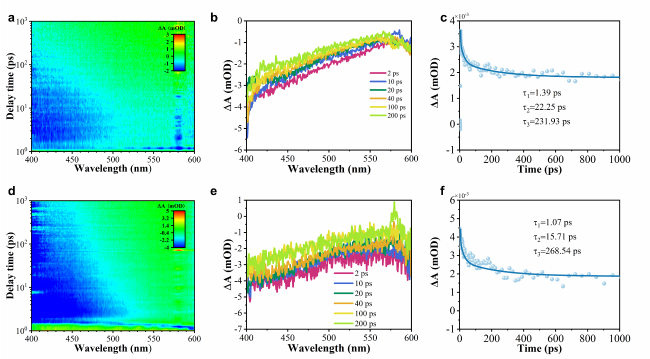
Figure 4. 2D pseudo-color maps of fs-TA spectra (a and d), transient fs-TA spectra (b and e), and kinetic time profiles (c and f) of normalized transient absorption at 400 nm, in TPOv, and WO/TPOv under 320 nm laser pulse irradiation. |
In the present work, systematic experimental and theoretical investigations have validated that photoexcited e- tend to accumulate preferentially on the conduction band of TPOv. Notably, these photoexcited e- serve as the predominant active species responsible for the photosynthesis of H2O2 within the WO/TPOv photocatalytic system. Consequently, deciphering the specific activation mechanism of the spatially separated photogenerated e- is indispensable for gaining comprehensive insights into the fundamental origins of the overall photocatalytic process. To this end, an XPS experiment was designed to study the performance of hydrogen reduction in the composite system to reveal the influence of the oxygen vacancy structure on the surface electronic structure of the material. By comparing the XPS spectra of TPO and TPOv (Figure 5a and Figure S18), a distinct new characteristic peak of binding energy was observed on the surface of the TPOv catalyst, with its position centered at approximately 532 eV. This characteristic peak is ascribed to O2 molecules adsorbed on oxygen vacancies, indicating that many oxygen vacancies are generated in TPO material after hydrogen reduction treatment. Analysis of the O 1s XPS spectra (Figure S18a) reveals a monotonic increase in oxygen-vacancy content with prolonged H2 treatment: rising from 7.2% in pristine TPO to 17.2% (TPOv1), 34.4% (TPOv2), and ultimately 39.1% (TPOv3), unequivocally confirming H2 thermal reduction as a direct route for generating oxygen vacancies. Further analysis showed that in TPOv material, the content of Ti3+ binding energy characteristic peaks (located at 458.59 eV and 464.26 eV) significantly increased, and the binding energy of these peaks slightly shifted to the negative direction. This phenomenon can be attributed to the formation of oxygen vacancies in the Ti-O-P structure, leading to the reconstruction of the Ti3+-Ov-P structure [66,67]. By virtue of the oxygen atom deficiency, the intense electronegative coordination interaction exerted by oxygen atoms to captivate e- is diminished, which in turn elevates the electron density of Ti sites. More importantly, the charge compensation mechanism also promotes the partial reduction of Ti4+ sites to Ti3+ sites, further enhancing the electronic activity of the material. In order to further corroborate the presence of Ti3+ active sites in the TPOv catalyst, low-temperature EPR spectroscopic measurements were performed (Figure 5b). Systematic characterization results revealed the presence of distinct Ti3+ species signals in the TPOv catalyst, where the associated g-values were determined to be 1.93, 1.99, and 1.998 [68,69]. The presence of these signals further confirmed that the introduction of oxygen vacancies indeed promoted the generation of Ti3+ sites. The restructured Ti3+-Ov-P structure may become the active center for photogenerated e-, thereby improving the photocatalytic performance of the material. To gain deeper insights into the variations in charge density subsequent to the generation of the restructured Ti3+-Ov-P structure, theoretical calculations were performed on TPO and TPOv (Figure 5c and Figure S19-20). The calculation results showed that the atomic charge density adjacent to oxygen vacancies increased. This finding further validated that following the elimination of oxygen atoms, the electron density at Ti sites is augmented owing to the scarcity of electron-withdrawing capacity. Such an elevation in electron density facilitates the sequestration and activation of photoexcited e-, thereby improving the efficiency of the WO/TPOv catalyst system in H2O2 photosynthesis.
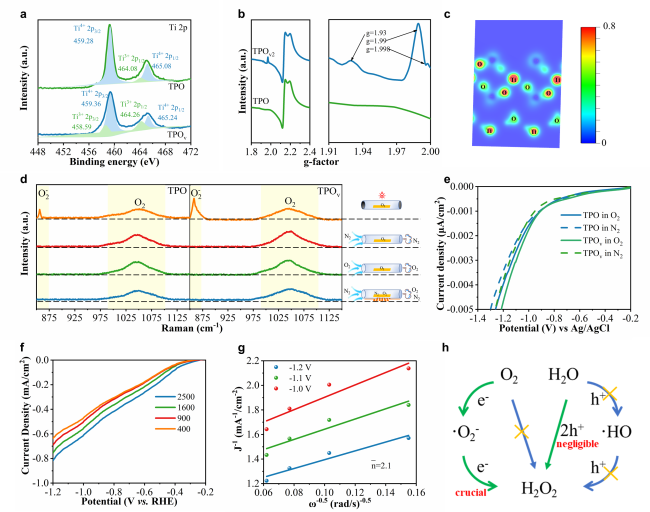
Figure 5. (a) XPS spectra of Ti 2p and (b) EPR spectra of TPO and TPOv. (c) Local charge density map of TPOv. (d) In-situ Raman spectra and (e) electrochemical reduction curves in different atmosphere of TPO and TPOv. (f) The Linear-sweep voltammograms signal of WO/TPOv catalyst measured on a rotating disk electrode at different rotation speeds. (g) K-L plots of WO/TPOv catalyst at constant electrode potentials. (h) Validated pathways for photocatalytic H2O2 production. |
To deeply investigate the impact of the Ti3+-Ov-P structure on the O2 activation effect, we first systematically examined its O2 adsorption capacity. By analyzing the data in Figures S21 and S22, we found that in the TPOv catalyst, with the extension of O2 adsorption duration, the characteristic binding energy peak corresponding to adsorbed oxygen in the in-situ O1s XPS spectrum has been significantly higher than the corresponding peak of the TPO catalyst since the initial stage of the experiment, indicating that the TPOv catalyst possesses a stronger O2 adsorption activity. Further O2-TPD experimental results also confirmed this point [70-72]. Whether considering chemisorption or physisorption, the O2 adsorption activity of the TPOv catalyst is significantly better than that of the TPO material. These findings lay a solid foundation for subsequent O2 activation capacity testing. Prior to the formal in-situ Raman spectroscopy measurements, a series of pretreatment operations were conducted, encompassing the elimination of surface contaminants, adsorption of O2, and purging with N2 to ensure the reliability of subsequent test results. As illustrated in Figure 5d, the Raman spectrum reveals that the characteristic Raman peak assigned to adsorbed O2 remains essentially unchanged for the same material throughout the entire testing period, confirming the absence of free O2 interference during detection [73-75]. Furthermore, the intensity of the adsorbed oxygen-related Raman peak for TPOv is consistently higher than TPO, which further verifies that the Ti3+-Ov-P structure enhances the O2 adsorption capability. Notably, upon introducing light into the monitoring system, TPOv exhibits a more prominent ·O₂⁻ characteristic peak, indicative of its superior oxygen activation performance. This finding is corroborated from an alternative perspective via atmosphere-controlled electrochemical oxygen reduction measurements (Figure 5e). Upon switching the purge gas from N2 to fully O2-saturated electrolyte, the potential required to activate O2 on TPOv material dropped markedly below that observed for TPO material. In addition, the SS-SPS spectra with different atmospheres (Figure S23) and DMPO-·O2- EPR spectrum (Figure S24) also provided evidence supporting this conclusion. From the perspective of electronic structure essence, the projected density of states clearly reveals the decisive regulatory role of oxygen vacancies (OV) in the catalytic activity of TPO (Fig. S25). For the vacancy-free sample, the density of states near the Fermi level (Ef) is almost vacant with a wide band gap. The Ti 3d and O 2p orbitals are locally confined, failing to provide sufficient e- to the O2 π* orbitals, thus oxygen activation is restricted by the electron transfer prohibition. After the introduction of oxygen vacancies, to strictly maintain the overall electrical neutrality of the material, the positive charge defects released by oxygen vacancy formation trigger a local charge self-compensation mechanism. Under the action of this mechanism, Ti4+ ions adjacent to the oxygen vacancies are selectively occupied by e- and reduced to Ti3+, thereby forming a local polaron state with high electron density in the defect region, and the 3d1 e- form new energy levels within the band gap. These levels rehybridize with the relaxed O 2p orbitals around the vacancies, generating continuous defect states with high intensity near Ef. Such defect states simultaneously satisfy three electronic criteria for oxygen activation: (1) The density of states crosses Ef, enabling immediate participation of e- in the reaction; (2) The significant overlap between Ti 3d and O 2p peaks achieves effective coupling with the O₂ π* orbitals; (3) The significant increase in the density of states at Ef, greatly enhancing the electron supply capacity. The experimentally observed enhancement in oxygen activation activity is thereby directly explained at the electronic structure level. In summary, through a series of experiments, we have demonstrated that the Ti3+-Ov-P structure has significant advantages in O2 adsorption and activation.
In this study, the rotating disk electrode technique was adopted to quantify the selectivity of O2 activation [76-79]. Measurements were repeated at four precisely controlled rotation speeds: 400, 900, 1600 and 2500 rpm, to generate a set of hydrodynamic profiles. The resulting current-potential data were used to calculate the electron-transfer number, allowing the 2e⁻ versus 4e⁻ selectivity of the O2 activation process to be evaluated under well-defined mass-transport conditions. The current density data obtained under these different rotation speed conditions, as shown in Figure 5f, provided important experimental evidence for analyzing the O2 activation process. Furthermore, we conducted an in-depth analysis of the experimental data using the Koutecky-Levich (K-L) theory and plotted the K-L graph shown in Figure 5g [80]. This graph clearly illustrates the average electron transfer number (n) during the O2 reduction process. For the WO/TPOv catalyst, the averaged n-value is 2.1, which is highly consistent with the theoretical 2e- O2 reduction mechanism. More importantly, the selectivity of this material during the O2 reduction step is as high as 95.2%, fully demonstrating that the WO/TPOv composite material primarily follows the 2e- indirect O2 activation pathway. Based on the analysis results of the averaged n-value together with the mechanistic evidence provided by trapping experiments (as shown in Figure 2f), we further plotted the H2O2 generation mechanism diagram based on the indirect 2e- O2 activation pathway, as shown in Figure 5h. The diagram provides an end-to-end mechanistic portrait of O2-to- H2O2 conversion via the indirect 2e- mechanism under the catalysis of the WO/TPOv composite material.
A deep understanding of molecular behavior during photocatalytic reactions is crucial for elucidating reaction mechanisms and optimizing catalyst design. In the previous section, we systematically investigated the adsorption capacity and active sites of the WO/TPOv heterojunction toward O2. Building on that, this section employs in-situ DRIFTS to study the key reaction steps during the photocatalytic H2O2 synthesis process Over the WO/TPOv heterojunction, with a particular focus on the adsorption behavior of H2O molecules and the formation of H2O2 (see Figures S26-27 and 6a-c). In the range of 3100-3700 cm-1, a characteristic infrared band assignable to the O-H stretching mode of adsorbed H₂O can be clearly identified [81-83]. The intensity of these peaks reflects the adsorption capacity of the catalyst surface toward H2O. Under identical experimental conditions, we compared three representative catalyst samples: TPO, TPOv, and WO/TPOv. The results showed that the intensities of the H2O characteristic peaks were nearly identical across all three samples, indicating that their H₂O adsorption capacities are similar. This suggests that neither the introduction of oxygen vacancies (Ov) and Ti3+ sites to form the Ti3+-Ov-P structure nor the incorporation of WO to construct the heterojunction interface significantly alters the surface adsorption behavior of H2O molecules. This finding implies that the activation of H2O molecules may not be the key factor contributing to the enhanced photocatalytic performance in this system. Instead, combined with our previous analysis of O2 adsorption behavior, it is reasonable to infer that the improved H2O2 synthesis performance is primarily due to the effective adsorption and activation of O2 molecules. To verify this hypothesis, we further monitored the infrared signal changes during H2O2 formation. In the range of 2840-2860 cm-1, characteristic infrared absorption peaks attributed to H2O2 molecules were observed (Figure 6b) [84,85]. The appearance of these peaks directly reflects the formation of H2O2 on the catalyst surface. Under the same reaction conditions, the intensities of the H2O2 characteristic peaks followed the order: WO/TPOv > TPOv > TPO, which is consistent with their photocatalytic activities in H2O2 synthesis. This further confirms that structural optimization of the catalyst promotes H2O2 formation efficiency.
Beyond macroscopic observations of H2O adsorption and H2O2 formation, we also focused on the microscopic pathway of the stepwise conversion of O₂ and H2O into H2O2. As shown in Figure 6c, with increasing illumination time, the characteristic peaks of O2* and OOH* radicals progressively intensified [86-88]. Compared with substrate, the WO/TPOv catalyst exhibited a pronounced surge in the signal intensities of both radical species. This experimental evidence strongly supports that the Ti3+-Ov-P structure and the introduction of WO act as a vital facilitator in accelerating O2 activation and promoting H2O2 photosynthesis. On the basis of in-situ DRIFTS results, we further employed DFT to investigate the Gibbs free energy changes of the indirect 2e- O2 reduction mechanism on TPO and WO/TPOv [89-91]. As shown in Figure 6d, all theoretical models exhibited a downward trend in Gibbs free energy along the reaction pathway, indicating that H2O2 formation is thermodynamically feasible on TPO-based photocatalysts. More importantly, at each key stage-O2 adsorption, OOH* formation, and H2O2 generation-the Gibbs free energy values for WO/TPOv were significantly lower than those for pure TPO. This is mainly due to the strong O2 adsorption capability of the reconstructed Ti3+-Ov-P structure, which effectively captures and activates O2 molecules, facilitating subsequent reactions. In the indirect 2e- O2 activation mechanism, the formation of the OOH* intermediate and its protonation to H2O2 are generally considered the rate-determining steps, directly influencing the overall reaction efficiency. Our data show that, compared with TPO, WO/TPOv exhibits the lowest Gibbs free energy values for both OOH* formation and its protonation. This substantiates that the Ti3+-Ov-P structure and WO incorporation not only favor OOH* formation but also significantly accelerate the reaction kinetics of the indirect 2e- O2 reduction process, thereby greatly enhancing H2O2 production efficiency. In conclusion, the synergistic effect of the Ti3+-Ov-P structure and WO component optimizes both the thermodynamic and kinetic conditions for H2O2 formation by enhancing O2 activation and promoting the transformation of key intermediates such as OOH*.
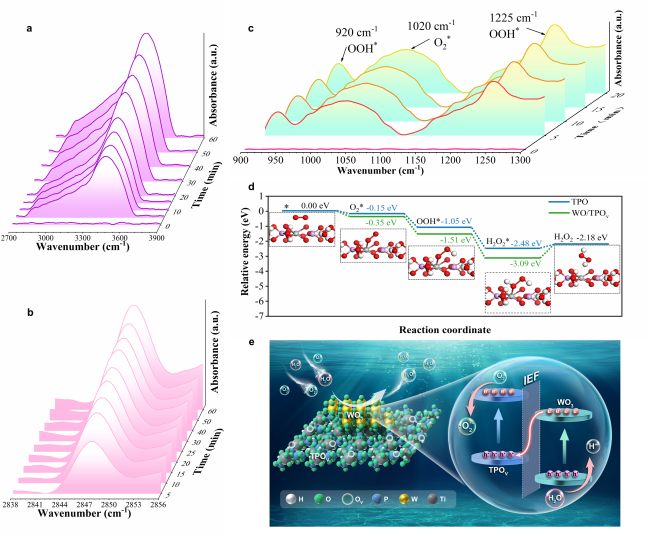


Figure 6. In-situ DRIFTS of (a) H2O adsorption, (b) H2O2 production and (c) H2O conversion on WO/TPOv catalyst. (d) Free energy diagrams for H2O2 production processes over WO/TPOv catalyst with optimized configurations for each step. (e) Schematic of the S-scheme mechanism and H2O2 photosynthesis reaction involved in WO/TPOv catalyst. |
Drawing on the above data, we advance a streamlined charge transfer and redox model to explain the generation of H2O2 on the WO/TPOv catalyst (Figure 6e). Upon light irradiation, the photoexcited h+ of WO are localized by its valence band, thus expediting water oxidation and H⁺ release. Meanwhile, the push-pull electronic effects caused by oxygen vacancies reconstitute the Ti3+-Ov-P structure, which is beneficial for O2 adsorption. The high-energy e- with significantly prolonged lifetimes due to the S-scheme mechanism initiate an indirect oxygen activation mechanism, promoting the H2O2 generated. The synergistic coupling between prolonged photoelectron lifetime and exceptional oxygen activation capability empowers the rationally architected WO/TPOv catalyst to deliver an outstanding H2O2 production performance.
4. Conclusion
In conclusion, we propose an indirect 2e- oxygen activation strategy for efficient H2O2 photosynthesis without a sacrificial agent. By constructing a WO/TPOv catalyst rich in oxygen vacancies through structural and interfacial strategies, the optimized WO/TPOv catalyst achieves an H2O2 generation performance of 0.15 mmol/g/h, and achieved an SCC efficiency of 0.75%. Both experiments and theoretical calculations confirm that the excellent H2O2 production activity of the catalyst originates from the synergistic effect of the reconstituted Ti3+-Ov-P structure activation of O2 and the prolonged electron lifetime due to the S-scheme heterojunction. This study provides a new idea for efficient H2O2 photosynthesis by achieving synergistic regulation of the electron lifetime and oxygen activation ability of a single-component catalyst through dual structural and interfacial regulation strategies.
CRediT authorship contribution statement
Shanyue He: Investigation, Validation, Visualization, Formal analysis, Writing-original draft. Mei Chen and Xin Zhang: Formal analysis. Hongquan Jiang, Yang Qu and Jizhou Jiang: Funding acquisition; Supervision; Writing-review and editing. Yanduo Liu: Conceptualization; Funding acquisition; Supervision; Writing-review and editing.
Declaration of competing interest
The authors declare that they have no known competing financial interests or personal relationships that could have appeared to influence the work reported in this article. Jizhou Jiang is the Editor-in-Chief, and Yang Qu is an Editorial Board Member of this journal and they were not involved in the editorial review or the decision to publish this article.