
[an error occurred while processing this directive]

  • Jizhou Jiang , a, * ,
  • Yanghanbin Zhang a ,
  • Wei Sun a ,
  • Jiahe Peng a ,
  • Weilong Shi , b, * ,
  • Yang Qu c ,
  • Enzhou Liu , d, * ,
  • Arramel e ,
  • Zhiliang Jin f, *
展开

收稿日期: 2025-02-11

  修回日期: 2025-04-02

  录用日期: 2025-04-14

  网络出版日期: 2025-04-17

A review of updated red phosphorus-based photocatalysts

  • Jizhou Jiang , a, * ,
  • Yanghanbin Zhang a ,
  • Wei Sun a ,
  • Jiahe Peng a ,
  • Weilong Shi , b, * ,
  • Yang Qu c ,
  • Enzhou Liu , d, * ,
  • Arramel e ,
  • Zhiliang Jin f, *
Expand
  • a. School of Materials Science and Engineering, State Key Laboratory of Green and Efficient Development of Phosphorus Resources, Engineering Research Center of Phosphorus Resources Development and Utilization of Ministry of Education, Key Laboratory of Green Chemical Engineering Process of Ministry of Education, Hubei Key Laboratory of Plasma Chemistry and Advanced Materials, Novel Catalytic Materials of Hubei Engineering Research Center, Wuhan Institute of Technology, Wuhan 430205, P. R. China.
  • b. School of Material Science and Engineering, Jiangsu University of Science and Technology, Zhenjiang, Jiangsu 212003, P. R. China.
  • c. Key Laboratory of Functional Inorganic Materials Chemistry (Ministry of Education), School of Chemistry and Materials Science, International Joint Research Center for Catalytic Technology, Heilongjiang University, Harbin 150080, P. R. China.
  • d. School of Chemical Engineering, Shanxi Key Laboratory for Carbon Neutral Technology, Northwest University, Xi'an 710069, P. R. China.
  • e. Nano Center Indonesia, Jl PUSPIPTEK, South Tangerang, Banten 15314, Indonesia.
  • f. School of Chemistry and Chemical Engineering, Ningxia Key Laboratory of Solar Chemical Conversion Technology, Key Laboratory for Chemical Engineering and Technology, State Ethnic Affairs Commission, North Minzu University, Yinchuan 750021, P. R. China.
* E-mail: (J. Jiang), (W. Shi), (E. Liu), zl-jin@nun.edu.cn (Z. Jin)

Received date: 2025-02-11

  Revised date: 2025-04-02

  Accepted date: 2025-04-14

  Online published: 2025-04-17

Copyright

© 2025 This is an open access article under the CC BY-NCND license (http://creativecommons.org/licenses/by-nc-nd/4.0/).

本文引用格式

Jizhou Jiang , Yanghanbin Zhang , Wei Sun , Jiahe Peng , Weilong Shi , Yang Qu , Enzhou Liu , Arramel , Zhiliang Jin . [J]. Composite Functional Materials, 2025 , 1(1) : 20250101 . DOI: 10.63823/20250101

Abstract

Red phosphorus (RP), as a promising non-metallic photocatalyst, has garnered considerable attention due to its unique structural characteristics and exceptional optoelectronic properties. While previous reviews have explored RP-based photocatalysis, recent advancements in fabrication strategies, characterization techniques, and theoretical modeling have significantly reshaped the design, synthesis, and optimization of these materials. This review provides a comprehensive and critical evaluation of the latest progress in RP-based photocatalysts over the past five years, with a particular focus on strategies aimed at enhancing light harvesting capabilities, improving the separation and transport of photogenerated charge carriers, and ensuring long-term stability. Particular emphasis is placed on the role of innovative in-situ characterization techniques and density functional theory (DFT) simulations in elucidating the underlying photocatalytic mechanism across diverse applications, including photocatalytic hydrogen evolution, CO2 reduction, bacterial disinfection and organic pollutant degradation. Finally, this review highlights emerging challenges and forward-looking strategies to further boost the photocatalytic performance of RP-based systems, offering valuable insights for the rational design of next-generation non-metallic photocatalysts.

1 Introduction

The rapid progression of science and technology has markedly escalated the consumption of fossil fuels, precipitating profound environmental degradation and exacerbating energy scarcity [1-5]. In response to these critical challenges, the scientific community has increasingly directed its efforts toward exploring renewable energy alternatives, including biomass, solar, nuclear, ocean, and wind energy. Among these, solar energy emerges as an exceptionally promising option, distinguished by its renewable, clean, and inexhaustible characteristics. Advances in solar energy technologies not only diminish reliance on fossil fuels but also play a pivotal role in reducing greenhouse gas emissions and mitigating the impacts of global warming [6-10]. Notably, semiconductor-based photocatalytic technologies have gained prominence as an efficient approach to harnessing solar energy, providing carbon-neutral and sustainable substitutes for conventional fossil fuel utilization.
Since the seminal work of Fujishima and Honda in 1972 on TiO2-based photocatalytic water splitting, a substantial body of research has been devoted to the discovery and development of novel semiconductor photocatalysts. To date, more than 2, 000 semiconductor materials have been identified, predominantly encompassing transition-metal-based oxides, sulfides, and nitrides [11-13]. Despite these advancements, the practical efficiency of these materials remains constrained by their suboptimal spectral alignment with solar radiation, which hinders the effective generation of electron-hole pairs essential for photocatalytic processes [14-17].
The breakthrough introduction of carbon nitride as a photocatalyst in 2009 represented a pivotal turning point, shifting research focus toward non-metallic semiconductors [18]. Within this emerging field, phosphorus has garnered significant interest due to its distinctive physicochemical properties and the versatility of its allotropes [19-21]. Among these, black phosphorus (BP) has exhibited substantial promise in photocatalysis, owing to its layered architecture and adjustable bandgap. More recently, red phosphorus (RP) has surfaced as a compelling alternative, distinguished by its abundance, low toxicity, cost-effectiveness, and enhanced chemical stability [22-25].
RP manifests in multiple isomeric forms, including amorphous (ARP), hexagonal (h-RP), metastable (m-RP), triskelion fiber, and monoclinic Hittorf’s phosphorus (m-HRP), each characterized by unique structural attributes and functional capabilities [26-29]. Significantly, RP exhibits a bandgap spanning 1.5 to 2.2 eV, enabling efficient absorption of visible light-the predominant constituent of the solar spectrum [30-36]. This attribute is instrumental in bolstering the efficacy of solar-driven photocatalysis. Additionally, RP’s environmentally benign profile and advantageous electronic properties position it as a highly attractive alternative to traditional metal-based photocatalysts [37-40].
Notwithstanding its inherent advantages, the practical deployment of RP in photocatalysis is impeded by several challenges. Its intrinsically low specific surface area and poor dispersibility in bulk form substantially curtail photocatalytic efficiency [41-42]. Moreover, the rapid recombination of photogenerated electron-hole pairs further compromises its performance. To surmount these constraints, recent investigations have pursued a range of strategies, including nanostructuring, heterojunction engineering, and surface modification, aimed at amplifying the photocatalytic activity of RP. These developments offer considerable promise for realizing the full potential of RP in sustainable energy applications [43-47].
This review consolidates recent progress in the development of RP-based photocatalysts, emphasizing diverse synthesis methodologies, structural enhancements, and strategies designed to elevate photocatalytic efficacy. The discussion extends to the applications of RP photocatalysts in environmental remediation and hydrogen generation. It critically assesses the strengths and shortcomings of prevalent synthesis techniques, including hydrothermal synthesis, ball milling, chemical vapor deposition (CVD), and physical vapor deposition (PVD). Hydrothermal synthesis is noted for its simplicity and cost-effectiveness, yet it grapples with issues of uniformity and scalability. Ball milling efficiently generates nanostructures but often leads to particle aggregation and suboptimal dispersion. CVD produces high-quality, precisely controlled films, albeit at the expense of requiring elevated temperatures and sophisticated equipment. PVD offers meticulous control over thin-film deposition but is hindered by high costs and limited suitability for large-scale production. In conclusion, the review explores RP’s potential as a sustainable and efficient photocatalyst for solar energy conversion, while delineating existing challenges and outlining prospective research trajectories in this domain.
A recent report from the Web of Science indicates that a total of 14067 articles were retrieved using the keywords “red phosphorus” and “red phosphorus-based catalysts” between 2014 and 2024. These articles received a total of 15, 449 citations (excluding self-citations), reflecting a year-on-year increase in research interest and activity (Fig. 1a). The majority of these publications originated from China (56.4%), the United States (13.6%), Germany (5.4%), India (4.8%), Australia (4.5%), Brazil (4.2%), and other countries (11.1%) (Fig. 1b).
A review of the literature on RP in the Web of Science database reveals key research hotspots since its discovery, as shown in Fig. 1c. These include photo/electrocatalysis, total hydrolysis, and various isomers. The figure illustrates the evolution of research focus on RP over time.
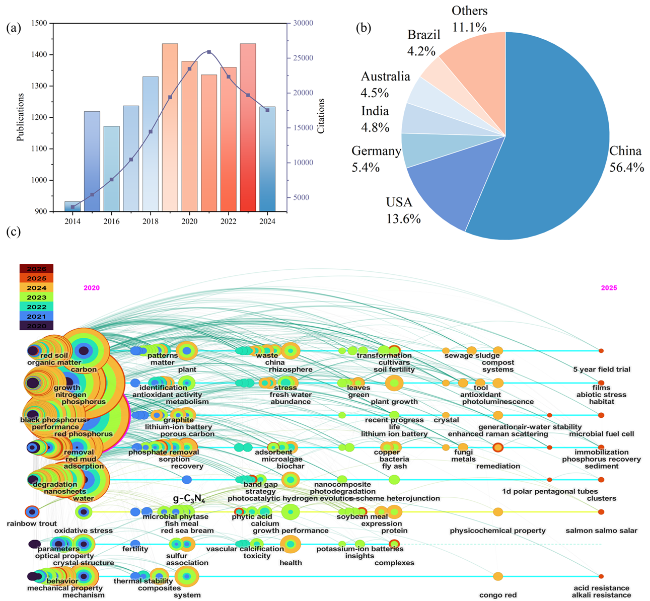
Fig. 1 (a) Number of citations and publications in Web of Science over time. (b) Percentage of publications from different countries. (c) Using “red phosphorus” as the key “title word”, set “publication year”, and search the “Web of Science” database to find out the evolution of the number of records of the literature published from 2020 to 2025.
Despite significant advancements in the field of RP-based photocatalytic applications, several challenges remain to be addressed. The preparation processes are often complex, the materials lack sufficient stability, and the catalytic mechanisms are not yet fully understood, which has hindered their broader application. The aim of this review is to provide a comprehensive overview of the recent developments
in photocatalysis using elemental RP-based materials (Fig. 2).
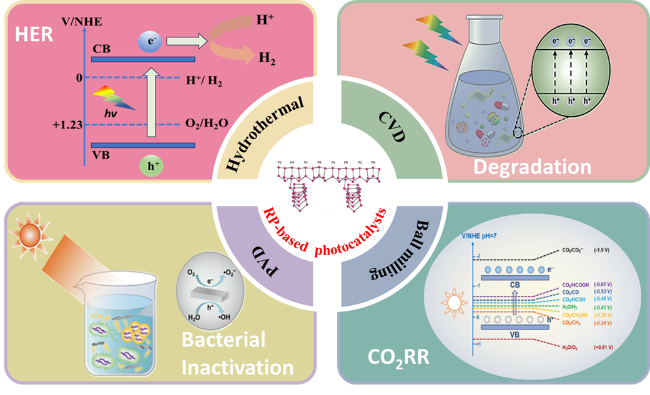
Fig. 2 Synthesis and photocatalytic applications of RP-based photocatalysts.
To elucidate the underlying mechanisms of RP-based photocatalysts, we integrate the principles of DFT with advanced characterization techniques. This knowledge is then applied to guide the design of future RP materials. Our findings highlight the potential advantages of utilizing metal-free, monolithic RP materials in photocatalytic applications, showcasing their promise for enhancing efficiency and sustainability in photocatalysis [48-51].

2 Structure properties of RP

The history of the discovery of phosphorus is filled with both mystery and serendipity. In 1669, the German alchemist Hennig Brand accidentally discovered a substance that glowed in the dark while attempting to create gold by distilling urine [52-55]. Brand’s discovery marked the beginning of a new era in the study of chemical elements. However, the initial production of phosphorus proved to be a significant challenge, both in terms of difficulty and cost.
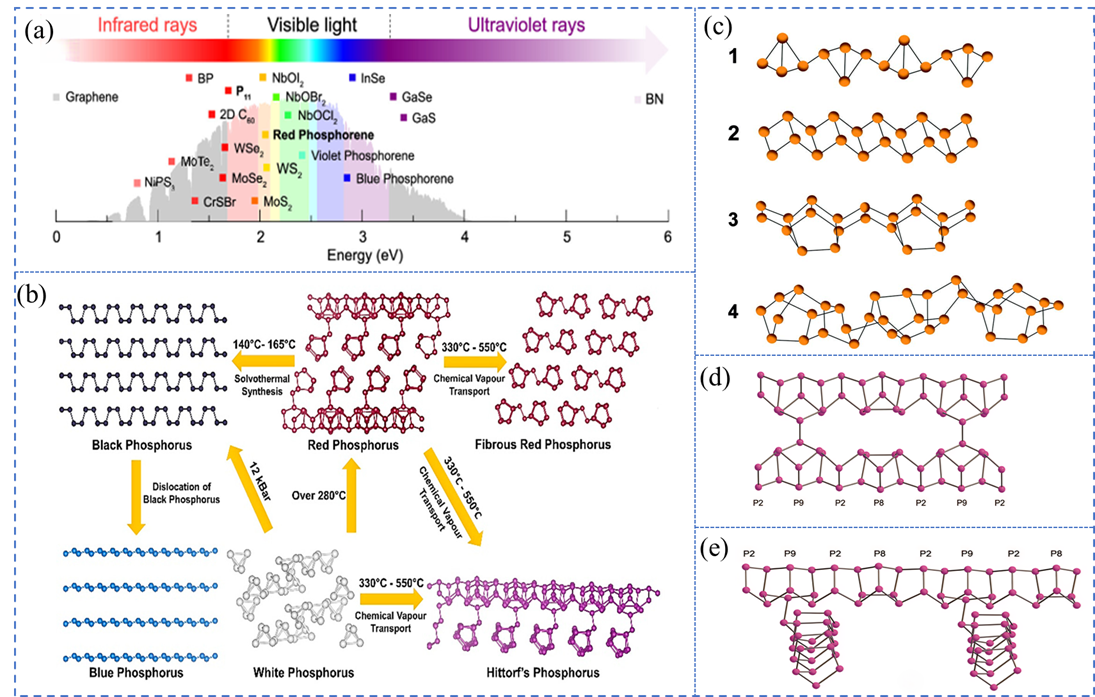
Over the following century, the properties of phosphorus were gradually elucidated, and by the mid-19th century, chemists turned their attention to the various allotropes of phosphorus (Fig 3a) [60]. In 1847, Austrian chemist Anton Schrötter succeeded in synthesizing RP by prolonging the heating of WP and controlling the rate at which it was cooled during a study of WP in Vienna. Fig. 3b illustrates the different atomic configurations of phosphorus allotropes and the corresponding synthesis routes [22]. The crystal structure of RP, however, was not determined by X-ray diffraction (XRD) until 1966, when V. H. Thurn and H. Krebs conducted these measurements [56-60].

2.1 Types and chemical structures of RP

Compared to WP and BP, the multiple isomers of RP present several challenges for its structural characterization. Early literature studies used Roman numerals to designate the various RP isomers, numbering them from I to V based on their thermal stability. Since the discovery of RP, there has been no consensus on its precise structural characteristics, leading to the proposal of several different morphologies, including amorphous and fibrous structures, for classification purposes [15-23,61 -64].
RP can exhibit a range of molecular structures, from cage-like to lattice structures, due to the triplet nature of the phosphorus atom [22-28]. In 1947, W. L. Roth and colleagues proposed that RP had five distinct allotropes, designated types I-V. Among these, the commercially available RP (type Ⅰ) is APR. Several possible linear molecular structures for ARP have been suggested in the literature, but its exact structure remains unclear. In 2019, Zhang et al. proposed a potential structure for ARP based on theoretical single-molecule elastic quantum computation (QM) and experimental measurements using monomolecular atomic force microscopy (AFM), revealing a zig-zag ladder structure for ARP [64-68].
Types II to V of RP are all crystalline. Type II is hexagonal, type III is metastable, type IV is triclinic, and type V is monoclinic. In 1966, V. H. Thurn and H. Krebs characterized the structure of type V RP using XRD, as originally described by W. Hittorf in 1865. As a result, type V RP is also known as violet phosphorus (VP) or Hittorf’s phosphorus (Fig 3c-e) [52,63].
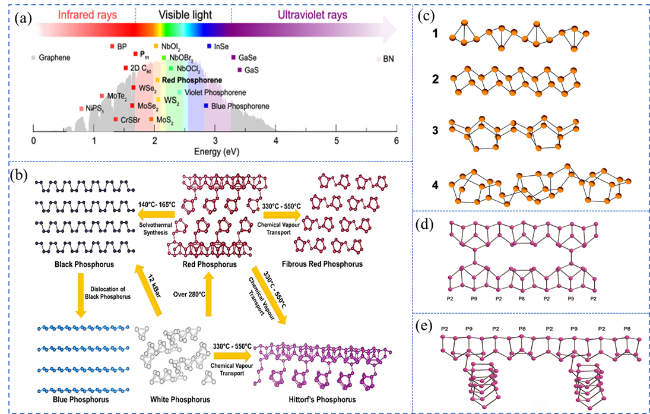
Fig. 3 (a) The absorption of light by RP and other 2D materials. Reproduced with promission. (b) Atomic structure of different P allotropes and the associated synthesis conditions. Reproduced with promission. (c) Four probable structural subunits of ARP. Reproduced with promission. Proposed atomic structure of (d) fibrous RP and (e) Hittorf’s P. (a) is adapted with permission from ref. 60 (Copyright 2020, Royal Society of Chemistry); (b) is reproduced with permission from ref. 22 (Copyright 2022, American Chemical Society); (c) is reproduced with permission from ref. 63 (Copyright 2019, Wiley-VCH); (d and e) are reproduced with permission from ref. 52 (Copyright 2010, American Chemical Society).

2.2 Electronic structures of RP

The electronic structure and band gap are critical characteristics of RP semiconductors, determining their ability to absorb light and generate electron-hole pairs across the solar spectrum. RP is one of the few elements in nature that meets the stringent criteria for a narrow band gap, typically less than 3.0 eV. Specifically, RP semiconductors exhibit an energy band gap ranging from 1.70 to 2.0 eV, making them highly efficient for solar energy conversion by extending light absorption into the visible spectrum. This feature is particularly advantageous for optimizing solar energy utilization [26,53,60 -67,69,70].
Similar to other two-dimensional materials, RP undergoes a transition in its energy band structure when its bulk form is exfoliated into monolayers or single-layer systems. This transition shifts the material from an indirect to a direct band gap. When RP is transformed from a bulk structure into a monolayer sheet, it becomes a gap semiconductor. Calculations of the energy band structure reveal that the conduction band minimum (CBM) and valence band maximum (VBM) of RP are located at different reciprocal lattice points with high symmetry, indicating that RP is an indirect bandgap semiconductor in its bulk form. Additionally, bilayer and trilayer RP structures are also characterized as indirect bandgap semiconductors. The band gap of bulk RP is expected to fall within the range of 1.70 to 2.0 eV. Interestingly, a modest increase in the bandgap has been observed as the number of layers decreases. For example, the band gap increases from 1.99 eV in the bulk form to 2.02 eV in the trilayer configuration, 2.12 eV in the bilayer, and 2.39 eV in the monolayer. Despite this increase, the monolayer RP's direct bandgap has the potential to enhance solar energy conversion efficiency, though further exploration of the lattice dynamics governing charge-carrier transfer is needed. Moreover, the mobility of photogenerated electron-hole pairs may be significantly enhanced in monolayer RP due to the increased dispersion of the CB level in the monolayer nanosheets compared to the bulk, trilayer, and bilayer systems [62-75].

3 Synthesis strategies of RP-based photocatalysts

Given the significant impact of photocatalysis research, various synthesis methods for RP-based photocatalysts have been explored. These methods can be broadly classified into four categories: hydrothermal, ball milling, PVD, and CVD [12-16,76 -80].

3.1 Hydrothermal

Hydrothermal synthesis is an advanced technique that utilizes high-temperature and high-pressure conditions within a sealed autoclave to drive material synthesis. In recent years, it has become a key method in photocatalyst research. By employing water or aqueous solutions as the reaction medium, this approach allows for controlled crystal growth and phase transitions under relatively mild thermal conditions, enabling the synthesis of materials with high crystallinity and tunable structural properties [55,82].
The hydrothermal method offers several notable advantages. Firstly, it operates under mild reaction conditions, which allows for the efficient synthesis of materials with low energy input. Secondly, it provides exceptional control over crystal morphology, allowing for precise tuning of reaction parameters such as temperature, pressure, and reaction time, enabling the optimization of material microstructures. Additionally, since water is the primary reaction medium, the hydrothermal process is environmentally sustainable, making it a green approach for material synthesis. This versatility makes the hydrothermal method highly suitable for the synthesis of a wide range of photocatalysts, including metal oxides, sulfides, phosphides, and composite materials, underscoring its broad applicability [81-88].
In the context of RP-based photocatalyst synthesis, the hydrothermal method offers distinct advantages. By optimizing reaction temperature, pressure, and solution composition, it significantly enhances the dispersion and specific surface area of RP, improving its photocatalytic efficiency. Moreover, the hydrothermal process facilitates the in-situ integration of RP with other semiconductors, enhancing interfacial interactions and improving the separation efficiency of photogenerated electron-hole pairs. These improvements collectively result in a significant enhancement of the material’s photocatalytic performance.
The hydrothermal method has been extensively employed to refine RP for superior catalytic performance. Jia et al. [85] subjected commercial RP to high-temperature and high-pressure conditions to eliminate surface oxides, followed by the in-situ incorporation of single metal atoms using a metal precursor (Fig. 4a-c). This approach optimized the material’s morphology, augmented its surface area and active sites, and markedly enhanced catalytic efficiency. Likewise, Wang et al. [86] utilized hydrothermal synthesis to produce nanoscale RP, subsequently integrating it with cubic MnSe2, resulting in exceptional hydrogen evolution performance (Fig. 4d-f). Despite its efficacy in regulating particle size and morphology, the hydrothermal method is not without drawbacks, including prolonged reaction durations, elevated energy demands, and the propensity for particle agglomeration.
Hydrothermal synthesis has also proven instrumental in the development of RP-based composite photocatalysts. For instance, an RP/ZnAl-layered double hydroxide (LDH) composite was fabricated through ultrasonic dispersion followed by hydrothermal treatment, yielding a seamlessly integrated heterostructure with significantly enhanced photocatalytic activity (Fig. 4g-i) [87]. Similarly, Zhao and co-workers [88] synthesized RP nanosheets by dispersing RP in water and subjecting it to hydrothermal processing under meticulously controlled conditions. The resultant nanosheets displayed expanded surface area and a greater abundance of active sites, with scanning electron microscopy (SEM) and transmission electron microscopy (TEM) analyses confirming successful structural optimization (Fig. 4j-l).

3.2 Ball milling

Ball milling is a widely used mechanical processing technique for material synthesis, offering several
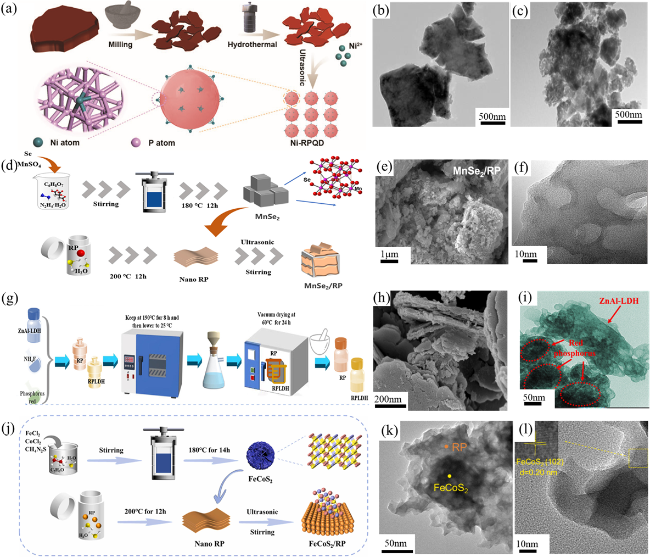
Fig. 4 (a) The hydrothermal synthesis strategy for Ni-RPQD photocatalysts. TEM images of (b) bulk RP and (c) hydrothermal RP. Reproduced with promission. (d) The hydrothermal synthesis strategy for MnSe2/RP photocatalysts. SEM image (e) and TEM (f) of 10 wt % MnSe2/RP. Reproduced with promission. (g) The hydrothermal synthesis strategy for RPLDH photocatalysts. SEM image (h) and TEM (i) of RPLDH0.8. Reproduced with promission. (j) The hydrothermal synthesis strategy for FeCoS2/RP. SEM image (k) and TEM image (l) of FeCoS2/RP. Reproduced with promission. (a-c) are adapted with permission from ref. 85 (Copyright 2023, Wiley-VCH); (d-f) are reproduced with permission from ref. 86 (Copyright 2024, American Chemical Society); (g-i) are reproduced with permission from ref. 87 (Copyright 2023, Elsevier); and (j-l) are reproduced with permission from ref. 88 (Copyright 2023, Elsevier.)
advantages in the preparation of photocatalysts. This method involves intense collisions and friction between powder materials and milling balls within a ball mill, effectively reducing particle size, inducing phase transformations, and enhancing surface properties. Notably, ball milling is characterized by its simplicity, ease of operation, and low energy consumption, making it especially suitable for the synthesis of multi-component materials and doping modifications [89-91].
In the synthesis of photocatalysts, ball milling has proven to be effective in enhancing the specific surface area and dispersion of materials, thereby improving their photocatalytic performance. Through ball milling, different catalytic components can be uniformly mixed in a relatively short period. The high-energy collisions generated during the milling process also facilitate modifications to the crystal structure and the formation of new phases. Ball milling is widely used in the preparation of photocatalytic materials such as metal oxides, nitrides, and sulfides. Additionally, it has been successfully applied to the synthesis of composite photocatalysts, significantly enhancing the synergistic interactions between the different components [92-96].
Ball milling has proven to be highly effective in the preparation of RP-based photocatalysts. By facilitating the composite formation with other semiconductor materials, this method significantly enhances the dispersion of RP and strengthens interfacial interactions, thereby improving the separation efficiency of photogenerated charge carriers. Moreover, ball milling effectively prevents material agglomeration during the composite synthesis process, contributing to improved stability and catalytic efficiency. As a simple and efficient preparation technique, ball milling has emerged as a crucial approach for developing RP-based photocatalysts.
Ball milling has emerged as a highly effective strategy for modifying RP-based materials to enhance their catalytic and photothermal properties. In a study conducted by Ansari, RP was integrated with TiO2 through a 12 h ball milling process, which substantially improved its photocatalytic performance under visible light by promoting charge separation and transfer
(Fig. 5a-c) [22]. This approach presents a cost-effective and scalable alternative to plasmonic metals for visible-light-driven applications, offering significant potential for the development of advanced photocatalytic systems.
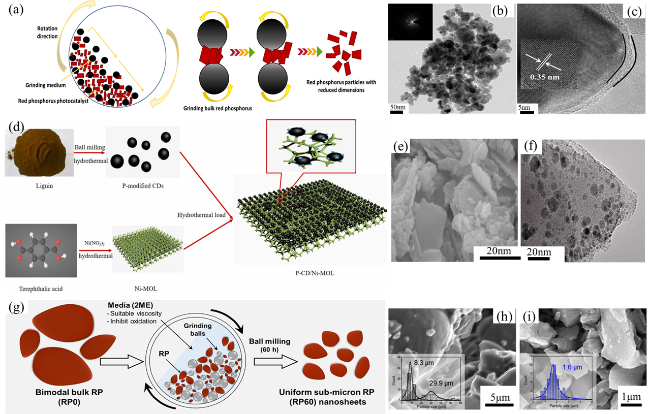
Fig. 5 (a) Ball milling synthesis strategy. (b) TEM image and (c) HR-TEM image of the RP-TiO2-12h. Reproduced with promission. (d) The schematic diagram of synthetic route. (e) SEM image and (f) HR-TEM image of the P(1.0)-CD/Ni-MOL. Reproduced with promission. (g) Ball milling synthesis strategy. SEM images of (h) RP30, and (i) RP60. Reproduced with promission. (a-c) are adapted with permission from ref. 22, 94 (Copyright 2022, 2016, American Chemical Society, Science); (d-f) are reproduced with permission from ref. 95 (Copyright 2022, Elsevier); and (g-i) are reproduced with permission from ref. 96 (Copyright 2023, Elsevier).
Ma et al. reported the synthesis of a phosphorus-doped carbon quantum dot/nickel metal-organic layer (CD/Ni-MOL) heterojunction photocatalyst via RP-assisted ball milling followed by hydrothermal treatment (Fig. 5d) [95]. Their study demonstrated that the partial embedding of carbon quantum dots within the Ni-MOL framework (Fig. 5e-f) significantly enhanced photocatalytic degradation and mineralization efficiency. These findings underscore the potential of phosphorus-doped materials in photocatalysis, highlighting their ability to facilitate charge separation and promote reactive species generation for efficient pollutant degradation.
Shridharan et al. developed a ball-milling strategy to synthesize RP nanosheets with tunable morphology and size by precisely controlling the milling duration
(Fig. 5g-i) [96]. Their results revealed that the optimized RP60 exhibited a defect-rich nanosheet structure, which significantly enhanced its photothermal performance. Further improvements in solar steam generation were achieved by incorporating a porous polyurethane support and plasmonic resonance-heating silver nanoparticles, thereby maximizing light absorption and heat localization. Despite these advancements, challenges persist in ensuring the long-term stability, high-temperature durability, and cost-effectiveness of these materials. Future research should focus on optimizing structural design and material integration to achieve a balance between efficiency, stability, and economic viability for large-scale applications.

3.3 PVD

PVD is a thin-film deposition technique that involves transforming source materials from solid or liquid states into a gaseous phase, followed by deposition onto a substrate. It is widely employed for fabricating uniform, high-purity thin films. The primary advantages of PVD include precise control over film thickness and composition, relatively low processing temperatures, and versatility across various material systems. However, PVD’s efficiency can be limited when dealing with substrates of complex geometries or achieving uniform deposition over large areas. Additionally, the high cost of PVD equipment can restrict its broader application in some fields [97-100].
In the synthesis of RP-based photocatalysts, PVD offers significant advantages through its ability to precisely control deposition at the atomic or molecular level. This allows for fine-tuning of film thickness, crystallinity, and morphology to optimize photocatalytic performance. Furthermore, PVD facilitates the doping of RP with metals or nonmetals, enhancing visible-light absorption and improving charge separation efficiency. However, due to the low melting point and high oxidation susceptibility of RP, strict process control is necessary to avoid material degradation or performance loss [32-36]. These challenges make PVD a promising yet technically demanding approach for advancing RP-based photocatalysts, offering opportunities for further optimization.
Recent advancements in RP-based materials have underscored their immense potential in photocatalysis and electrochemical nitrogen fixation. Lin and co-workers developed a SiO2/crystalline red phosphorus (CRP) photocatalyst using a sublimation-deposition method, in which nanosized CRP was deposited onto optically inactive SiO2 nanospheres (Fig. 6a-b) [100]. During this process, the in situ carbonization of surfactants within the SiO2 nanospheres led to the formation of a carbonaceous phase that effectively modified RP, thereby significantly enhancing its photocatalytic nitrogen fixation efficiency. This strategy presents a scalable and facile approach for designing high-performance photocatalysts, offering new avenues for optimizing RP-based materials in sustainable energy and environmental applications.
Liu and co-workers synthesized few-layer triclinic CRP nanoribbons (NRs) using an iodine-assisted PVD method, followed by probe ultrasonic exfoliation to obtain high-aspect-ratio NRs (Fig. 6c-d) [101]. These CRP NRs achieved an impressive ammonia yield of 15.4 μg h-1mgcat -1 and a Faradaic efficiency of 9.4% in a neutral electrolyte under ambient conditions, highlighting their potential as highly efficient electrocatalysts for the nitrogen reduction reaction (NRR). Despite these promising results, further research is needed to address challenges related to material stability, large-scale synthesis, and long-term catalytic performance under practical operating conditions, ensuring their viability for real-world applications.
A solid-state synthesis method was employed to fabricate fibrous red phosphorus (FRP), a crystalline allotrope with a distinctive urchin-like morphology and promising photocatalytic properties [102]. To further enhance its photocatalytic efficiency, FRP was integrated with TiO2 nanofibers (NFs) via PVD, forming a heterostructure that significantly improved charge separation and reactive oxygen species (ROS) generation (Fig. 6e-f). The TiO2/FRP composite, synthesized through a sequential process involving hydrothermal treatment, ultrasonic dispersion, freeze-drying, and low-pressure thermal processing, exhibited outstanding photocatalytic performance under solar irradiation. The optimized band alignment and structural stability of FRP contributed to its enhanced activity, highlighting the potential of FRP-based heterostructures for solar-driven catalytic applications.

3.4 CVD

CVD is a versatile and widely utilized technique for material synthesis, particularly in the preparation and modification of photocatalysts. The method involves introducing gaseous precursors into a reaction chamber under controlled conditions, where they undergo chemical reactions or decomposition to deposit solid-state materials onto substrates. Due to its ability to produce high-purity, structurally tailored materials, CVD has gained significant attention in the field of photocatalysis [103,104].
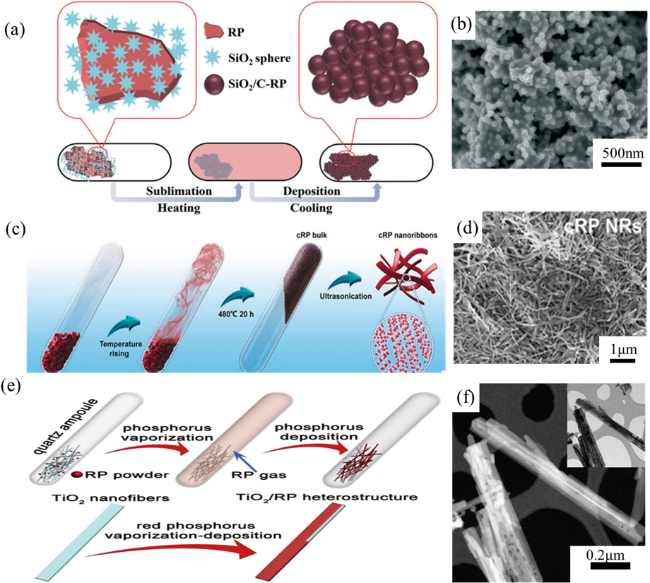
Fig. 6 (a) Schematic illustration for the preparation of SiO2/C-RP. (b) SEM image of SiO2/C-RP. (c) Synthesis of CRP bulk and nanoribbons. (d) SEM images of CRP NRs. (e) Schematic illustration for the preparation of TiO2/RP. (f) STEM image of TiO2/RP. (a and b) are adapted with permission from ref. 100 (Copyright 2020, Royal Society of Chemistry); (c and d) are reproduced with permission from ref. 101 (Copyright 2020, Wiley-VCH); and (e and f) are reproduced with permission from ref. 102 (Copyright 2019, Elsevier).
CVD has shown great promise in the synthesis and enhancement of RP-based photocatalysts, offering key advantages such as uniform dispersion to minimize agglomeration, improved interfacial charge transfer through in-situ integration with secondary semiconductors, and tailored morphologies that enhance light absorption and catalytic performance [105-108]. However, its application is constrained by several challenges, including the thermal sensitivity of RP, which limits the operating conditions; the high energy demands and complexity of CVD equipment, which restrict scalability; and the technical difficulty of identifying safe and effective phosphorus-based precursors for deposition [109-112].
Wu et al. synthesized dendritic elemental RP photocatalysts via a CVD method, utilizing bismuth as a co-catalyst to regulate crystal phases and morphology, resulting in efficient charge transfer and hydrogen evolution performance (Fig. 7a-c) [110]. While this approach offers significant improvements in material performance, it faces challenges. The scalability and cost of the CVD method may limit its broader application. Additionally, the stability and durability of RP, particularly under real-world conditions, require further validation. The environmental impact and sustainability of bismuth as a co-catalyst also need to be addressed. Despite these challenges, this strategy offers promising prospects for photocatalyst design, with overcoming issues related to material stability, cost, and environmental compatibility being essential for widespread use.Dong et al. developed RuCu/CRP composite photocatalysts through a multi-step process, with CVD playing a pivotal role. RuCu alloy nanoparticles were initially synthesized via a co-reduction method, followed by the conversion of ARP to CRP using CVD. The RuCu nanoparticles were then impregnated onto CRP and calcined in hydrogen to form the RuCu/CRP composites, which exhibited enhanced catalytic properties (Fig. 7d) [111]. The CVD process facilitated the synthesis of high-purity CRP with an optimal morphology, thereby improving catalytic performance. TEM analysis further revealed the uniform distribution of RuCu nanoparticles and lattice spacings corresponding to Ru-Cu and CRP facets, confirming the successful formation of the composite and its structural integrity (Fig. 7e-f).
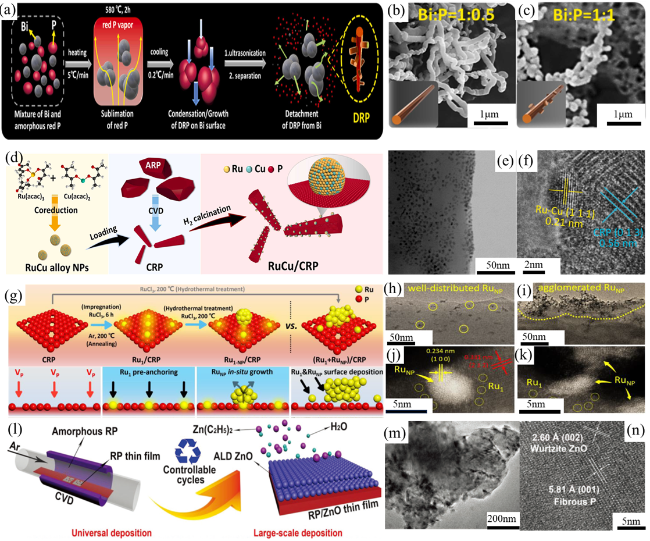
Fig. 7 (a) The CVD synthetic procedure of the DRP products. SEM images of (b-c) DRP. Reproduced with promission. (d) Schematic synthesis strategy of RuCu/CRP. TEM image (e) and HR-TEM image (f) of RuCu/CRP. Reproduced with promission. (g) Schematic synthesis strategy of Ru1/CRP, Ru1-NP/CRP, and (Ru1+RuNP)/CRP. TEM images of (h) Ru1-NP/CRP, and (i) (Ru1+RuNP)/CRP. HAADF-STEM images of (j) Ru1-NP/CRP, and (k) (Ru1+RuNP)/CRP. Reproduced with promission. (l) Schematic synthesis strategy of RP/ZnO. TEM images of (m) and HR-TEM image (n) of Ti-RP/ZnO. Reproduced with promission. (a-c) are adapted with permission from ref. 110 (Copyright 2022, Elsevier); (d-f) are reproduced with permission from ref. 111 (Copyright 2024, Elsevier); (g-k) are reproduced with permission from ref. 112 (Copyright 2024, Wiley-VCH); and (l-n) are reproduced with permission from ref.113 (Copyright 2019, Wiley-VCH).
Bian et al. developed an innovative co-functionalization strategy by simultaneously incorporating ruthenium single atoms (Ru1) and nanoparticles (RuNP) into CRP to significantly enhance photocatalytic hydrogen evolution performance. Through precise atomic engineering, Ru1 atoms were strategically anchored at defect sites on the CRP matrix, which not only facilitated the in-situ nucleation and growth of RuNP but also established efficient charge transfer pathways (Fig. 7g-k) [112]. This dual-functional catalyst architecture demonstrated remarkable improvements in multiple aspects: (a) enhanced interfacial charge migration efficiency, (b) prolonged lifetime of photogenerated charge carriers, and (c) superior catalytic stability, collectively contributing to the dramatically increased hydrogen evolution rate and operational durability. In a parallel development, Li and colleagues employed advanced vapor deposition techniques to fabricate RP/ZnO heterostructure thin films. By combining CVD with atomic layer deposition (ALD), they achieved exceptional film uniformity and substrate compatibility, making this approach particularly promising for large-scale photocatalytic applications (Fig. 7l-n) [113]. However, the researchers noted that the practical implementation of this methodology still faces challenges, primarily related to the high equipment costs and inherent complexity of the deposition processes, which may limit its widespread adoption in industrial settings.
The CVD method holds great potential for fabricating RP-based photocatalysts due to its ability to precisely control film thickness and uniformity, along with its compatibility with various substrates, making it suitable for large-scale applications. Through CVD, the photocatalytic performance of RP can be effectively enhanced, particularly in terms of improving the separation and transport of photogenerated charges. However, challenges such as equipment costs and process complexity still need to be addressed for broader applications.

4 Structural characterization techniques of RP-based photocatalysts

A comprehensive structural analysis of RP-based photocatalysts is crucial for understanding their intrinsic physical properties, surface morphology, and interfacial interactions with composite components [114-120]. Advanced characterization techniques, offering a broad range of spatial resolutions and analytical capabilities, are utilized to investigate structural attributes at multiple scales-from bulk material properties to nanoscale features. This multifaceted approach provides a deeper insight into the relationship between structural characteristics and photocatalytic performance, enabling the rational design and optimization of RP-based materials for improved functionality [121-126].

4.1 AFM

Atomic Force Microscopy (AFM) is a powerful nanoscale imaging tool widely used for surface characterization. By utilizing the interaction forces between a sharp probe tip and the sample surface, AFM scans the surface to generate high-resolution topographical images with sub-nanometer precision. Unlike optical or electron microscopy, AFM does not rely on lenses or electron beams, making it applicable to a broad range of materials, including insulators, semiconductors, and biological specimens [127-131]. Its versatility and ability to capture intricate surface details make AFM an indispensable technique for advanced material analysis [132-135].

4.2 KPFM

Kelvin Probe Force Microscopy (KPFM), an extension of AFM, is a powerful technique for analyzing the surface potential distribution at the nanoscale [136-141]. By measuring the contact potential difference (CPD) between a conductive probe and the sample surface, KPFM reveals critical local electronic properties, such as work function, Fermi level, and charge distribution. The method involves applying an alternating current (AC) voltage to the probe during surface scanning, while a direct current (DC) feedback voltage compensates for the electrostatic force, enabling precise mapping of the CPD with high spatial and voltage sensitivity. KPFM is extensively used in the investigation of semiconductors, photovoltaic materials, and photocatalysts, offering essential insights into their electronic structures and charge transfer dynamics [142-147].
Chen et al. employed AFM (Fig 8a) and KPFM
(Fig 8b) to examine the electron transfer dynamics between bulk RP and RP nanosheets (RP NS) [148]. AFM images revealed structural differences between bulk RP and RP NS, confirming the formation of a composite structure with distinct surface morphologies. KPFM measurements indicated a potential difference between the two forms of RP, with the ultra-thin RP nanosheets exhibiting a lower potential than the bulk RP. This potential difference facilitated the transfer of photogenerated electrons from bulk RP to RP nanosheets, which was critical for enhancing photocatalytic performance. The optimized energy band structure and surface potential at the interface effectively promoted electron migration, leading to an improved hydrogen production rate and stability over multiple cycles. Thus, AFM and KPFM not only confirmed the structural features but also provided direct evidence of the electron interactions that play a crucial role in enhancing photocatalytic performance.
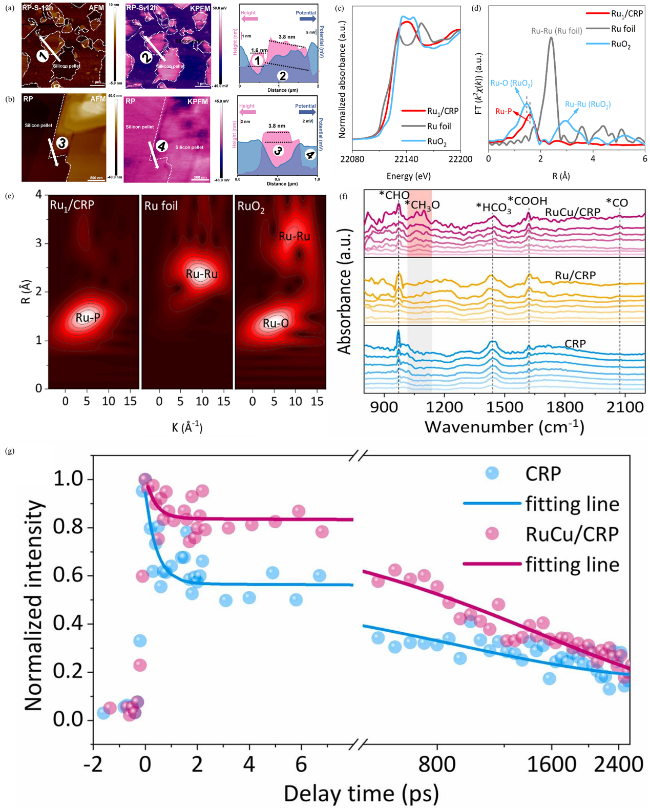
Fig. 8 AFM images, KPFM images (a) RP-S-12 h and (b) bulk RP. Reproduced with promission. (c) Ru K-edge XANES profile, (d) Fourier-transform EXAFS spectra in R space, and (e) wavelet transform EXAFS spectra of Ru1/CRP, Ru foil, and RuO2. Reproduced with promission. (f) in-situ DRIFTS spectra of the CRP, Ru/CRP, and RuCu/CRP samples. (g) Normalized fs-TA decay kinetics plots with exponential fitting curves of CRP and RuCu/CRP probed at 650 nm under 343 nm laser excitation. Reproduced with promission. (a and b) are adapted with permission from ref. 148 (Copyright 2022, Elsevier); (c-e) are reproduced with permission from ref. 112 (Copyright 2024, Wiley-VCH); and (f and g) are reproduced with permission from ref.111 (Copyright 2024 Elsevier).

4.3 XANES

X-ray Absorption near edge structure (XANES) is a spectroscopic technique used to investigate the local electronic structure and chemical states of specific elements within a material. As a subset of X-ray absorption spectroscopy (XAS), XANES focuses on the near-edge region of the absorption spectrum, typically within 50 eV of the absorption edge [149-154]. Detailed analysis of this region provides essential information about the oxidation states, coordination environments, and electronic transitions of the target element, making it an invaluable tool for understanding material properties.

4.4 EXAFS

Extended X-ray absorption fine structure (EXAFS) is an advanced spectroscopic technique that provides detailed insights into the local atomic environment of materials. As part of XAS, EXAFS analyzes oscillations in the absorption spectrum beyond the absorption edge, typically extending several hundred electron volts [155-160]. These oscillations result from interference between outgoing photoelectrons and those scattered by neighboring atoms. EXAFS yields critical structural information, including bond distances (the spacing between the absorbing atom and its neighbors), coordination numbers (the number of neighboring atoms), and insights into structural disorder and thermal effects, reflecting changes in the material due to atomic vibrations.

4.5 in-situ DRIFTS

In-situ diffuse reflectance infrared Fourier transform spectroscopy (DRIFTS) is a powerful technique for monitoring surface reactions and chemical transformations in real-time under operational conditions. Unlike conventional infrared spectroscopy, DRIFTS captures the diffuse reflectance of infrared light from powdered or rough sample surfaces, making it especially suitable for studying heterogeneous catalysts and solid materials [161-165]. The “in-situ” capability allows measurements during exposure to controlled environments, such as varying temperature, pressure, and reactant gases, providing real-time insights into surface chemical processes.
This technique is particularly valuable for examining interactions between reactants and photocatalysts, including adsorption and desorption phenomena, surface chemistry changes, and charge carrier dynamics during photocatalytic reactions [37-41,165]. DRIFTS is widely used in catalytic studies, environmental monitoring, and energy research, offering essential information on reaction mechanisms and material behavior under practical conditions.
Bian et al. employed XANES and EXAFS spectroscopy to confirm the successful embedding of Ru1 at the VP in CRP, which is essential for enhancing photocatalytic hydrogen evolution (PHE) performance (Fig. 8c-e) [112]. XANES analysis revealed that Ru1 in CRP has an average valence state between 0 and +4, consistent with a single-atom configuration, rather than metallic Ru or RuO2. EXAFS spectroscopy further supported this finding, showing a Ru-P bond at 1.61 Å, confirming P coordination without the presence of metallic Ru. These two techniques collectively provide direct structural and electronic evidence for the successful incorporation of Ru1 at the VP sites, which facilitates defect repair and effective charge carrier migration, ultimately improving photocatalytic efficiency and stability.

4.6 fs-TA

Femtosecond transient absorption spectroscopy (fs-TA) is an ultrafast technique designed to investigate the dynamic behavior of excited states in materials with femtosecond (10-15 second) time resolution [166]. Using a pump-probe configuration, fs-TA excites the sample with a pump pulse to generate transient species, while a time-delayed probe pulse tracks changes in the absorption spectrum as these excited states evolve over time.
This approach provides valuable insights into the lifetimes and relaxation dynamics of excited states, charge carrier behavior, energy transfer pathways, and the formation of intermediate species. By resolving these ultrafast processes, fs-TA uncovers detailed photophysical and photochemical mechanisms that define material properties.
Fs-TA is particularly effective for photocatalytic systems, enabling real-time observation of photogenerated charge carriers, such as electrons and holes, as well as their recombination and transport dynamics. In RP-based photocatalysts, fs-TA can reveal charge separation and transfer mechanisms at heterojunction interfaces, offering critical guidance for enhancing photocatalytic performance [167-172].
Dong et al. used fs-TA and in-situ DRIFTS analyses to elucidate the mechanism by which RuCu/CRP photocatalysts enhance CO2 reduction performance
(Fig. 8f-g) [111]. The fs-TA measurements revealed the process of charge carrier migration, indicating that the incorporation of RuCu alloy effectively extended the lifetime of charge carriers and reduced charge recombination. This prolonged charge lifetime played a decisive role in enhancing photocatalytic activity, thus promoting CH4 generation. Meanwhile, in-situ DRIFTS analysis identified the key intermediates formed during the CO2 reduction process, further showing that the addition of Cu altered the reaction pathway and facilitated the formation of *CH3O, a critical intermediate for CH4 synthesis. By combining these two characterization techniques, the study verified the synergistic effect of the RuCu alloy, optimizing charge carrier separation, improving reaction efficiency, and steering the CO2 reduction process toward the CH4 synthesis pathway, significantly surpassing the performance of current elemental phosphorus-based photocatalysts.

5 Theoretical simulations

DFT calculations offer significant advantages in the study of catalytic materials, particularly in the analysis of electronic interactions at the level of individual atomic sites. Firstly, DFT calculations can provide high-precision electronic structure information, thus assisting researchers in attaining a more profound comprehension of the electronic distributions and interactions between single-atom sites and surrounding atoms. Secondly, DFT calculations can predict the stability and reaction paths of catalytic materials under different reaction conditions, thereby elucidating the pivotal role played by single-atom sites in the catalytic process. Through this theoretical analysis, researchers can design catalysts with enhanced catalytic activity and selectivity, thus improving the efficiency and sustainability of industrial applications [173-179]. Consequently, the application of DFT calculations in catalytic materials science provides a robust theoretical foundation and guidance for the development of new and efficient catalysts.

5.1 Electronic structure calculations

Electronic structure calculations are an essential theoretical foundation in photocatalysis research, used to analyze materials’ band structures, density of states (DOS), and band edge positions to evaluate their photocatalytic activity (Fig 9a-g) [180]. Calculations based on DFT indicate that RP is a narrow-bandgap semiconductor (~1.4-2.2 eV), capable of absorbing visible light and generating photo-induced charge carriers. However, standard DFT often underestimates the bandgap, and therefore, methods such as the HSE06 exchange-correlation functional or the GW approximation are typically employed to refine the results. These calculations are also crucial for studying the effects of doping (both metal and non-metal), surface modifications, and defect engineering on the electronic structure of RP [66-72].

5.2 Optical absorption and photoresponse analysis

The optical absorption characteristics of RP-based photocatalysts are critical for their performance under visible light irradiation. Time-dependent density functional theory (TDDFT) can be utilized to simulate the absorption spectra and analyze the material’s optical transition properties and response range. Furthermore, calculating the dielectric function, absorption coefficient, and refractive index provides additional insights into the light-harvesting efficiency and photo-excitation dynamics of RP-based photocatalysts. Theoretical studies indicate that the layered structure of RP promotes stronger light absorption, and strategies such as impurity level introduction or heterojunction formation can broaden the absorption range and enhance the utilization of visible light [17-25,172,185].

5.3 Interface and heterojunction simulations

Constructing heterojunctions is a highly effective strategy for enhancing charge carrier separation and preventing electron-hole recombination in RP-based photocatalysts [182-188]. First-principles calculations are instrumental in studying interfacial charge transfer, Fermi level alignment, and work function differences, providing valuable insights into the electronic structure and charge transport mechanisms at the heterojunction (Fig 9h) [181]. Techniques such as charge density difference analysis, Bader charge analysis, and energy distribution calculations further elucidate the electronic interactions and charge transfer pathways at the interface.
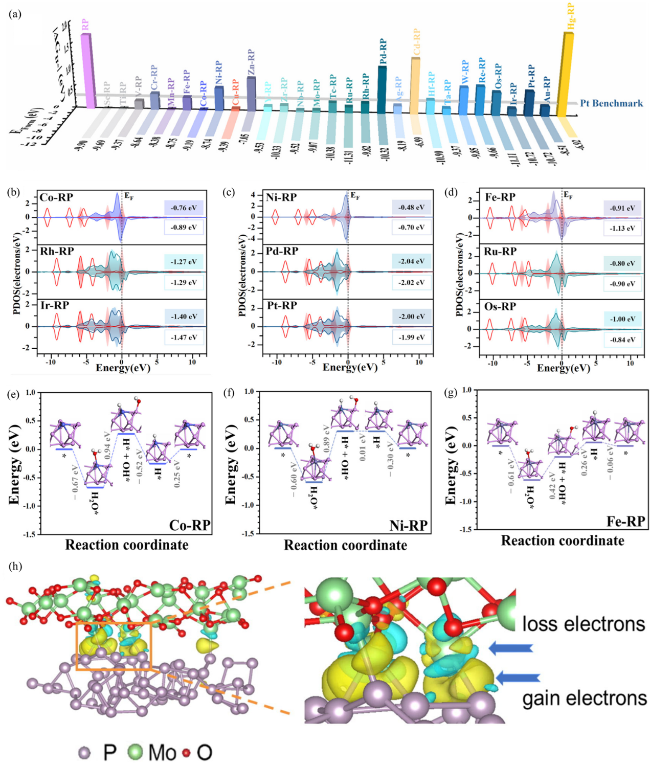
Fig. 9 (a) The cube columns represent |ΔGH*|, and the shadows indicate the corresponding formation energy (EForm) of pristine RP and 29 types of TM-RP SACs. (b-d) The d-band center positions of TM-RP before (color-filled) and after (color-framed) H2O adsorption calculated via density of states (DOS). The reaction energy changes of the key steps in the HER during water splitting on (e) Co-RP, (f) Ni-RP and (g) Fe-RP. Reproduced with promission. (h) Charge difference map of P-MoO2 and P-MoO2-CO2. Reproduced with promission. (a-g) are adapted with permission from ref. 180 (Copyright 2024, Royal Society of Chemistry), and (h) is reproduced with permission from ref.181 (Copyright 2025 Elsevier).
Through comprehensive theoretical calculations, the electronic and optical properties of RP-based photocatalysts can be optimized, offering a scientific basis for the design of novel and efficient photocatalytic systems.

6 Applications of RP in photocatalysis

A photocatalytic reaction is defined as a chemical reaction in which electrons in the VB are excited and jump from the VB to the CB to form photogenerated electrons and photogenerated holes in the CB and VB, respectively [34-52]. This occurs when a semiconductor absorbs energy greater than or equal to its forbidden band width. A proportion of the photogenerated electrons and holes are incorporated into the semiconductor and dissipated as heat and other forms of energy. The remaining photogenerated electrons and holes with strong redox capacity migrate to the semiconductor surface, where they participate in a series of photocatalytic reactions, including hydrogen evolution, CO2 reduction, bacterial disinfection and pollutant degradation [12-18,189 -194].

6.1 Photocatalytic for hydrogen production

The photocatalytic decomposition of water to generate clean hydrogen is considered one of the most promising solutions to address the global energy crisis and environmental challenges. The main goal is to design and develop semiconductor photocatalysts with appro priate energy band structures to efficiently utilize solar energy for water oxidation and reduction, while achieving high quantum yields and long-term stability. Phosphorus-based materials, especially CRP-based materials, have garnered significant interest due to their narrow bandgap, low cost, and abundant availability [195-200]. Additionally, these materials have a visible light absorption range extending up to 700 nm, making them suitable for harnessing solar energy for photocatalytic hydrogen production. However, the slow charge transfer rate and rapid recombination of photogenerated electron-hole pairs limit the effectiveness of RP in photocatalytic applications. This section will discuss and assess recent advancements in the development of RP-based materials for hydrogen production via photocatalysis [100-112].
Bian et al. pioneered the integration of ruthenium single atoms (Ru1) with ruthenium nanoparticles (RuNP) in CRP, leading to a substantial enhancement in photocatalytic hydrogen evolution (PHE) efficiency [112]. By strategically anchoring Ru₁ at the defect sites within CRP, the researchers effectively addressed inherent defects, minimizing charge deep trapping and extending the lifetime of active charge carriers. The optimized Ru1-NP/CRP catalyst achieved a photocatalytic hydrogen evolution rate of 3175 μmol h-1 g-1, which is 454 times greater than bare CRP and 15 times higher than Ru₁/CRP, demonstrating exceptional catalytic performance (Fig. 10a-b). This study highlights the pivotal role of metal single atom integration and presents a novel approach for sustainable hydrogen production with substantial potential for various applications.
Wang et al. achieved a significant enhancement in photocatalytic hydrogen production by constructing an S-scheme heterojunction with MnSe2/RP composite materials [86]. Experimental results showed that under 300 W xenon lamp irradiation, the hydrogen production rate of the 5 wt% MnSe2/RP composite reached 940 μmol g-1 h-1, representing increases of 3.5 times and 22 times compared to pure RP and MnSe2, respectively (Fig. 10c-d). This improvement is attributed to the effective charge separation capability of the heterojunction, which reduces charge recombination and boosts the efficiency of the photocatalytic reaction. Additionally, the composite exhibited good stability in multiple cycling experiments, suggesting its potential for practical applications. These findings provide valuable theoretical insights and practical guidance for further research on RP-based catalysts in the field of photocatalytic hydrogen production.
Huang et al. successfully synthesized RP-modified TiO2 hollow sphere heterostructures using a CVD method to enhance their performance in photocatalytic hydrogen production [201]. In their experiment, SiO2 nanospheres were first synthesized as templates, followed by the preparation of TiO2 hollow spheres. Finally, RP was integrated with TiO2 to form the TiO2@RP heterostructure. This catalyst achieved a hydrogen production rate of 215.5 μmol g-1 h-1 under simulated solar light, significantly outperforming both pure RP and TiO2 (Fig. 10e-f).
The enhanced performance can be attributed to the incorporation of RP, which broadened the light absorption spectrum. Additionally, the heterojunction formed between TiO2 and RP effectively facilitated the separation and migration of photogenerated charge carriers, reducing recombination rates and significantly improving the efficiency of the photocatalytic reaction. This study provides new insights and methodologies for the development of efficient photocatalysts.
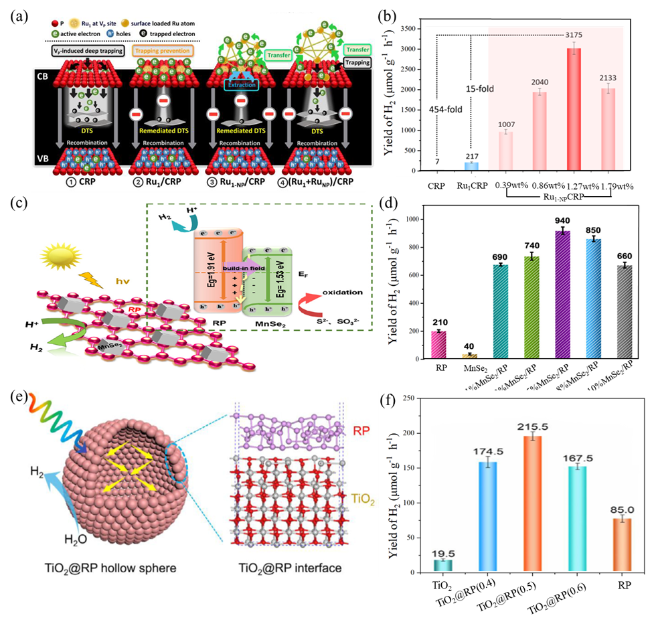
Fig. 10 (a) Schematic illustration of the proposed charge dynamics. (b)Visible light PHE rates of CRP, Ru1/CRP, and the Ru1-NP/CRP samples with different Ru contents. Reproduced with promission. (c) Schematic illustration of the proposed charge dynamics. (d) Rates of pure RP, pure MnSe2, and x wt % MnSe2/RP. Reproduced with promission. (e) Suggested mechanism for photocatalytic hydrogen generation using TiO2@RP. (f) Photocatalytic hydrogen production activities. Reproduced with promission. (a and b) are adapted with permission from ref. 112 (Copyright 2024, Wiley-VCH); (c and d) are reproduced with permission from ref. 86 (Copyright 2024, American Chemical Society); and (e and f) are reproduced with permission from ref.201 (Copyright 2022, Elsevier).
RP-based photocatalysts exhibit immense potential in the field of photocatalytic hydrogen evolution; however, several challenges remain. Enhancing charge separation efficiency, optimizing the band structure, and improving light absorption capabilities are critical directions for further enhancing catalytic performance. Moreover, integrating RP-based catalysts with other functional materials, such as single-atom catalysts, cocatalysts, and conductive substrates, holds promise for achieving synergistic performance enhancement. Additionally, the development of green, cost-effective, and scalable synthesis methods will facilitate the practical application of RP-based catalysts. Future research should focus on integrating material design with mechanistic studies to provide theoretical guidance and technical support for achieving efficient, stable, and sustainable photocatalytic hydrogen production.

6.2 Photocatalytic for CO2 reduction

The excessive emission of CO2 into the atmosphere is a key driver of environmental challenges, including the greenhouse effect. Current research efforts are focused on developing stable and efficient methods for CO2 conversion. Photocatalytic CO2 reduction technology offers a promising solution by addressing the dual challenges of environmental sustainability and energy security. This technology converts CO2 into valuable fuels while promoting carbon recycling. Its advantages include mild reaction conditions (room temperature, atmospheric pressure, and light-driven processes), high CO2 conversion efficiency, and effective carbon recycling, positioning it as an optimal approach for CO2 utilization [202-211].
However, conventional photocatalysts often face limitations such as low charge separation efficiency and insufficient catalytic activity, which hinder their overall performance. In this context, RP-based photocatalysts have emerged as a promising alternative due to their unique properties, including a suitable bandgap (~1.42 eV) for visible-light absorption, high chemical stability, and environmental friendliness. By leveraging these advantages, RP-based catalysts can enhance charge separation and facilitate the efficient reduction of CO2 to high-value products, making them a key focus in advancing photocatalytic CO2 conversion technology [43-55].
RP-based photocatalysts are considered promising candidates for CO2 reduction due to their unique advantages in light absorption and charge separation. As highlighted in the study by Dong et al., incorporating metal alloy nanoparticles, such as RuCu alloy, into CRP significantly enhances CO2 reduction efficiency and product selectivity. This composite system leverages synergistic effects to improve charge separation and increase the utilization of active sites, achieving a notable CH4 selectivity of 96% and a significant improvement in yield (Fig. 11a-b) [111]. While the study demonstrates impressive CH4 production performance, its originality is somewhat limited. The work provides insufficient insight into the catalytic mechanism and overlooks critical considerations regarding practical feasibility and scalability, which constrains its contribution to advancing photocatalytic CO2 conversion technologies.
Fung et al. developed an advanced dual Z-scheme photocatalytic system featuring mixed-phase RP/BP and WO3 for efficient CO2 reduction. This system effectively boosted charge separation and transfer efficiency through the synergistic interaction between RP/BP homojunctions and WO3, resulting in a high CH4 yield under visible light [216]. The study highlighted that the RP/BP@WO3 composite successfully addressed the charge transport limitations of conventional photocatalysts by employing a two-step electron transfer mechanism. By optimizing charge carrier dynamics, this photocatalyst demonstrated significantly improved photocatalytic performance, underscoring its promising potential for CO2 conversion into valuable fuels (Fig. 11c-e). However, while some progress has been made in photocatalytic CO2 reduction, the innovation is still relatively limited, and the mechanistic discussion is superficial, lacking sufficient in situ characterization and kinetic analysis.
Ou et al. presented a novel photocatalyst based on RP for the efficient reduction of CO2 [217]. By incorporating single-atom Au into the RP matrix, the researchers significantly enhanced the efficiency of C-C coupling reactions. The excellent electronic conductivity and lower electronegativity of RP enable effective adsorption and activation of CO2, facilitating the production of multi-carbon compounds. Experimental results indicate that this catalyst achieves a remarkable selectivity of up to 96% for C2H6 in CO2 reduction (Fig. 11f-h), highlighting its promising potential in sustainable energy conversion. This work offers new insights for the design of efficient photocatalysts and advances the development of CO2 conversion technologies.
In the context of the growing environmental challenges associated with the greenhouse effect, photocatalytic CO2 reduction represents a promising avenue of research due to its environmentally friendly, mild, and effective nature. Future studies should focus on elucidating the specific mechanisms of RP for CO2 reduction, with the ultimate goal of developing practical solutions for achieving carbon neutrality [111,216 -222].

6.3 Photocatalytic bacterial disinfection

The safety of drinking water is an urgent global concern, particularly in developing countries, where pathogenic microorganisms (including fungi, bacteria, viruses, spores, and protozoa) pose significant risks to water quality [223-226]. To address this pressing issue, various water disinfection techniques, such as ozonation, microbial chlorine degradation, and ultraviolet irradiation, have been employed. However, these conventional methods come with several drawbacks, including the generation of toxic by-products, high costs, and low efficiency [227-230].
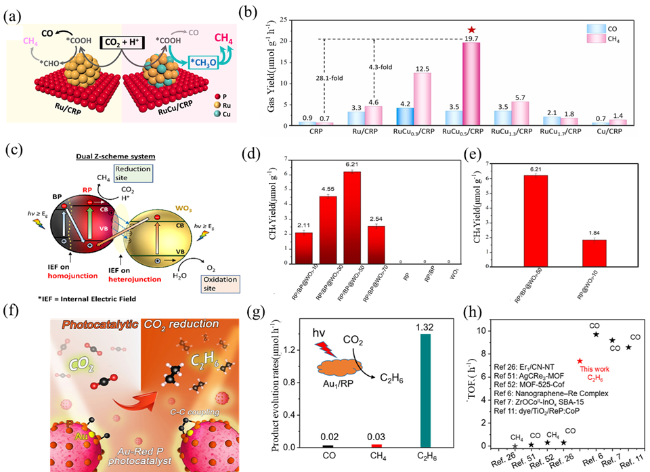
Fig. 11 (a) Proposed reaction mechanism for photocatalytic CO2 reduction reaction processes over Ru/CRP and RuCu/CRP. (b) The production yield rates of CO and CH4 in various photocatalysts under solar light irradiation. Reproduced with promission. (c) Mechanism diagram of photocatalytic reduction of CO2 by RP/BP@WO3. (d) Total photocatalytic CH4 yield achieved by RP/BP@WO3-x samples, RP, RP/BP, and WO3 after 6 h of visible light irradiation. (e) Interface-assisted catalytic C-C Coupling of Au singleatoms over RP. Photocatalytic reduction of CO2 to ethane. Reproduced with promission. (f) Photocatalytic activity of Au1/RP in CO2 reduction reaction, TOF for photocatalytic CO2 reduction of Au1/RP in comparison with recent reports. The production yield rates (g-h). Reproduced with promission. (a and b) are adapted with permission from ref. 111 (Copyright 2024, Elsevier); (c-e) are reproduced with permission from ref. 216 (Copyright 2022, American Chemical Society); and (f-h) are reproduced with permission from ref.217 (Copyright 2022, American Chemical Society).
As a result, there is a growing need to explore innovative disinfection technologies and materials. Recently, photocatalytic water disinfection has emerged as a safe, economical, and effective alternative. In this regard, RP has gained increasing attention as an eco-friendly photocatalytic disinfection material due to its visible-light activity, reasonable cost, and broad range of applications. This is primarily due to the high stability and non-metallic nature of RP, which effectively prevents the leakage of toxic metal ions-a common issue with traditional metal-based photocatalysts [56-72,230 -232].
In this context, the use of metal-free RP can help mitigate environmental contamination caused by secondary metal ions, highlighting its critical role in environmental remediation.
Chen et al. developed a novel photocatalyst featuring RP nanodots on polymeric carbon nitride nanotubes for effective bacterial inhibition (Fig. 12a-b) [233]. The RP (40)-CN photocatalyst exhibited remarkable activity under visible light, completely inactivating Escherichia coli in 25 min and Staphylococcus aureus in 30 min, reducing bacterial concentration to 107 CFU/mL. This performance enhancement is primarily attributed to RP's role in improving the separation of photoinduced electron-hole pairs and reducing charge recombination, which enhances reactive oxygen species (ROS) generation. Additionally, RP-CN responds to longer visible light wavelengths, extending up to 700 nm. The inactivation mechanism involves bacterial membrane damage, and the photocatalyst demonstrated excellent cycling stability, achieving a 99.89% inactivation rate against S. aureus after five cycles, making it a promising solution for water treatment and environmental remediation.
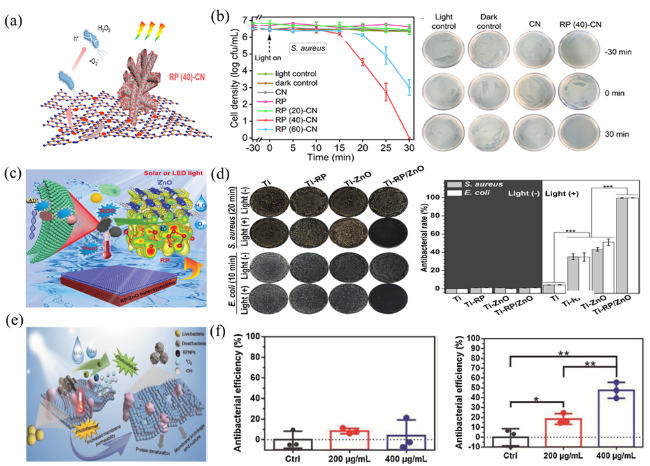
Fig. 12 (a) Mechanism of photocatalytic bacterial inactivation. (b) Photocatalytic inactivation performance and the corresponding spread plate results against S. aureus. (c) Mechanism of photocatalytic bacterial inactivation. (d) Inactivation of E.coli and corresponding spread plate results. (e) Sterilization mechanism of the RPNPs under simulated sunlight. (f)The antibacterial efficiency of RPNPs under different conditions. (a and b) are adapted with permission from ref. 233 (Copyright 2022, American Chemical Society); (c and d) are reproduced with permission from ref. 113 (Copyright 2019, Elsevier); and (e and f) are reproduced with permission from ref. 234 (Copyright 2021, Elsevier).
Liu et al. synthesized a titanium dioxide/RP (TiO2@RP) heterostructure using a vacuum ampoule strategy to enhance its photocatalytic antibacterial properties (Fig. 12c-d) [113]. Under visible light irradiation, TiO2@RP was able to completely inactivate 7-log CFU/mL of Escherichia coli within 25 min and Staphylococcus aureus within 30 minutes. The remarkable antibacterial efficacy is attributed to the generation of strong oxidizing species, such as photogenerated holes and superoxide anions, which effectively disrupt bacterial cell membranes, leading to cell death. This research presents an innovative solution for water treatment and bacterial inactivation, highlighting the potential of TiO2@RP in environmental remediation. However, the long-term stability and durability of the TiO2@RP heterostructure have not been thoroughly assessed. Additionally, the study did not investigate the impact of varying water quality conditions on photocatalytic performance, which may limit its applicability in real-world scenarios.
RPNPs, a degradable photosensitive material, demonstrate excellent photocatalytic and photothermal properties. Under simulated sunlight, they achieve 99.98% bactericidal efficiency against Staphylococcus aureus by generating reactive oxygen species and inducing photothermal damage to bacterial membranes, making them highly effective for sterilization
(Fig. 12e-f) [234].
RPNPs are biocompatible, degradable, and cost-effective. They degrade within eight weeks without toxicity to fibroblast cells. As an eco-friendly disinfectant, RPNPs show great potential, though their effectiveness depends on light conditions. Further research is needed to evaluate their long-term stability and broad-spectrum performance.
RP-based photocatalysts, as emerging sterilization materials, exhibit significant antibacterial effects and environmental advantages [235-242]. Through the photocatalytic generation of reactive oxygen species and photothermal effects, they efficiently kill bacteria, showing particular strength in disinfecting antibiotic-resistant strains. Additionally, RP-based photocatalysts have good degradability and biocompatibility, which, compared to traditional chemical disinfectants, not only reduce environmental pollution but also avoid secondary contamination. However, their performance is still influenced by light conditions, and their long-term stability and broad-spectrum antibacterial effects require further study. With continuous technological advancements, RP-based photocatalysts are expected to see wide application in environmental disinfection, air purification, and wastewater treatment, becoming an important eco-friendly sterilization material [116,242 -251].

6.4 Photocatalytic pollutant degradation

Using visible light to break down organic pollutants is an effective and environmentally friendly way to address pollution. To successfully degrade contaminants like pesticides and industrial wastewater, it’s crucial to develop photocatalysts with the right level of activity [252-257]. As photocatalytic technology advances, researchers are focusing on efficient, ecological, low-cost, and easily accessible materials to remove organic pollutants and reduce heavy metals. Among the promising materials, RP stands out as a sustainable option. It is affordable, abundant in soil, and free of metals, offering stable, efficient, and cost-effective catalysts that can degrade even challenging pollutants like organic waste [258-262].
Tao et al. synthesized Co3O4/RP photocatalysts using straightforward hydrothermal and mechanical milling techniques (Fig. 13a-b) [263]. Co3O4 nanocrystals were deposited on the RP surface, enhancing RP’s light absorption capacity compared to pure RP. The 10% Co3O4/RP composite demonstrated exceptional degradation of malachite green (MG) under visible light irradiation, achieving a 94.5% degradation rate in 20 min. In comparison, pure Co3O4 and RP showed much lower degradation rates of 17.3% and 5%, respectively. Cycling experiments revealed the catalyst’s high photocatalytic stability, with 9.9% of MG remaining degraded after multiple cycles. The Co3O4 nanocrystals effectively suppressed the recombination of photogenerated electron-hole pairs in RP semiconductors, improving its catalytic performance under visible light.
Bai et al. successfully developed a low-cost, environmentally sustainable, stable, and high-performance RP-MoS2/rGO nanocomposite through a simple two-step hydrothermal method (Fig. 13c-d) [264]. The introduction of MoS2/rGO complexes significantly improved RP’s photocatalytic properties, including the photoreduction of Cr(VI) and the photo-oxidation of various organic pollutants. These improvements were attributed to an increase in the number of excited electrons and holes, as well as enhanced charge carrier separation efficiency. The coexisting Cr(VI) and RhB exhibited superior photocatalytic activity compared to the solutions alone, demonstrating that RP-MoS2/rGO composite photocatalysts with suitable nanostructures possess excellent adsorption capacity, contributing to both the selectivity and efficiency of the catalytic process.
Zheng et al. developed an RPLDH0.8/Vis photocatalytic system based on a RP/zinc-aluminum layered double hydroxide (RP/ZnAl-LDH) heterojunction, achieving efficient antibiotic degradation (Fig. 13e) [87]. Within 90 min, the system demonstrated a tetracycline removal efficiency of 89% and a mineralization rate of 21%. Even after five cycles, the degradation performance remained above 87%. Additionally, when applied to complex water bodies like livestock wastewater, the system achieved a 15% reduction in total organic carbon (TOC) (Fig. 13f). The S-scheme heterojunction design significantly enhanced charge separation, boosting photocatalytic efficiency and minimizing the production of toxic intermediates. This innovative approach shows strong adaptability to environmental challenges and offers promising potential as a sustainable solution for wastewater treatment.
RP-based photocatalysts hold great potential for pollutant degradation. Their excellent photocatalytic properties enable the effective degradation of organic pollutants, heavy metal ions, and other environmental contaminants in water and air under light exposure. RP nanomaterials exhibit high light absorption capacity, stability, and tunability, allowing them to catalyze reactions under visible light or even sunlight, reducing energy consumption and improving degradation efficiency. Moreover, their good degradability and low cost make them an eco-friendly and economical choice. However, challenges remain in improving their catalytic efficiency, stability, and broad-spectrum performance in complex environments to enhance their practical application in pollution control.
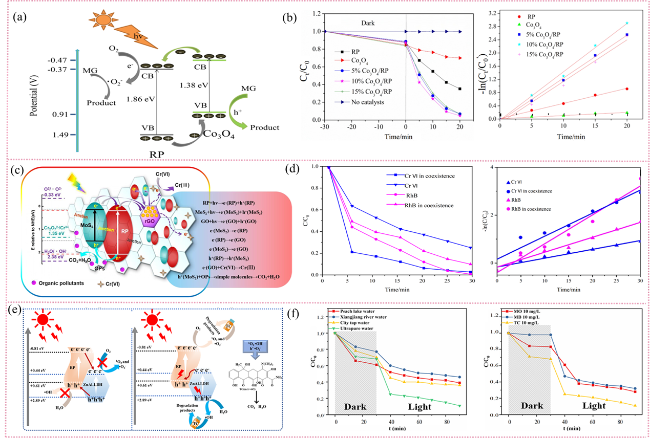
Fig. 13 (a) Photocatalytic degradation mechanism diagram. (b) Degradation efficiency and kinetics of MG under visible light using various photocatalysts. (c) Photocatalytic degradation mechanism diagram. (d) Photocatalytic performance for Cr(VI) reduction and RhB oxidation under varying conditions, with corresponding kinetic fitting. (e) Photocatalytic degradation mechanism diagram (f) Degradation efficiency in natural water samples and other organic pollutants. (a and b) are adapted with permission from ref. 263 (Copyright 2020, Elsevier); (c and d) are reproduced with permission from ref. 264 (Copyright 2018, Elsevier); and (e and f) are reproduced with permission from ref. 87 (Copyright 2023, Elsevier).

6.5 Other photocatalytic applications

6.5.1 Nitrogen fixation

Ammonia plays a crucial role in sustaining the life cycle, serving as a vital source of nitrogen for both plants and animals. The synthesis of ammonia through nitrogen fixation is a key process in addressing the ongoing energy crisis and environmental challenges [34-45,100,265]. Traditional industrial methods, such as the Haber process, are limited by their harsh reaction conditions. In contrast, photocatalytic N2 fixation offers a promising alternative, utilizing sunlight to drive the reaction in a sustainable and environmentally friendly manner. In recent years, significant advances have been made in photocatalytic N2 conversion to NH3, presenting a potential solution for meeting the demands of modern agriculture and the fertilizer industry [266-273].
Lin’s team developed a nanocrystalline RP composite loaded on photoactive SiO2 nanorods using a simple sublimation-deposition method [100]. In this approach, RP was modified by in situ-formed carbon materials. The resulting hybrid catalyst (SiO2/C-RP) exhibited an NH2 yield of 0.73 μmol h-1 in 40 mL of pure water with a catalyst dosage of 20 mg, significantly outperforming crystalline bulk RP. This remarkable enhancement in photocatalytic activity was attributed to the synergistic effects of an increased specific surface area, improved light absorption, enhanced water dispersibility, and better charge separation properties. The findings of this study provide valuable insights for the future design of photocatalysts for nitrogen fixation.

6.5.2 Photoelectrochemical (PEC) sensing

RP-based catalysts demonstrate great potential in photoelectrochemical (PEC) sensing, particularly in enhancing interfacial charge separation and migration efficiency [274-288]. For example, a 3D CuInS2 and 2D RPns n-n heterojunction was constructed to create functional materials with superior charge transfer properties [289]. Experimental results showed that the heterojunction possesses a broad light response range and a significant built-in electric field, effectively shortening carrier transport distances and enhancing the stability of the photoinduced current. The CuInS2/RP NS-based PEC aptamer sensor exhibited a wide detection range (1.0×10⁻¹⁴ to 1.0×10⁻⁵ mg·mL-1) and an ultra-low detection limit (2.03×10⁻¹⁵ mg·mL-1) for ciprofloxacin, providing new insights into high-performance photo-sensor development and opening new avenues for environmental monitoring and biomedical applications.

6.5.3 Resource extraction and separation technology

RP-based catalysts hold significant promise in uranium extraction, especially within the tributylphosphate-kerosene (TBP-kerosene) system [280-294]. However, due to the inherent difficulty of oxidizing organic components in this system, the reduction of hexavalent uranium (U(VI)) has been challenging. To address this, a self-oxidation strategy has been proposed, where deeply oxidized RP (DO-CRP) facilitates the photocatalytic reduction of U(VI). In a 30% TBP-kerosene solution, DO-CRP achieves an impressive extraction efficiency of 88.0% and a U(VI) capacity of 580.8 mg/g within just 120 min [295]. This process leverages PO43- groups formed at defect sites in RP as binding sites to capture U(VI). During the desorption process, these defect sites are released and regenerated for the next cycle, ensuring continuous uranium extraction. Mechanistic studies indicate that this self-oxidation process enables sustained uranium extraction. This strategy not only provides a novel solution for uranium extraction in the TBP-kerosene system but also offers a breakthrough for reducing metal resources in stable organic systems.

7 Challenges in current research

RP-based photocatalysts face several challenges, ranging from synthesis methods to theoretical calculations [296-313]. Below is an outlook on these challenges:
(a) Synthesis methods: Current synthesis methods for RP-based catalysts are still limited by challenges in achieving high-quality, uniformly distributed materials. The development of more efficient, controllable, and cost-effective techniques is crucial to obtaining a wide range of RP nanostructures, thin films, and other tailored morphologies, while simultaneously addressing issues related to oxidation and long-term stability. Advanced approaches such as nanofabrication, high-throughput synthesis, and AI-assisted material design hold considerable promise in optimizing catalyst fabrication, enabling more precise control over structure-property relationships and enhancing the overall performance of RP-based photocatalysts.
(b) In-situ techniques: Real-time characterization of RP-based photocatalysts is essential for gaining a deeper understanding of their structural evolution and reaction mechanisms. While conventional ex-situ techniques like XRD and SEM offer valuable static snapshots, they are limited in their ability to capture dynamic transformations occurring during catalytic processes. Advanced in-situ techniques, such as Raman spectroscopy, XAS, and synchrotron-based methods, show significant promise for real-time analysis. However, their spatial and temporal resolution still requires further enhancement to fully capture transient phenomena during catalysis. Additionally, monitoring surface properties remains a considerable challenge. While XPS and IR spectroscopy provide valuable surface insights, the need for real-time, surface-sensitive techniques remains paramount to comprehensively understanding surface dynamics.
Moreover, probing the electronic states of RP-based photocatalysts during reactions is crucial for optimizing charge carrier dynamics and improving photocatalytic efficiency. Techniques like UV-visible spectroscopy and transient absorption spectroscopy offer important information on electronic transitions, but their relatively limited spatial and temporal resolution often constrains the analysis of fast processes. Emerging ultrafast techniques, such as femtosecond time-resolved spectroscopy, provide exciting opportunities to capture rapid electronic state transitions with greater precision. The integration of high-resolution, real-time monitoring techniques with computational simulations will play a pivotal role in elucidating the fundamental mechanisms that govern the photocatalytic behavior of RP-based materials, offering valuable insights for the design of more efficient photocatalysts.
(c) Theoretical calculations (Big Data and Machine Learning): Computational approaches are essential in the rational design and optimization of RP-based photocatalysts. The application of machine learning and big data analytics has greatly facilitated the discovery and fine-tuning of novel catalysts. However, the effective integration of theoretical models with experimental validation remains a significant challenge. Deep learning methodologies, such as deep-seek strategies, hold great potential for enhancing material property predictions by identifying complex patterns within high-dimensional datasets. Additionally, AI-driven generative models and reinforcement learning techniques can significantly accelerate the identification of RP-based photocatalysts with enhanced stability and activity. Cloud-based big data platforms further support collaborative research, allowing for the seamless integration of high-throughput screening with automated experimental validation processes.
The convergence of advanced machine learning models, deep-seek strategies, and big data analytics will be transformative in overcoming the current limitations of RP-based photocatalysts. The development of self-learning algorithms that continually refine their predictions through feedback from experimental results is poised to revolutionize the catalyst discovery process. Future research in this area should focus on the following priorities:
AI-Driven Material Discovery: Employing generative adversarial networks (GANs) and reinforcement learning to design innovative RP-based photocatalysts with superior performance, stability, and efficiency.
Automated High-Throughput Screening: Utilizing robotic laboratories to expedite material synthesis and characterization, thereby minimizing trial-and-error approaches and accelerating catalyst development.
Multiscale Theoretical Simulations: Integrating quantum mechanical calculations with AI-driven force fields to provide a more accurate and comprehensive representation of photocatalytic processes.
Cloud-Based Collaborative Research Networks: Establishing open data-sharing platforms to integrate experimental insights, computational predictions, and machine learning models, fostering a collaborative ecosystem that will accelerate innovation in photocatalyst development.
The integration of these approaches promises to significantly enhance the precision, efficiency, and scalability of RP-based photocatalysts, advancing both fundamental understanding and practical applications.
(d) Single-site catalysts: RP, as a promising photocatalytic material, exhibits distinctive semiconductor properties and abundant surface active sites, positioning it as a robust platform for the construction of single-atom catalysts and heteronuclear diatomic catalysts. The integration of single metal atoms enhances its optical absorption properties, charge carrier separation efficiency, and catalytic stability by modulating the local electronic structure. Meanwhile, the incorporation of heteronuclear diatomic metals exploits the synergistic interactions between two metal atoms, resulting in optimized reaction kinetics and improved catalytic selectivity. These strategies not only address the intrinsic chemical instability of RP but also significantly expand its applicability in CO2 reduction, NRR, and HER. Looking forward, achieving further breakthroughs will necessitate the precise control of the coordination environments of single-atom and diatomic metals, the rational design of metal-phosphorus interfaces to promote charge transfer, and the integration of theoretical simulations to guide the selection of metal combinations and reaction pathways. By synergizing advancements in material synthesis, in-depth characterization techniques, and application-oriented studies, RP-based photocatalysts are expected to play a transformative role in advancing sustainable energy technologies and environmental remediation efforts.
(e) Dimensional control and structural design: Dimensional control and structural design of RP-based photocatalysts enable the optimization of electronic properties and catalytic efficiency. By manipulating material dimensions (0D, 2D, and 3D), properties such as light absorption, charge separation, and transport can be enhanced. Structural strategies like heterostructure formation, defect tuning, and surface functionalization further boost performance. These approaches enable the tailored design of catalysts for specific reactions, advancing RP in sustainable energy and environmental applications.
Future research on RP-based photocatalysts can advance by optimizing synthesis methods, enhancing in situ characterization techniques, incorporating big data and machine learning in theoretical calculations, developing single-atom and bimetallic dual-atom catalysts, and exploring 0D and 2D materials, as shown in Fig. 14. By overcoming these current bottlenecks, the application effectiveness of RP-based photocatalysts in energy and environmental fields can be significantly improved.
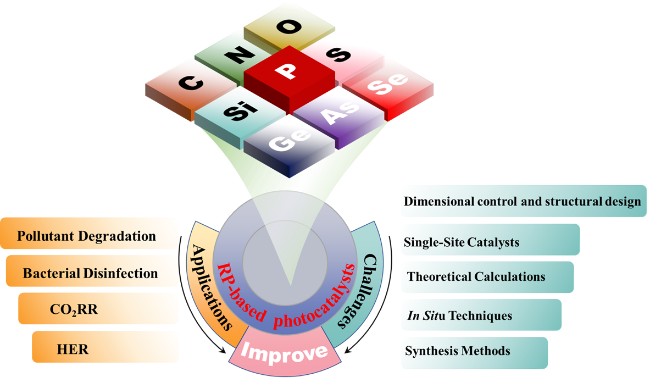
Fig. 14 Summary and perspective for RP-based photocatalysts.

J.J., Y.Z. and Z.J. designed the proposal and wrote the manuscript. All authors have given approval to the final version of the manuscript.

The authors declare no competing financial interest.

This work is supported by the National Natural Science Foundation of China (62004143), the Key R&D Program of Hubei Province (2022BAA084), the Open Fund of the Key Laboratory of Functional Inorganic Material Chemistry (Heilongjiang University), Ministry of Education, and the Innovation Project of Engineering Research Center of Phosphorus Resources Development and Utilization of Ministry of Education (LCX202404).

[1]
Jian Wang, Jiahe Zhang, Yang Li, Xinghui Xia, Hengjing Yang, Jae-Hong Kim, Wen Zhang. Silver single atoms and nanoparticles on floatable monolithic photocatalysts for synergistic solar water disinfection. Nature Communications, 2025, 16, 981. https://doi.org/10.1038/s41467-025-56339-2

[2]
Fangyi Li, Guihua Zhu, Jizhou Jiang, Lang Yang, Fengxia Deng, Arramel, Xin Li. A review of updated S-scheme heterojunction photocatalyst. Journal of Materials Science & Technology, 2024, 177, 142-180. https://doi.org/10.1016/j.jmst.2023.08.038

[3]
Jizhou Jiang, Fangyi Li, Lei Ding, Chengxu Zhang, Arramel, Xin Li. MXenes/carbon nanotubes hybrids: Synthesis, energy and environmental applications, and developing strategies. Nano Research, 2024, 17, 3429-3454. https://doi.org/10.1007/s12274-023-6302-x

[4]
Jiamei Wang, Jizhou Jiang, Fangyi Li, Jing Zou, Kun Xiang, Haitao Wang, Youji Li, Xin Li. Emerging carbon-based quantum dots for sustainable photocatalysis. Green Chemistry, 2023, 25, 32-58. https://doi.org/10.1039/D2GC03160D.

[5]
Arnab Pal, Sreerag Suresh, Arshad Khan, Li Huai Kuo, Li Tang Chi, Anindita Ganguly, Chih-Yao Kao, Manish Kumar Sharma, Tsung-Shing Andrew Wang, Dun-Yen Kang, Zong-Hong Lin. Metal-organic frameworks as thermocatalysts for hydrogen peroxide generation and environmental antibacterial applications. Science Advances, 2025, 11, eads4711. https://doi.org/10.1126/sciadv.ads4711

[6]
Jizhou Jiang, Zhiguo Xiong, Haitao Wang, Guodong Liao, Saishuai Bai, Jing Zou, Pingxiu Wu, Peng Zhang, Xin Li. Sulfur-doped g-C3N4/g-C3N4 isotype step-scheme heterojunction for photocatalytic H2 evolution. Journal of Materials Science & Technology, 2022, 118, 15-24. https://doi.org/10.1016/j.jmst.2021.12.018

[7]
Hongjun Dong, Chunhong Qu, Chunmei Li, Bo Hu, Xin Li, Guijie Liang, Jizhou Jiang. Recent advances of covalent organic frameworks-based photocatalysts: Principles, designs, and applications. Chinese Journal of Catalysis, 2025, 70, 142-206. https://doi.org/10.1016/S1872-2067(24)60184-1

[8]
Tingting Yu, Bing Yang, Rong Zhang, Chenyu Yang, Arramel, Jizhou Jiang. Fabrication of a novel Z-S-scheme photocatalytic fuel cell with the Z-scheme TiO2/GO/g-C3N4 photoanode and S-scheme BiOAc1-xBrx/BiOBr photocathode for TC degradation. Journal of Materials Science & Technology, 2024, 188, 11-26. https://doi.org/10.1016/j.jmst.2023.12.004

[9]
Tingting Yu, Chenyu Yang, Ran Deng, Yonghang Zhang, Jiajun Li, Tao Yang, Jizhou Jiang. Piezoelectric-enhanced BiOBr/UiO-66-NH2(Hf) photocatalysts for purification of mixed pollutants. Science China Technological Sciences, 2025, https://doi.org/10.1007/s11431-024-2884-5

[10]
Entian Cui, Yulian Lu, Zhaoxia Li, Zhilei Chen, Chengyan Ge, Jizhou Jiang. Interfacial B-O bonding modulated S-scheme B-doped N-deficient C3N4/O-doped-C3N5 for efficient photocatalytic overall water splitting. Chinese Chemical Letters, 2025, 36, 110288. https://doi.org/10.1016/j.cclet.2024.110288

[11]
Mengfang Liang, Xiaodong Shao, Yunhee Cho, Amol R. Jadhav, Yosep Hwang, Jinsun Lee, Min Gyu Kim, Yeseul Hong, Sara Ajmal, Dong-Yub Yee, Trang Thu Tran, Jeongyong Kim, Viet Q. Bui, Thi Huynh Ho, Shufang Zhao, Young Dok Kim, Ji-Hee Kim, Hyoyoung Lee. Effective charge separation in a dual-single-atom photocatalyst for sacrificial agent-free H2 evolution. ACS Sustainable Chemistry & Engineering, 2024, 12, 16, 6122-6131. https://doi.org/10.1021/acssuschemeng.3c07119

[12]
Fan Fu, Yongxin Liu, Mingliang Liu, Zhengguang Li, Wanying Zhong, Yaqin Li, Kaixiu Li, Jun Wang, Yongchao Huang, Yiming Li, Wei Liu, Yi Zhang, Kaisong Xiang, Hui Liu, Pingshan Wang, Die Liu. Non-noble metal single-molecule photocatalysts for the overall photosynthesis of hydrogen peroxide. Journal of the American Chemical Society, 2024, doi: 10.1021/jacs.4c09445 https://doi.org/10.1021/jacs.4c09445

[13]
Vinoth Kumar Ponnumsamy, Hussein E. Al-Hazmi, Sutha Shobana, Jeyaprakash Dharmaraja, Dipak Ashok Jadhav, Rajesh Banu J, Grzegorz Piechota, Bartłomiej Igliński, Vinod Kumar, Amit Bhatnagar, Kyu-Jung Chae, Gopalakrishnan Kumar. A review on homogeneous and heterogeneous catalytic microalgal lipid extraction and transesterification for biofuel production. Chinese Journal of Catalysis, 2024, 59, 97-117. https://doi.org/10.1016/S1872-2067(23)64626-1

[14]
Dongshu Sun, Tianyu Zhou, Guangbo Che, Chunbo Liu. A synergism between Schottky junction and interfacial P-Ni bond for improving the hydrogen evolution of 2D/2D NiS/Phosphorus-doped g-C3N4 photocatalyst. Applied Surface Science, 2022, 578, 152004. https://doi.org/10.1016/j.apsusc.2021.152004.

[15]
Aiqin Wang, Tao Zhang. Surprised by exceptional stability of confined single-atom cluster catalysts. Science China Materials, 2024, 67, 1676-1677. https://doi.org/10.1007/s40843-024-2876-2

[16]
Tian Zhang, Xiaohui Ren, Shuai Mo, Wenzhe Cao, Chaogang Zhou, Feng Ma, Rongsheng Chen, Chao Zeng, Li Shi, Tao Liu, Hua Zhang, Hongwei Ni. Modulating Fe/P ratios in Fe-P alloy through smelting reduction for long-term electrocatalytic overall water splitting. Journal of Materials Science & Technology, 2024, 199, 66-74. https://doi.org/10.1016/j.jmst.2024.02.037

[17]
Fangxin Yin, Pinquan Qin, Jingsan Xu, Shaowen Cao. Methylene blue incorporated donor-acceptor g-C3N4 nanosheet photocatalyst for H2 production. Acta Physico-Chimica Sinica, 2023, 39, 2212062.

[18]
Christopher T. Reinhard, Noah J. Planavsky, Benjamin C. Gill, Kazumi Ozaki, Leslie J. Robbins, Timothy W. Lyons, Woodward W. Fischer, Chunjiang Wang, Devon B. Cole, Kurt O. Konhauser. Evolution of the global phosphorus cycle. Nature, 2017, 541, 386-389. https://doi.org/10.1038/nature20772

[19]
Andrew R. Jupp, Steven Beijer, Ganesha C. Narain, Willem Schipper J. Chris Slootweg. Phosphorus recovery and recycling-closing the loop. Chemical Society Reviews, 2021, 50, 87-101. https://doi.org/10.1039/D0CS01150A

[20]
Haijiang Tian, Jiahong Wang, Gengchang Lai, Yanpeng Dou, Jie Gao, Zunbin Duan, Xiaoxiao Feng, Qi Wu, Xingchen He, Linlin Yao, Li Zeng,a Yanna Liu, a Xiaoxi Yang,a Jing Zhao, Shulin Zhuang, Jianbo Shi, Guangbo Qu, Xue-Feng Yu, Paul K. Chu, Guibin Jiang. Renaissance of elemental phosphorus materials: properties, synthesis, and applications in sustainable energy and environment. Chemical Society Reviews, 2023, 52, 5388-5484. https://doi.org/10.1039/D2CS01018F

[21]
Ximing Shao, Zhihao Ding, Wenhua Zhou, Yanyan Li, Zhibin Li, Haodong Cui, Xian Lin, Guoli Cao, Binghua Cheng, Haiyan Sun, Meiqing Li, Ke Liu, Danyi Lu, Shengyong Geng, Wenli Shi, Guofang Zhang, Qingle Song, Liang Chen, Guocheng Wang, Wu Su, Lintao Cai, Lijing Fang, David Tai Leong, Yang Li, Xue-Feng Yu, Hongchang Li. Intrinsic bioactivity of black phosphorus nanomaterials on mitotic centrosome destabilization through suppression of PLK1 kinase. Nature Nanotechnology, 2021, 16, 1150-1160. https://doi.org/10.1038/s41565-021-00952-x

[22]
Cheng-May Fung, Chen-Chen Er, Lling-Lling Tan, Abdul Rahman Mohamed, Siang-Piao Chai. Red phosphorus: An up-and-coming photocatalyst on the horizon for sustainable energy development and environmental remediation. Chemical Reviews 2022 122, 3879-3965. https://doi.org/10.1021/acs.chemrev.1c00068

[23]
Feiyue Wang, Tong Yang, Wencong Feng, Jingke Ren, Xingbao Chen, Chaojie Cheng, Wen Luo, Xiaobin Liao, Liqiang Mai. Homogeneous adsorption of multiple potassiation products of red phosphorus anode toward stable potassium storage. ACS Nano 2024, 18, 26, 17197-17208. https://doi.org/10.1021/acsnano.4c04344

[24]
Nathan D. Yoshino, Lee-Ping Wang. Two P, ten P, white P, red P: Mechanistic exploration of the oligomerization of red phosphorus from diphosphorus with the Ab initio nanoreactor. Inorganic Chemistry, 2024, 63, 41, 19074-19086. https://doi.org/10.1021/acs.inorgchem.4c02299

[25]
Qingshun Zhang, Jiaying Wang, Chuanwen Liu, Huimei Duan, Jiaxiu Liu, Yukun Zhu, Jizhou Jiang. Red phosphorus decorated In2O3 hollow fiber heterostructures for boosting white LED driven photocatalytic bacterial inactivation. Nano Research, 2025, https://doi.org/10.26599/NR.2025.94907320.

[26]
Sajid Ali Ansari. Elemental semiconductor red phosphorus/ZnO nanohybrids as high performance photocatalysts. Ceramics International. 2023, 49, 17746-17752. https://doi.org/10.1016/j.ceramint.2023.02.140

[27]
Junying Liu, Zhidong Wei, Wenjian Fang, Yangchun Yong, Wenfeng Shangguan. In-situ construction of amorphous red phosphorus/SrTiO3 heterojunctions for enhanced visible-light photocatalytic hydrogen production. International Journal of Hydrogen Energy, 2024, 93, 1127-1134. https://doi.org/10.1016/j.ijhydene.2024.11.067

[28]
Zhuanhu Wang, Yuhua Ma, Yanjie Shi, Shiyin Wang, Minghe Gao, Yulian Qiu, Chen Li. Bi2WO6/red phosphorus heterojunction photocatalyst with excellent visible light photodegrading activity. Chemical Physics Letters, 2023, 818, 140422. https://doi.org/10.1016/j.cplett.2023.140422

[29]
Gulibahaer Aimaiti, Yuhua Ma, Yanjie Shi, Xin Wang, Shiyin Wang, Zhuanhu Wang, Yuchen Li, Jiawen Li, Xianhui Qi, Xi Chen. Nb2O5/red phosphorus S-scheme heterojunction photocatalyst for removal of organic contaminant and Cr(VI): Electrochemical performance and mechanism. Materials Science in Semiconductor Processing, 2023, 160, 107421. https://doi.org/10.1016/j.mssp.2023.107421

[30]
Xianhui Qi, Gulibahaer Aimaiti, Yanbo Zou, Yuhua Ma, Munire Tuerhong, Jizhou Jiang. Enhanced interface charge carrier transport of MgO/red phosphorus via oxygen vacancy synergized S-scheme heterojunction for bactericidal and contaminant degradation. Applied Surface Science. 2025, 688, 162345. https://doi.org/10.1016/j.apsusc.2025.162346

[31]
Yukun Zhu, Jun Ren, Guiqing Huang, Chung-Li Dong, Yu-Cheng Huang, Ping Lu, Hua Tang, Yiming Liu, Shaohua Shen, Dongjiang Yang. Red phosphorus grafted high-index (116) faceted anatase TiO2 for Z-scheme photocatalytic purewater splitting. Advanced Functional Materials. 2024, 34, 2311623. https://doi.org/10.1002/adfm.202311623

[32]
Yi Dong, Wei Zhang, Zhuofeng Hu, Yun Hau Ng, Zhen Wei, Yuxi Liu, Jiguang Deng, Hongxing Dai, Lin Jing. Advancing CO2 to CH4 conversion: The pivotal role of RuCu alloy in crystalline red phosphorus photocatalysis. Applied Catalysis B: Environment and Energy, 2024, 357,124347. https://doi.org/10.1016/j.apcatb.2024.124347.

[33]
Ashish Yadav, Shobhita Singal, Jitender Kumar, Raj Kishore Sharma. Sonochemically synthesized porous V2CTX MXene/red-black phosphorus composite: A promising electrode for supercapacitors. Journal of Energy Storage, 2024, 79, 110155. https://doi.org/10.1016/j.est.2023.110155.

[34]
Tianyang Li, Chen Guan, Lingyu Xu, Chenyu Li, Zhuo Song, Ningxin Zhang, Chengyu Yang, Xuefei Shen, Daohao Li, Gang Wei, Yan Xu. Facile synthesis of MoS2@red phosphorus heterojunction for synergistically photodynamic and photothermal therapy of renal cell carcinoma. Colloids and Surfaces B: Biointerfaces, 2024, 241, 114031. https://doi.org/10.1016/j.colsurfb.2024.114031.

[35]
Muhammad Qasim, Maochang Liu, Liejin Guo. Z-scheme P-doped-g-C3N4/Fe2P/red-P ternary composite enables efficient two-electron photocatalytic pure water splitting. Catalysis Today, 2023, 409, 117-129. https://doi.org/10.1016/j.cattod.2022.05.007.

[36]
Shafali Singh, Sushil Kumar Kansal. Enhanced performance of dual-functional ZIF-8/red phosphorus photocatalysts for concurrent degradation of organic dyes and hydrogen generation under natural solar light irradiation. Chemical Communications, 2024, 60, 10970-10973. https://doi.org/10.1039/d4cc02644f.

[37]
Meng Liu, Liqian Guan, Yujiao Wen, Lezhu Su, Zhan Hu, Zhengjie Peng, Shikai Li, Qiyuan Tang, Zhi Zhou, Nan Zhou. Rice husk biochar mediated red phosphorus for photocatalysis and photothermal removal of E. coli. Food Chemistry, 2023, 410, 135455. https://doi.org/10.1016/j.foodchem.2023.135455.

[38]
Yingnan Duan, Ruru Li, Qiuya Liu, Zhurui Shen. Elemental phosphorus for recent sustainable processes: Rules and strategies in preparation and applications. Green Chemistry, 2022, 24, 3475-3501. https://doi.org/10.1039/d2gc00727d.

[39]
Habiba Khiar, Noureddine Barka, Alberto Puga. Metal phosphates for the design of advanced heterogeneous photocatalysts. Coordination Chemistry Reviews, 2024, 510, 215814. https://doi.org/10.1016/j.ccr.2024.215814.

[40]
Yajie Sun, Xinya Pei, Bo Wang, Yun Hau Ng, Ruixue Zhu, Qichao Zhang, Jiguang Deng, Yuxi Liu, Lin Jing, Hongxing Dai. Point defect engineering of elemental phosphorus for photocatalytic hydrogen evolution. Chemical Engineering Journal, 2023, 463, 142488. https://doi.org/10.1016/j.cej.2023.142488.

[41]
Fangli Zhao, Hui Miao, Jun Fan, Tao Sun, Chunni Tang, Enzhou Liu. Fabrication of S-scheme FeCoS2/Red phosphorus heterojunction for efficient photocatalytic H2 evolution. Colloids and Surfaces A: Physicochemical and Engineering Aspects, 2023, 676, 132316. https://doi.org/10.1016/j.colsurfa.2023.132316.

[42]
Shafali Singh, Sushil Kumar Kansal. Recent progress in red phosphorus-based photocatalysts for photocatalytic water remediation and hydrogen production. Applied Materials Today, 2022, 26, 101345. https://doi.org/10.1016/j.apmt.2021.101345.

[43]
Yingtong Lv, Ru Cheng, Guolin Yang, Wang Liu, Jingye Zhang, Xiaofang Yu, Wencai Bai, Rong He, Wenkun Zhu. Self-oxidation cycle of oxidized red phosphorus for regeneration of binding sites enables efficient uranium extraction in tributylphosphate-kerosene system. Chemical Engineering Journal, 2023, 460, 141834. https://doi.org/10.1016/j.cej.2023.141834.

[44]
Ruiyu Zhong, Yujie Liang, Fei Huang, Shinuo Liang, Shengwei Liu. Regulating interfacial coupling of 1D crystalline g-C3N4 nanorods with 2D Ti3C2TX MXene for boosting photocatalytic CO2reduction. Chinese Journal of Catalysis, 2023, 53, 109-122. https://doi.org/10.1016/S1872-2067(23)64513-9

[45]
Qi Li, Jiehao Li, Huimin Bai, Fatang Li. Progress on facet engineering of catalysts for application in photo/electro-catalysis. Chinese Journal of Catalysis, 2024, 58, 84-106. https://doi.org/10.1016/S1872-2067(23)64600-5

[46]
Zhongliao Wang, Jing Wang, Jinfeng Zhang, Kai Dai. Overall utilization of photoexcited charges for simultaneous photocatalytic redox reactions. Acta Physico-Chimica Sinica, 2023, 39, 2209037.

[47]
Kai Zheng, Xiaojing Zhang, Jun Hu, Chengbin Xu, Juncheng Zhu, Jing Li, Mingyu Wu, Shan Zhu, Li Li, Shumin Wang, Yumei Lv, Xin He, Ming Zuo, Chengyuan Liu, Yang Pan, Junfa Zhu, Yongfu Sun, Yi Xie. High-rate CH4-to-C2H6 photoconversion enabled by Au/ZnO porous nanosheets under oxygen-free system. Science China Chemistry, 2024, 67, 869-875. https://doi.org/10.1007/s11426-023-1792-8

[48]
Feiyue Wang, Tong Yang, Wencong Feng, Jingke Ren, Xingbao Chen, Chaojie Cheng, Wen Luo, Xiaobin Liao, Liqiang Mai. Homogeneous adsorption of multiple potassiation products of red phosphorus anode toward stable potassium storage. ACS Nano, 2024, 18, 17197-17208. https://doi.org/10.1021/acsnano.4c04344

[49]
Bowen Zhang, Wujia Chen, Kezheng Tao, Zhaojian Sun, Qiang Li, Qingfeng Yan. Assessing the structural diversity of form II red phosphorus via stepwise crystal structure search. Journal of the American Chemical Society, 2024, 146, 26369-26378.https://doi.org/10.1021/jacs.4c09250

[50]
Xunfu Zhou, Yuanxuan Xian, Ziqing Li, Chen Yujie, Jin Luo, Xiaomei Ning, Xuliang Fan, Yongming Zhong, Xiaosong Zhou. All-solid-state red phosphorus/RGO/WO3 Z-scheme heterostructure for photocatalytic overall water splitting. Separation and Purification Technology, 2025, 357, 130117. https://doi.org/10.1016/j.seppur.2024.130117.

[51]
Youyu Zhu, Xiaofang Tang, Zonglin You, Yixi Zhang, Wei Du, Yingfeng Duan, Jiangtao Cai, Yating Zhang, Conductive polymer-coated red phosphorus encapsulated in 3D graphene oxide aerogel for high-performance sodium-ion batteries anode. Journal of Electroanalytical Chemistry, 2024, 966, 118413. https://doi.org/10.1016/j.jelechem.2024.118413.

[51]
Jingwen Wu, Rui Xu, Mingfei Shao, Laixi Zhao, Wenhua Xu, Yanchuan Guo. Phosphorus-based nnomaterials for biomedical applications: A review. ACS Applied Nano Materials, 2024, 7, 10, 11022-11036. https://doi.org/10.1021/acsanm.4c00015

[52]
Manfred Scheer, Gábor Balázs, Andreas Seitz. P4 activation by main group elements and compounds. Chemical Reviews, 2010, 110, 7, 4236-4256. https://doi.org/10.1021/cr100010e

[53]
W. Hittorf. Zur Kenntniss des Phosphors. Annalen der Physik, 1865, 202, 193-228. https://doi.org/10.1002/andp.18652021002

[54]
Hao Yang, Dongyang He, Tingting Zhang, Chuanhao Liu, Fangyuan Cheng, Yangjian Zhou, Ya-nan Zhang, Jiao Qu. Magnetic carbon nanotubes/red phosphorus/graphitic carbon nitride heterojunction for highly efficient visible-light photocatalytic water disinfection. Chemical Engineering Journal, 2023, 466, 143309. https://doi.org/10.1016/j.cej.2023.143309.

[55]
Wenjian Fang, Jiawei Yan, Zhidong Wei, Junying Liu, Weiqi Guo, Zhi Jiang, Wenfeng Shangguan. Account of doping photocatalyst for water splitting. Chinese Journal of Catalysis, 2024, 60, 1-24. https://doi.org/10.1016/S1872-2067(23)64637-6.

[56]
Lin-Wei Chen, Nannan Lu, Fanfan Liu, Yu Shao, Lei Wang. Red phosphorus encapsulated in 3D N-doped porous carbon nanofibers: an enhanced sodium-ion battery anode material. Chemical Communications, 2024, 60, 3186-3189. https://doi.org/10.1039/d3cc06080b.

[57]
R. Architha, M. Roshith, P.S. Athira, A.K. Nanda Kumar,Darbha V. Ravi Kumar. Wet chemical synthesis of type-II red phosphorus and evaluation of its photocatalytic activity using a non-dye degradation method. Materials Letters, 2024, 360, 136001. https://doi.org/10.1016/j.matlet.2024.136001.

[58]
Guanghui Luo, Huimin Liu, Ruilin Wang, Chengyu Duan, Mengdi Sun, Yinglong Lu, Zheshun Ou, Zhuofeng Hu. Construction of a red phosphorus-molybdenum dioxide electron-rich interface for efficient photocatalytic reduction of carbon dioxide. Journal of Colloid and Interface Science, 2025, 684, 346-354. https://doi.org/10.1016/j.jcis.2024.12.244.

[59]
Guozhen He, Tao Dong, Zhaochu Yang, Per Ohlckers. Tuning 2D black phosphorus: Defect tailoring and surface functionalization. Chemistry of Materials, 2019, 31, 24, 9917-9938. https://doi.org/10.1021/acs.chemmater.9b03639

[60]
Ju Zhou, Tian-Yi Cai, Sheng Ju. Anisotropic exciton excitations and optical properties of Hittorf’s phosphorene. Physical Review Research, 2020, 2, 2643-1564. https://doi.org/10.1103/PhysRevResearch.2.033288

[61]
Peng Zeng, Yang Zhou, Lingling Peng, Shaochuan Wang, Tianyou Peng. Architecture modification and In3+-doping of WO3 photoanodes to boost the photoelectrochemical water oxidation performance. Science China Chemistry, 2023, 66, 3269-3279. https://doi.org/10.1007/s11426-023-1691-1

[62]
Rui Chen, Xiang Fang, Dongfang Zhang, Lanqi He, Yinlong Wu, Chenghua Sun, Kun Wang, Shuqin Song. In-situ construction of three- dimensional ordered cobalt- nitrogen- carbon nanotubes integrated self- supporting electrode for efficiently electrocatalyzing oxygen reduction reaction. Chinese Journal of Catalysis, 2024, 61, 237-246. https://doi.org/10.1016/S1872-2067(24)60023-9

[63]
Song Zhang, Hu-jun Qian, Zhonghua Liu, Hongyu Ju, Zhong-yuan Lu, Haiming Zhang, Lifeng Chi, Shuxun Cui. Towards Unveiling the Exact Molecular Structure of Amorphous Red Phosphorus by Single-Molecule Studies. Angewandte Chemie International Edition, 2019, 58, 1659-1663. https://doi.org/10.1002/anie.201811152

[64]
Yanghanbin Zhang, Dongxiao Wen, Wei Sun, Jiahe Peng, Dezhong Yu, Xin Li, Yang Qu, Jizhou Jiang. State-of-the-art evolution of g-C3N4-based photocatalytic applications: A critical review. Chinese Journal of Structural Chemistry, 2024, 43, 100469. https://doi.org/10.1016/j.cjsc.2024.100469

[65]
Guanghui Luo, Huimin Liu, Ruilin Wang, Chengyu Duan, Mengdi Sun, Yinglong Lu, Zheshun Ou, Zhuofeng Hu. Construction of a red phosphorus-molybdenum dioxide electron-rich interface for efficient photocatalytic reduction of carbon dioxide. Journal of Colloid and Interface Science, 2025, 684, 346-354. https://doi.org/10.1016/j.jcis.2024.12.244.

[66]
Tianyang Li, Chen Guan, Lingyu Xu, Chenyu Li, Zhuo Song, Ningxin Zhang, Chengyu Yang, Xuefei Shen, Daohao Li, Gang Wei, Yan Xu. Facile synthesis of MoS2@red phosphorus heterojunction for synergistically photodynamic and photothermal therapy of renal cell carcinoma. Colloids and Surfaces B: Biointerfaces, 2024, 241, 114031. https://doi.org/10.1016/j.colsurfb.2024.114031.

[67]
Rukeyamu Kayisier, Yuhua Ma, Kezhen Qi, Lu Xiao, Yun Wang, Yuchen Li, Jiawen Li, Yunpeng Li. Synergetic removal of mixed pollutants over cerium oxide/red phosphorus heterojunction composite. Vacuum, 2023, 213, 112068. https://doi.org/10.1016/j.vacuum.2023.112068.

[68]
Chenye An, Abiduweili Sikandaier, Xue Guo, Yukun Zhu, Hua Tang, Dongjiang Yang. Hierarchical S-scheme heterojunction of red phosphorus nanoparticles embedded flower-like CeO2 triggering efficient photocatalytic hydrogen production. Acta Physico-Chimica Sinica, 2024, 40, 2405019. https://doi.org/10.3866/PKU.WHXB202405019.

[69]
Junying Liu, Zhidong Wei, Wenjian Fang, Yang-Chun Yong, Wenfeng Shangguan. In-situ construction of amorphous red phosphorus/SrTiO3 heterojunctions for enhanced visible-light photocatalytic hydrogen production. International Journal of Hydrogen Energy, 2024, 93, 11227-1134. https://doi.org/10.1016/j.ijhydene.2024.11.067.

[70]
Jingyi Li, Dan Liu, Hongyang Gao, Yu Chen, Sirui Wang, Haolin Tang, Deyu Qu. Thermal vapor sulfurization modified micro-sized red phosphorus/activated carbon composite anode for sodium-ion batteries. Applied Surface Science, 2024, 699, 160579. https://doi.org/10.1016/j.apsusc.2024.160579.

[71]
Jianchen Wang, Dandan Yu, Yifan Zheng, Wen Luo, Tianqi Ge, Hongjie Liu, Weiwei Gao, Yuanchun Zhang, Wenlong Song, Da Chen. A red phosphorus/mesoporous carbon anode for potassium-ion storage. Materials Letters, 2024, 360, 136004. https://doi.org/10.1016/j.matlet.2024.136004.

[72]
Tao Xu, Huan Liu, Jing Tang, Wenxi Wen, Chenjie Gu, Tao Jiang, Hongbin Xu. Monitoring of clinical drug osimertinib based on red phosphorus@silver composite SERS substrate synthesized by a photo-induced in-situ reduction method. Applied Surface Science, 2024, 677, 161033. https://doi.org/10.1016/j.apsusc.2024.161033.

[73]
Hongyi Zhang, Wenda Li, Hao Luo, Lingyan Huang, Facai Wei, Shanzhe Ke, Liguo Ma, Chengbin Jing, Jiangong Cheng, Shaohua Liu. Mesoporous N-rich carbon nanospheres regulating high dispersion of red phosphorus for sodium-ion batteries. Chinese Chemical Letters, 2024. https://doi.org/10.1016/j.cclet.2024.110605.

[74]
Yu’an Lin, Dongping Yang, Deping Xiong, Li Chen, Zuyong Feng, Kunhua Wen, Miao He. Red phosphorus confined in porous structures formed by PVDF-derived carbon as superior anode material for sodium-ion batteries. Journal of Electroanalytical Chemistry, 2024, 957, 118122. https://doi.org/10.1016/j.jelechem.2024.118122.

[75]
Zhenglong He, Yan Liu, Yuntao Liang, Yong Sun, Shuanglin Song, Xinfeng Cui. Hybrid red phosphorus/melamine microcapsules for enhanced fire resistance and PH3 suppression of polyurethane composite foam. Chemical Engineering Journal, 2025, 505, 159504. https://doi.org/10.1016/j.cej.2025.159504.

[76]
Shijie Li, Xiaobo Chen, Yupeng Yuan. Boosting photocatalytic hydrogen evolution by interlayer chemical bonding in 2D layered covalent organic frameworks. Acta Physico-Chimica Sinica, 2023, 39, 2303032.

[77]
Dongxue Zhou, Xiangdong Xue, Qingjie Luan, Liguo Zhang, Baozhen Li, Xing Wang, Wenjun Dong, Ge Wang, Changmin Hou. A unique Janus PdZn-Co catalyst for enhanced photocatalytic syngas production from CO2 and H2O. Chinese Chemical Letters, 2023, 34, 107798. https://doi.org/10.1016/j.cclet.2022.107798

[78]
Yao Wu, Jiefu Yang, Mei Zheng, Dianyi Hu, Teddy Salim, Bijun Tang, Zheng Liu, Shuzhou Li. Two-dimensional cobalt ferrite through direct chemical vapor deposition for efficient oxygen evolution reaction. Chinese Journal of Catalysis, 2023, 55, 265-277. http://dx.doi.org/10.1016/S1872-2067(23)64558-9

[79]
Chengcheng Zhang, Jing Wang, Shenshen Ouyang, Hui Song, Jinhua Ye, Li Shi. Cocatalysts in photocatalytic methane conversion: recent achievements and prospects. Science China Chemistry, 2023, 66, 2532-2557. https://doi.org/10.1007/s11426-023-1737-2

[80]
Dachao Yuan, Guanda Han, Zhixuan Wang, Jianguo Zhao, Kailuan Li, Pengfei Wang, Jianjun Hao, Yaguang Li, Jinhua Ye. Hybrid structure of iron single atoms and metallic titanium for photothermal ethanol steam reforming. Science China Chemistry, 2024, 67, 848-854. https://doi.org/10.1007/s11426-023-1858-y

[81]
Qiang Cao, Xuefeng Cheng, Jia Wang, Chang Zhou, Liujun Yang, Guan Wang, Dongyun Chen, Jinghui He, Jianmei Lu. Performance optimization of chalcogenide catalytic materials in lithium-sulfur batteries: Structural and electronic engineering. Chinese Chemical Letters, 2024, 35, 108759. https://doi.org/10.1016/j.cclet.2024.109543

[82]
Xinya Pei, Junwei Bian, Wei Zhang, Zhuofeng Hu, Yun Hau Ng, Yi Dong, Xinhui Zhai, Zhen Wei, Yuxi Liu, Jiguang Deng, Hongxing Dai, Lin Jing. Overcoming defect limitations in photocatalysis: Boron-incorporation engineered crystalline red phosphorus for enhanced hydrogen production. Advanced Functional Materials, 2024, 34, 2400542. https://doi.org/10.1002/adfm.202400542

[83]
Ke Tian, Limin Hu, Letian Li, Qingzhu Zheng, Yanjun Xin, Guangshan Zhang. Recent advances in persulfate-based advanced oxidation processes for organic wastewater treatment. Chinese Chemical Letters, 2022, 33, 4461-4477. https://doi.org/10.1016/j.cclet.2021.12.042

[84]
Diab khalafallah, Yunxiang Zhang, Hao Wang, Jong-Min Lee, Qinfang Zhang. Energy-saving electrochemical hydrogen production via co-generative strategies in hybrid water electrolysis: Recent advances and perspectives. Chinese Journal of Catalysis, 2023, 55, 44-115. http://dx.doi.org/10.1016/S1872-2067(23)64544-9

[85]
Guangri Jia, Mingzi Sun, Ying Wang, Xiaoqiang Cui, Bolong Huang, Jimmy C. Yu. Enabling efficient photocatalytic hydrogen evolution via in situ loading of Ni single atomic sites on red phosphorus quantum dots. Advanced Functional Materials. 2023, 33, 2212051. https://doi.org/10.1002/adfm.202212051

[86]
Jiale Wang, Zhuonan Lei, Tao Sun, Jun Fan, Enzhou Liu. SScheme heterojunctions formed by MnSe2 cubic microparticles supported on red phosphorus nanosheets as photocatalyst for H2 production. ACS Applied Nano Materials, 2024, 7, 14, 16842-16851. https://doi.org/10.1021/acsanm.4c02912

[87]
Jiangfu Zheng, Changzheng Fan, Xiaoming Li, Qi Yang, Dongbo Wang, Abing Duan, Shuaijun Pan, Baowei Zhang, Jinglin Ding, Junwu Liu. Efficient photocatalytic degradation of antibiotics by visible light-driven red phosphorus/ZnAl-LDH heterostructures: Mineralization activity and actual farming wastewater treatment. Journal of Cleaner Production, 2023, 407, 137112. https://doi.org/10.1016/j.jclepro.2023.137112

[88]
Fangli Zhao, Hui Miao, Jun Fan, Tao Sun, Chunni Tang, Enzhou Liu. Fabrication of S-scheme FeCoS2/red phosphorus heterojunction for efficient photocatalytic H2evolution. Colloids and Surfaces A: Physicochemical and Engineering Aspects. 2023, 676, 132316. https://doi.org/10.1016/j.colsurfa.2023.132316

[89]
Qilong Feng, Chongzhi Zhu, Guan Sheng, Tulai Sun, Yonghe Li, Yihan Zhu. Four-dimensional scanning transmission electron microscopy: From material microstructures to physicochemical propertiesp. Acta Physico-Chimica Sinica, 2023, 39, 2210017.

[90]
Zheng Hu. Regulating the electronic state of single metal sites in ultrathin conjugated microporous polymer nanosheets for catalyzing CO2 cycloaddition with High Efficiency. Acta Physico-Chimica Sinica, 2023, 39, 2012021.

[91]
R. Sivaranjanee, P. Senthil Kumar, Gayathri Rangasamy. A critical review on biochar for environmental applications. Carbon Letters, 2023, 33, 1407-1432. https://doi.org/10.1007/s42823-023-00527-x

[92]
Jiaqi Xu, Mengxiao Zhong, Na Song, Ce Wang, Xiaofeng Lu. General synthesis of Pt and Ni co-doped porous carbon nanofibers to boost HER performance in both acidic and alkaline solutions. Chinese Chemical Letters, 2023, 34, 107359. https://doi.org/10.1016/j.cclet.2022.03.082

[93]
Jianjian Yi, Zhou Zhou, Yu Xia, Ganghua Zhou, Guoxiang Zhang, Li Li, Xuyu Wang, Xingwang Zhu, Xiaozhi Wang, Huan Pang. Unraveling the role of phase engineering in tuning photocatalytic hydrogen evolution activity and stability. Chinese Chemical Letters, 2023, 34, 108328. https://doi.org/10.1016/j.cclet.2023.108328

[94]
Sajid Ali Ansari, Moo Hwan Cho. Highly visible light responsive, narrow band gap TiO2 nanoparticles modified by elemental red phosphorus for photocatalysis and photoelectrochemical applications. Scientific Reports, 2016, 6, 25405. https://doi.org/10.1038/srep25405

[95]
Huifang Ma, J inlu He, Zuyu Li, Liming Dong, Shuangzhen Guo, Xixi Zhu, Da Li, Lihua Zang, Linglong Shi, Teer Ba. Lignin-derived carbon quantum dots/Ni-MOL heterojunction from red phosphorus-assisted ball milling pretreatment and their application in photocatalysis: An insight from experiment and DFT calculation. Industrial Crops and Products, 2022, 189, 115829. https://doi.org/10.1016/j.indcrop.2022.115829

[96]
Tatachari Santhanagopalan Shridharan, Arumugam Sivanantham, Runfa Tan, Seo Yeong Hong, Dong Hoe Kim, I n Sun Cho. Defect-enriched red phosphorus nanosheets as efficient and stable photothermal absorber material for interfacial solar desalination. Desalination, 2023, 561, 116700. https://doi.org/10.1016/j.desal.2023.116700

[97]
Chen Yang, Yukun Zhu, Yiming Liu, Hongwei Wang, Dongjiang Yang. Ternary red phosphorus/CoP2/SiO2 microsphere boosts visible-light-driven photocatalytic hydrogen evolution from pure water splitting. Journal of Materials Science & Technology, 2022, 125, 59-66. https://doi.org/10.1016/j.jmst.2022.02.034.

[98]
Xiaohan Wang, Chenye An, Sujing Zhang, Sishe Wang, Junzhi Li, Yukun Zhu. Metal-free heterostructured 2D/1D polymeric carbon nitride/fibrous phosphorus for boosted photocatalytic hydrogen production from pure water. Separation and Purification Technology, 2024, 340, 126733. https://doi.org/10.1016/j.seppur.2024.126733.

[98]
R. Sivaranjanee, P. Senthil Kumar, Gayathri Rangasamy. A recent advancement on hydrothermal carbonization of biomass to produce hydrochar for pollution control. Carbon Letters, 2023, 33, 1909-1933. https://doi.org/10.1007/s42823-023-00576-2

[99]
Dinesh Kumar Madheswaran, Praveenkumar Thangavelu, Ram Krishna, Mohanraj Thangamuthu, Arulmozhivarman Joseph Chandran, Ilhami Colak. Carbon-based materials in proton exchange membrane fuel cells: a critical review on performance and application. Carbon Letters, 2023, 33, 1495-1518. https://doi.org/10.1007/s42823-023-00526-y

[100]
Ling Lin, Qing Zhu, Aozhi Chenga, Liang Ma. Efficient solar-driven nitrogen fixation over an elemental phosphorus photocatalyst. Catalysis Science & Technology, 2020, 10, 4119. https://doi.org/10.1039/D0CY00680G

[101]
Qian Liu, Xue Zhang, Jiahong Wang, Yanli Zhang, Shi Bian, Ziqiang Cheng, Ning Kang, Hao Huang, Shuang Gu, Yun Wang, Danni Liu, Paul K. Chu, Xue-Feng Yu. Crystalline red phosphorus nanoribbons: Large-scale synthesis and electrochemical nitrogen fixation. Angewandte Chemie, 2020, 1322, 14489-14493. https://doi.org/10.1002/ange.202006679

[102]
Yukun Zhu, Junzhi Li, Chung-Li Dong, Jun Ren, Yu-Cheng Huang, Daming Zhao, Rongsheng Cai, Daixing Wei, Xianfeng Yang, Chunxiao Lv, Wolfgang Theis, Yuyu Bu, Wei Han, Shaohua Shen, Dongjiang Yang. Red phosphorus decorated and doped TiO2nanofibers for efficient photocatalytic hydrogen evolution from pure water. Applied Catalysis B: Environment and Energy, 2019, 225, 117764. https://doi.org/10.1016/j.apcatb.2019.117764

[103]
Junbang Liu, Lijuan Zeng, Lianghui Ai, Tianci Feng, Ping Liu, Yuqin Xiong. Preparation of melamine borate coated red phosphorus microcapsules and use of zinc borate as synergistic flame retardant in polyethylene. Journal of Vinyl and Additive Technology, 2022, 28, 591-603. https://doi.org/10.1002/vnl.21909

[104]
Lingbo Liu, Ling Lei, Keni Zeng, Kangbing Wu, Nianjun Yang. Surface chemistry determined electrochemical sensing performance of red phosphorus and single walled carbon nanotube composites. Advanced Functional Materials, 2023, 33, 2211335. https://doi.org/10.1002/adfm.202211335

[105]
Fangyuan Chen, Shoutian Sun, Kelei Mu, Yi Li, Zhurui Shen, Sihui Zhan. In-situ-formed red phosphorus nanosheet on bulk red phosphorus for boosting charge separation in photocatalysis: The role of multiple interfacial effects. Applied Catalysis B: Environmental, 2022, 312, 121373. https://doi.org/10.1016/j.apcatb.2022.121373.

[106]
Zhichao Ge, Menglong Wang, Rui Li, Xiaodan Jin, Yubin Chen. Nanosized MoP as a cocatalyst over red phosphorus for photocatalytic water splitting. Materials Letters, 2024, 340, 134185. https://doi.org/10.1016/j.matlet.2023.134185.

[107]
Junhan Luo, Qi Qing, Liqin Huang, Zhe Wang, Shuang Liu, Jing Chen, Yuexiang Lu. Photocatalytic transformation of selected biomass derivatives to value added chemicals and hydrogen fuel. Chinese Chemical Letters, 2024, 35, 108483. https://doi.org/10.1016/j.cclet.2023.108723

[108]
Jing Mei, Yuqing Deng, Xiaohong Cheng, Xing Wang, Qi Wu. Strategies and opportunities of micro/nano delivery systems for targeted therapy of ulcerative colitis: Focus on underlying mechanisms and future perspectives. Chinese Chemical Letters, 2024, 35, 108900. https://doi.org/10.1016/j.cclet.2023.109074

[109]
Guiqing Huang, Wanneng Ye, Chunxiao Lv, Denys S. Butenko, Chen Yang, Gaolian Zhang, Ping Lu, Yan Xu, Shuchao Zhang, Hongwei Wang, Yukun Zhu, Dongjiang Yang. Hierarchical red phosphorus incorporated TiO2 hollow sphere heterojunctions toward superior photocatalytic hydrogen production. Journal of Materials Science & Technology, 2022, 108, 18-35. https://doi.org/10.1016/j.jmst.2021.09.026.

[110]
Chunxiao Wu, Ruixue Zhu, Wey Yang Teoh, Yuxi Liu, Jiguang Deng, Hongxing Dai, Lin Jing, Yun Hau Ng, Jimmy C. Yu. Hetero-phase dendritic elemental phosphorus for visible light photocatalytic hydrogen generation. Applied Catalysis B: Environment and Energy, 2022, 312, 121428. https://doi.org/10.1016/j.apcatb.2022.121428

[111]
Yi Dong, Wei Zhang, Zhuofeng Hu, Yun Hau Ng, Zhen Wei, Yuxi Liu, Jiguang Deng, Hongxing Dai, Lin Jing. Advancing CO2 to CH4 conversion: The pivotal role of RuCu alloy in crystalline red phosphorus photocatalysis. Applied Catalysis B: Environment and Energy. 2024, 357, 124347. https://doi.org/10.1016/j.apcatb.2024.124347

[112]
Junwei Bian, Wei Zhang, Yun Hau Ng, Zhuofeng Hu, Zhen Wei, Yuxi Liu, Jiguang Deng, Hongxing Dai, Lin Jing. Transforming red phosphorus photocatalysis: Dual roles of pre-anchored Ru single atoms in defect and interface engineering. Angewandte Chemie. 2024, 63, e202409179. https://doi.org/10.1002/anie.202409179

[113]
Jun Li, Xiangmei Liu, Lei Tan, Yanqin Liang, Zhenduo Cui, Xianjin Yang, Shengli Zhu, Zhaoyang Li, Yufeng Zheng, Kelvin Wai Kwok Yeung, Xianbao Wang, Shuilin Wu. Light-activated rapid disinfection by accelerated charge transfer in red phosphorus/ZnO heterointerface. Small Methods, 2019, 3, 1900048. https://doi.org/10.1002/smtd.201900048

[114]
Yuhua Ma, Xiadiye Aihemaiti, Kezhen Qi, Shiyin Wang, Yanjie Shi, Zhuanhu Wang, Minghe Gao, Fuhe Gai, Yulian Qiu. Construction of oxygen-vacancies-rich S-scheme BaTiO3/red phosphorous heterojunction for enhanced photocatalytic activity. Journal of Materials Science & Technology, 2023, 156, 217-229. https://doi.org/10.1016/j.jmst.2023.03.007.

[115]
Xiuting Li, Jiali Ma, Yongling Zhang, Lanxin Xu, Chenjie Gu, Guodong Wei,Xiaoling Zhang, Tao Jiang, Jun Zhou. Reusable dual-functional SERS sensor based on gold nanoflowers-modified red phosphorus nanoplates for ultrasensitive immunoassay and degradation of CA19-9. Biosensors and Bioelectronics, 2022, 207, 114148. https://doi.org/10.1016/j.bios.2022.114148.

[116]
Junwei Bian, Wei Zhang, Yun Hau Ng, Zhuofeng Hu, Zhen Wei, Yuxi Liu, Jiguang Deng, Hongxing Dai, Lin Jing. Transforming red phosphorus photocatalysis: dual roles of pre-anchored Ru single atoms in defect and interface engineering. Angewandte Chemie, 2023, 63, e202409179. https://doi.org/10.1002/anie.202409179

[117]
Xin Kang, Jiancong Liu, Ying Xie, Dongxu Wang, Qihui Liu, Peng Yu, Chungui Tian, Honggang Fu. Pt single atoms in oxygen vacancies boost reverse water-gas shift reaction by enhancing hydrogen spillover. Science China Materials, 2024, 67, 3579-3588. https://doi.org/10.1007/s40843-024-3011-6

[118]
Yang Sun, Jan E. Szulejko, Ki-Hyun Kim, Vanish Kumar, Xiaowei Li. Recent advances in the development of bismuth-based materials for the photocatalytic reduction of hexavalent chromium in water. Chinese Journal of Catalysis, 2023, 55, 20-43. http://dx.doi.org/10.1016/S1872-2067(23)64544-9

[119]
Mingjiao Lu, Zhixing Wang, Gui Luo, Huajun Guo, Xinhai Li, Guochun Yan, Qihou Li, Xianglin Li, Ding Wang, Jiexi Wang. Enhancement of catalytic activity for hydrogenation of nitroaromatic by anionic metal-organic framework. Chinese Chemical Letters, 2024, 35, 108638. https://doi.org/10.1016/j.cclet.2023.108639

[120]
Yingying Zhao, Jiangpei Yuan, Lei Zhu, Yu Fang. High-density triple-phase contact points for enhanced photocatalytic CO2 reduction to methanol. Chinese Chemical Letters, 2024, 35, 109065. https://doi.org/10.1016/j.cclet.2023.108651

[121]
Yukun Zhu, Jun Ren, Guiqing Huang, Chung-Li Dong, Yu-Cheng Huang, Ping Lu, Hua Tang, Yiming Liu, Shaohua Shen, Dongjiang Yang. Red phosphorus grafted high-index (116) faceted anatase TiO2 for Z-scheme photocatalytic pure water splitting. Advanced Functional Materials, 2024, 34, 2311623. https://doi.org/10.1002/adfm.202311623

[122]
Parthasarathy Sasikala, Jagannathan Madhavan, Thirugnanam Bavani, Mani Preeyanghaa, Bernaurdshaw Neppolian. Exploring superior photocatalytic behaviour of novel 2D/1D-NiFe2O4/Bi2O4 hybrid photocatalyst for efficacious degradation of methylene blue. Chemical Physics, 2025, 592, 112618. https://doi.org/10.1016/j.chemphys.2025.112618

[123]
Ning Zhang, Zhuhe Zhai, Yueru Yan, Xuejiao Feng, Shengqiang Chen, Yafei Zhao, Bing Zhang. Constructing 2D/2D heterostructure of ZnIn2S4 nanosheets on cobalt doped MoS2 for enhanced photocatalytic hydrogen production performance. Separation and Purification Technology, 2025, 362, 131694. https://doi.org/10.1016/j.seppur.2025.131694

[124]
Beibei Gao, Shuxian Wang, Min Liu, Jialing Ma, Tianliang Lu, Hongji Li. Photocatalytic reductive coupling of furfural into deoxyfuroin on mesoporous TiO. Chemical Communications , 2024, 61, 1625-1628. https://doi.org/10.1039/d4cc06100d

[125]
Teng Du, Yue Chao, Changgong Meng, Zemin He, Yuzhen Zhao, Zongcheng Miao. The role and progress of zeolites in photocatalytic materials. Environmental Research, 2025, 268, 120771. https://doi.org/10.1016/j.envres.2025.120771.

[126]
Isabel S. O. Barbosa, Yaidelin A. Manrique, Diana Paiva, Joaquim L. Faria, Ricardo J. Santos, Cláudia G. Silva. Efficient photocatalytic reactors via 3D printing: SLA fabrication and TiO2 hybrid materials. RSC Advances, 2025, 15, 2275-2286.https://doi.org/10.1039/d4ra07121b.

[127]
Hongyuan Zhu, Zhenyu Guo, Wei Yu, Shasha Yuan, Liguo Shen, Die Ling Zhao, Hongjun Lin. Illuminating for purity: Photocatalytic and photothermal membranes for sustainable oil-water separation. Water Research, 2025, 272, 122919. https://doi.org/10.1016/j.watres.2024.122919

[128]
Hamid Ali, Zeeshan Ajmal, Imed Boukhris, Asma M. Alenad M.S. Al-Buriahi, Ahmed M. Abu-Dief, Norah Salem Alsaiari, Asif Hayat, Hassan M.A. Hassan, Yan Liang, Dewu Yue. Recent advances, synthesis, modifications and photogenerated carrier dynamics of g-C3N4 for photocatalytic water splitting. International Journal of Hydrogen Energy, 2025, 100, 79-128. https://doi.org/10.1016/j.ijhydene.2024.12.181.

[129]
Xiaodong Liu, Yuanfei Li, Huanli Wang, Jiayuan Liu, Jingchuan Fu, Jia Liu, Shijie Li. In situ construction of N-rich carbon nitride (C3N5)/silver phosphate (Ag3PO4) S-scheme heterojunctions for the efficient photocatalytic removal of levofloxacin antibiotic and RhB. Carbon Letters, 2024, 34, 1995-2011. https://doi.org/10.1007/s42823-024-00741-1

[130]
Zongneng Zheng, Di Liu, Xinming Sun, Ziqian Geng, Qingyao Wang, Junwei Hou. SILAR synthesis of CdS-ZnS/TiO2 NTs for photocatalytic H2 evolution and dye degradation. Colloids and Surfaces A: Physicochemical and Engineering Aspects, 2025, 707, 135922. https://doi.org/10.1016/j.colsurfa.2024.135922.

[131]
Guangri Jia, Mingzi Sun, Ying Wang, Xiaoqiang Cui, Bolong Huang, Jimmy C. Yu. Enabling efficient photocatalytic hydrogen evolution via in situ loading of Ni single atomic sites on red phosphorus quantum dots. Advanced Functional Materials, 2023, 33, 2212051. https://doi.org/10.1002/adfm.202212051

[132]
Nam Ryeol Kim, Jae-Hyung Wee, Chang Hyo Kim, Dong Young Kim, Katsumi Kaneko, Cheol-Min Yang. Effects of supercritical-CO2 treatment on the pore structure and H2 adsorptivity of single-walled carbon nanohorns. Carbon Letters, 2024, 34, 2317-2323. https://doi.org/10.1007/s42823-024-00757-7

[133]
Linqin Zhu, Kangli Xu, Yanyan Fang, Xiaojun Wu, Li Song, Yongchun Zhu, Yitai Qian. Se-induced fibrous nano red P with superior conductivity for sodium batteries. Advanced Functional Materials, 2023, 33, 2302444. https://doi.org/10.1002/adfm.202302444

[134]
Qiuwen Wang, Yilin Dong, Jinyu Zhu, Jinlong Han, Zexun Li, Dongyu Xu, Lukas Fischer, Mathias Ulbricht, Zhijun Ren, Pengfei Wang. Critical review on emerging photocatalytic membranes for pollutant removal: From preparation to application. Talanta, 2025, 287, 127561. https://doi.org/10.1016/j.talanta.2025.127561

[135]
Haifan Yang, Guannan Liang, Xinyang Sun, Simiao Wu. A review on the adsorption of volatile organic compounds by biomass-based porous carbon (BPC) and its mechanism. Carbon Letters, 2024, 34, 1851-1875. https://doi.org/10.1007/s42823-024-00766-6

[136]
Lin-Wei Chen, Nannan Lu, Fanfan Liu, Yu Shao, Lei Wang. Red phosphorus encapsulated in 3D N-doped porous carbon nanofibers: an enhanced sodium-ion battery anode material. Chemical Communications, 2024, 60, 3186-3189. https://doi.org/10.1039/d3cc06080b.

[137]
R. Architha, M. Roshith, P.S. Athira, A.K. Nanda Kumar,Darbha V. Ravi Kumar. Wet chemical synthesis of type-II red phosphorus and evaluation of its photocatalytic activity using a non-dye degradation method. Materials Letters, 2024, 360, 136001. https://doi.org/10.1016/j.matlet.2024.136001.

[138]
Guanghui Luo, Huimin Liu, Ruilin Wang, Chengyu Duan, Mengdi Sun, Yinglong Lu, Zheshun Ou, Zhuofeng Hu. Construction of a red phosphorus-molybdenum dioxide electron-rich interface for efficient photocatalytic reduction of carbon dioxide. Journal of Colloid and Interface Science, 2025, 684, 346-354. https://doi.org/10.1016/j.jcis.2024.12.244.

[139]
Liang Chen, Jialin Zhao, Jinlong Li, Yan Zhuang, Dongxuan Guo, Shuang Meng, Dantong Zhang, Xue Yang, Guozhe Sui. Cu/Zn-bimetallic organic framework-derived RGO/CuO-ZnO Z-scheme heterojunction for efficient photocatalytic hydrogen production. International Journal of Hydrogen Energy, 2025, 103, 45-52. https://doi.org/10.1016/j.ijhydene.2025.01.229.

[140]
Songbo Dai, Xiaohan Yang, Fufen Li, Yuqing He, Xiudan Tao, Zhengjun Li. Synergistic effect of tannic acid and metal-doping for enhancing visible light-driven photocatalytic degradation performance of TiO2/TAPU composite membrane. Colloids and Surfaces A: Physicochemical and Engineering Aspects, 2025, 709, 136175. https://doi.org/10.1016/j.colsurfa.2025.136175.

[141]
Hongji Li, Wenjuan Wang, Liuqing Wang, Lijun Chen, Cong Liu. Framework Zr-enriched hierarchical Zr-Si zeolites photocatalysts: Effects and mechanism of CTAB amount on photocatalytic performance. Journal of Alloys and Compounds, 2025, 1013, 178563. https://doi.org/10.1016/j.jallcom.2025.178563

[142]
Yong Li, Xinyue Yang, Mengyao Wang, Deyun Yue, Jun Wu, Haojie Song. Constructing NH2-MIL-125(Ti) derived evaporator for simultaneous photocatalytic decontamination and water evaporation. Separation and Purification Technology, 2025, 361, 131567. https://doi.org/10.1016/j.seppur.2025.131567.

[143]
Mahdi Farzadkia, Ali Esrafili, Esrafil Asgari, Ahmad Jonidi Jafari, Roshanak Rezaei Kalantary. Investigating the toxicity of photocatalytic degradation products from metronidazole using ZnO/polyaniline and TiO2/polyaniline nanocomposites: A bioassay study. Desalination and Water Treatment, 2025, 321, 101005. https://doi.org/10.1016/j.dwt.2025.101005.

[144]
Ramona Riedel, Julia Schowarte, Laura Semisch, Miriam González-Castaño, Svetlana Ivanova, Harvey Arellano-García, Marion Martienssen. Improving the photocatalytic degradation of EDTMP: Effect of doped NPs (Na, Y, and K) into the lattice of modified Au/TiO2 nano-catalysts. Chemical Engineering Journal, 2025, 506, 160109. https://doi.org/10.1016/j.cej.2025.160109.

[148]
Fangyuan Chen, Shoutian Sun, Kelei Mu, Yi Li, Zhurui Shen, Sihui Zhan. In-situ-formed red phosphorus nanosheet on bulk red phosphorus for boosting charge separation in photocatalysis:The role of multiple interfacial effects. Applied Catalysis B: Environment and Energy, 2022, 312, 121373. https://doi.org/10.1016/j.apcatb.2022.121373

[149]
Zhengmei Wu, Xiangjiang Meng, Zhenxia Zhao. Efficient removal of VOCs enabled by triboelectric-photocatalytic coupling effect. Nano Energy, 2024, 132, 110364. https://doi.org/10.1016/j.nanoen.2024.110364.

[150]
Shukun Le, Ziye Zhang, Chong Chen, Jinlong Wang, Lei Chen, Quansheng Liu, Shaobin Wang, Chengzhang Zhu. Regulated charge transfer by S-scheme heterojunction of MOF(Fe)-methyl blue for efficient photocatalytic lignite depolymerization. Chemical Engineering Journal, 2025, 503, 158182. https://doi.org/10.1016/j.cej.2024.158182.

[151]
Mingxin Zou, Jie Wu, Rubo Chen, Hong Zhao, Hao Zhou, Guoliang Deng, Shouhuan Zhou. Preparation and photocatalytic properties of TiO2 based on burst-mode femtosecond laser and anodization. Optical Materials, 2025, 159, 116649. https://doi.org/10.1016/j.optmat.2025.116649.

[152]
Chienchieh Hu, Minjie Kao, Daming Wang, Huaiche Chang, Yucheng Chiu, Weisong Hung, Kueirrarn Lee, Juinyih Lai. Enhancing the efficiency of direct conversion of ultra-low concentration CO2 in the atmosphere to CH4: Structural modulation of the photocatalytic Janus membrane's reactive layer through integration of membrane formation mechanisms based on thermodynamics and kinetics. Journal of Membrane Science, 2025, 719, 123746. https://doi.org/10.1016/j.memsci.2025.123746.

[153]
Lili Wang, Xinyang Wang, Xiuquan Xu, Fangyu Wu, Yuzhu Ge. Construction of ZnO quantum dots anchored in oxygen-doped g-C3N4: A novel Z-type heterojunction with boosting photocatalytic performance for tetracycline degradation. Journal of Molecular Structure, 2025, 1328, 141382. https://doi.org/10.1016/j.molstruc.2025.141382

[154]
Xiongyi Peng, Jianyu Li, Xujia Cao, Jiarui Zhang, Yongqiang Li, Yufeng Liu, Rational design of novel Ag-MoS2@COF ternary heterojunctions and their photocatalytic applications. Journal of Molecular Structure, 2025, 1328, 141395. https://doi.org/10.1016/j.molstruc.2025.141395

[155]
Xiangtao Chen, Chao Zhen, Jianhang Qiu, Na Li, Nan Jia, Gang Liu. Modulating band alignment at the 3D metal/semiconductor interface of liquid metal-embraced semiconductor photoelectrodes for water splitting. Science China Materials, 2024, 67, 1804-1811. https://doi.org/10.1007/s40843-024-2929-6

[156]
Dandan Zheng, Qian Wang, Zhiming Pan, Sibo Wang, Yidong Hou, Guigang Zhang. Poly (triazine imide) nanospheres with spatially exposed prismatic facets for photocatalytic overall water splitting. Science China Materials, 2024, 67, 1900-1906.https://doi.org/10.1007/s40843-023-2752-9

[157]
M. Bouziani, A. Bouziani, H. Zaari, F. Mezzat, R. Hausler. Tuning the optical and photocatalytic properties of hexagonal boron nitride through Fe and co doping: A DFT study. Computational and Theoretical Chemistry, 2025, 1245, 115095. https://doi.org/10.1016/j.comptc.2025.115095.

[158]
Manman Mu, Lingqi Meng, Siting Ma, Wenjuan Chen, Xiaohong Yin, Guoyi Bai. Interfacial imine-bridging and charge directional migration dual regulation of ZnO/covalent organic frameworks S-scheme heterostructure for boosting photocatalytic CO2 reduction. Journal of Colloid and Interface Science, 2025, 686, 63-74. https://doi.org/10.1016/j.jcis.2025.01.232.

[159]
Liang Chen, Jialin Zhao, Jinlong Li, Yan Zhuang, Dongxuan Guo, Shuang Meng, Dantong Zhang, Xue Yang, Guozhe Sui. Cu/Zn-bimetallic organic framework-derived RGO/CuO-ZnO Z-scheme heterojunction for efficient photocatalytic hydrogen production. International Journal of Hydrogen Energy, 2025, 103, 45-52. https://doi.org/10.1016/j.ijhydene.2025.01.229

[160]
Wioletta Seremak, Marek Jasiorski, Agnieszka Baszczuk, Marcin Winnicki. Durability assessment of low-pressure cold-sprayed TiO2 photocatalytic coatings: Photocatalytic and mechanical stability. Surface and Coatings Technology, 2025, 497, 131740. https://doi.org/10.1016/j.surfcoat.2025.131740

[161]
Yufei Li, Dan Wang, Jingyuan Liu, Li Wang, Han Wang, Siyi Wang, Bo Wu, Meiying Liu. γ-PGA-dependent growth of BiOBr nanosheets with exposed {010} facets for enhanced photocatalytic RhB degradation. Applied Surface Science, 2025, 688, 162446. https://doi.org/10.1016/j.apsusc.2025.162446

[162]
Payam Veisi, Arash Fattah-alhosseini, Mosab Kaseem. Role of 2D layered double hydroxide based heterostructures in preparation polymeric photocatalytic membrane for wastewater treatment. Journal of Environmental Chemical Engineering, 2024, 12, 114957. https://doi.org/10.1016/j.jece.2024.114957.

[163]
Nathan D. Yoshino, Lee-Ping Wang. Two P, ten P, white P, red P: Mechanistic exploration of the oligomerization of red phosphorus from diphosphorus with the Ab initio nanoreactor. Inorganic Chemistry. 2024, 63, 19074-19086 https://doi.org/10.1021/acs.inorgchem.4c02299

[164]
Wei Jiang, Zuchun Wang, Qian Li, Jian Ren, Yang Xu, Erlin Zhao, Yajun Li, Yi Li, Limei Pan, Jian Yang. In situ construction of crumpled Ti3C2TX nanosheets confined S-doping red phosphorus by Ti-O-P bonds for LIBs anode with enhanced electrochemical performance. ACS Applied Materials & Interfaces. 2024, 16, 52393-52405. https://doi.org/10.1021/acsami.4c11060

[165]
Sirui Wang, Dan Liu, Yu Chen, Hongyang Gao, Jingyi Li, Haolin Tang, Deyu Qu. Optimization of porous structures of carbon matrices for loading red phosphorus to achieve high-capacity and long-life anodes for all-solid-state lithium-ion batteries. ACS Applied Materials & Interfaces. 2024, 16, 38041-38052. https://doi.org/10.1021/acsami.4c06239

[166]
Qin Geng, Hongtao Xie, Ye He, Si Chen, Fan Dong, Yanjuan Sun. In-situ designed Bimetal@defective Bi2O2SO4 to enhance photocatalytic NO removal via boosted directional interfacial charge transfer. Journal of Hazardous Materials, 2025, 485, 136951. https://doi.org/10.1016/j.jhazmat.2024.136951

[167]
Yu Wang, Junjun Wang, Qiuhui Zhu, Ke Zhao, Haitao Ren, Hong Kang, Meng Luo, Chuanyi Wang. Spherical Bi2MoO6 with oxygen vacancies via solvent manipulation for enhanced photocatalytic NO removal. Journal of Environmental Chemical Engineering, 2025, 13, 115046. https://doi.org/10.1016/j.jece.2024.115046

[168]
Jialin Lu, Pengnian Shan, Faqiang Chen, Changyu Lu, Ni Su, Bo Xiong, Jianhua Hou, Zhuo Liu, Yan Sun, Weilong Shi. Construction of a recyclable foam photocatalyst for boosted photothermal-assisted photocatalytic H2production. Journal of Alloys and Compounds, 2025, 1014, 178819. https://doi.org/10.1016/j.jallcom.2025.178819

[169]
Jiazang Chen. Semiconductor-cocatalyst interfacial electron transfer in actual photocatalytic reaction. Chinese Journal of Catalysis, 2025, 68, 213-222. https://doi.org/10.1016/S1872-2067(24)60178-6

[170]
Olga B. Kotova, Alexey V. Ponaryadov. Low-dimensional structures synthesized from titanium sand: The isomorphic impurities effect on photocatalytic properties. Materials Science and Engineering: B, 2025, 314, 118008. https://doi.org/10.1016/j.mseb.2025.118008

[171]
Hailiang Fei, Jiayu Wu, Jiaxu Zhang, Tianzheng Zhao, Wenya Guo, Xingyue Wang, Sanqiang Yang, Guanyu Liu. Photocatalytic performance and its internal relationship with hydration and carbonation of photocatalytic concrete: A review. Journal of Building Engineering, 2024, 97, 110782. https://doi.org/10.1016/j.jobe.2024.110782.

[172]
Yuyang Gong, Jiufu Chen, Dongmei Ma, Junbo Zhong. Green preparation of nitrogen vacancies enriched g-C3N4 for efficient photocatalytic reduction of CO2 and Cr(VI). Chemical Engineering Journal, 2025, 505, 159428. https://doi.org/10.1016/j.cej.2025.159428

[173]
Huifang Ma, Jinlu He, Zuyu Li, Liming Dong, Shuangzhen Guo, Xixi Zhu, Da Li, Lihua Zang, Linglong Shi, Teer Ba. Lignin-derived carbon quantum dots/Ni-MOL heterojunction from red phosphorus-assisted ball milling pretreatment and their application in photocatalysis: An insight from experiment and DFT calculation. Industrial Crops and Products, 2022, 189, 115829. https://doi.org/10.1016/j.indcrop.2022.115829.

[174]
Bowen Lu, Ling Wang, Xiaoya Zhu, Qinyi Gu, Chujun Feng, Jian Rong, Zhongyu Li, Song Xu. Coral like g-C3N4/Br-Bi2O2CO3 type-II heterojunction with efficient photocatalytic performance and mechanism for degradation of tetracycline. Solid State Sciences, 2025, 160, 107765. https://doi.org/10.1016/j.solidstatesciences.2024.107765

[175]
Monserrat Bizarro, Monserrat Ballesteros-Balbuena, Víctor Hugo Castrejón-Sánchez, Agileo Hernández-Gordillo, Marco Camacho-López. Improvement of the photocatalytic activity after reusing one-dimensional dark-ZnO films. Micro and Nanostructures, 2025, 199, 208070. https://doi.org/10.1016/j.micrna.2024.208070

[176]
Wenkang Zou, Qianxi Li, Qi Wu, Zheyu Zhang, Yan Zhou. Bifunctional Dy-MOF for efficient electrochemical detection and photocatalytic reduction of Cr(VI). Chemical Engineering Journal, 2025, 505, 159428. https://doi.org/10.1016/j.cej.2025.159428

[177]
Yuhui Ran, Renyin Cui, Xiaoyan Wang, Haixiang Wang, Li Zhang, Lijun Xu, Jianming Zhu, Qing Huang, Wenyi Yuan. Advancements in iron-based photocatalytic degradation for antibiotics and dyes. Journal of Environmental Management, 2025, 374, 123991. https://doi.org/10.1016/j.jenvman.2024.123991

[178]
Yongqi Mu, Ran Tao, Yanxin Wang, Yongming Lv, Jiale Li, Tianyang Piao, Xiaoxing Fan. Highly efficient photocatalytic nitrogen fixation of ZnWO4/g-C3N4 S-scheme heterojunction nanofibers: Synergistic effect of water molecules deprotonation and photogenerated electrons. Applied Surface Science, 2025, 688, 162402. https://doi.org/10.1016/j.apsusc.2025.162402.

[179]
Aminul Islam, Abdul Malek, Md. Tarekul Islam, Farzana Yeasmin Nipa, Obayed Raihan, Hasan Mahmud, Md. Elias Uddin, Mohd Lokman Ibrahim, G. Abdulkareem-Alsultan, Alam Hossain Mondal, Md. Munjur Hasan, Md. Shad Salman, Khadiza Tul Kubra, Md. Nazmul Hasan, Md. Chanmiya Sheikh, Tetsuya Uchida, Adiba Islam Rasee, Ariyan Islam Rehan, Mrs Eti Awual, Mohammed Sohrab Hossain, R.M. Waliullah, Md. Rabiul Awual. Next frontier in photocatalytic hydrogen production through CdS heterojunctions. International Journal of Hydrogen Energy, 2025, 101, 173-211. https://doi.org/10.1016/j.ijhydene.2024.12.300.

[180]
Lu Lu, Mingzi Sun, Tong Wu, Qiuyang Lu, Baian Chen, Cheuk Hei Chan, Hon Ho Wong, Bolong. Huang Screening of red phosphorus supported transition metal single-atom catalysts for efficient photocatalytic water splitting H2 generation. Inoganic Chemistry, 2024, 11, 6853-6861 https://doi.org/10.1039/D4QI01608D.

[181]
Guanghui Luo, Huimin Liu, Ruilin Wang, Chengyu Duan, Mengdi Sun, Yinglong Lu, Zheshun Ou, Zhuofeng Hu. Construction of a red phosphorus-molybdenum dioxide electron-rich interface for efficient photocatalytic reduction of carbon dioxide. Journal of Colloid and Interface Science. 2025, 684, 346-354. https://doi.org/10.1016/j.jcis.2024.12.244

[182]
Chunyan Zhang, Xiaohong Chen, Yanmi Liu, Yi Zhao, Han Zhang, Daomei Chen, Shirong Zong, Jiaqiang Wang. Synthesis of InP quantum dot decorated Bi2WO6 microspheres for the efficient photocatalytic production of hydrogen peroxide in water. Journal of Alloys and Compounds, 2025, 1011, 178253. https://doi.org/10.1016/j.jallcom.2024.178253

[183]
Hong-Ji Li, Shi-Ying Sun, Yu Zhang, Jing Yang, Tao Zhang, Cong Liu. Dye-sensitized hierarchical TS-1 zeolite for highly efficient photocatalytic degradation of MB under visible light irradiation. Inorganic Chemistry Communications, 2025, 172, 113750. https://doi.org/10.1016/j.inoche.2024.113750.

[184]
Muhammad Sufyan Javed, Muhammad Altaf Nazir, Zainab Shafiq, Sami Ullah, Tayyaba Najam, Rashid Iqbal, Mostafa A. Ismail, Tensangmu Lama Tamang, Syed Shoaib Ahmad Shah. Advanced materials for photocatalytic removal of antibiotics from wastewater. Journal of Alloys and Compounds, 2025, 1010, 177926. https://doi.org/10.1016/j.jallcom.2024.177926.

[185]
Xun Su, Zhengdong Xu, Minjiao Li, Junbo Zhong. HF acid treatment induced nitrogen vacancies enriched g-C3N4 for efficient photocatalytic CO2 reduction and hydrogen production. Chemical Physics Letters, 2025, 861, 141818. https://doi.org/10.1016/j.cplett.2024.141818.

[186]
Ardiansyah Taufik, Rosari Saleh, Tohru Sekino, Shu Yin. Mid-gap states induced by sulfur substitution in ZnO nanoparticle via low solvothermal temperature for enhanced photocatalytic NOX removal under visible light irradiation. Materials Science in Semiconductor Processing, 2025, 189, 109299. https://doi.org/10.1016/j.mssp.2025.109299.

[187]
Behnaz Borazjani, Ali Asghar Khakpoor. High photocatalytic efficiency and hydrophilicity of titanium dioxide nanolayer deposited on silver intermediate nanolayer. Surfaces and Interfaces, 2025, 59, 105914. https://doi.org/10.1016/j.surfin.2025.105914.

[188]
Yaqiang Wu, Jianuo Li, Wei-Kean Chong, Zhenhua Pan, Qian Wang. Novel materials and techniques for photocatalytic water splitting developed by Professor Kazunari Domen. Chinese Journal of Catalysis, 2025, 68, 1-50. https://doi.org/10.1016/S1872-2067(24)60152-X.

[189]
Yutian Wang, Xue Li, Ting Mei, Yongjuan Chen, Jiao He, Liang Jiang, Zhiying Yan, Jiaqiang Wang. Surface sulphur vacancies of CdS/MIL-68(In)-NH2 for Boosting Visible-Light photocatalytic hydrogen evolution. Inorganic Chemistry Communications, 2024, 168, 112987. https://doi.org/10.1016/j.inoche.2024.112987

[190]
Yi Zhang, Yixing Zhou, Molly Meng-Jung Li, Jun Di. Surface site design in photocatalytic carbon conversion applications. Coordination Chemistry Reviews, 2025, 529, 216459. https://doi.org/10.1016/j.ccr.2025.216459.

[191]
Hao Wei, Rundong Wan, Zhengfu Zhang, Guocai Tian, Huilong Luo. Potential of two-dimensional AgAlP2Se6 monolayer for high-efficiency photocatalytic hydrogen production. Materials Science in Semiconductor Processing, 2025, 186, 109040. https://doi.org/10.1016/j.mssp.2024.109040.

[192]
Daniel Masekela, Lovedonia K. Kganyakgo, Kwena D. Modibane, Tunde L. Yusuf, Sheriff A. Balogun, Wilson M. Seleka, Edwin Makhado. Green synthesis and enhanced photocatalytic performance of Co-Doped CuO nanoparticles for efficient degradation of synthetic dyes and water splitting. Results in Chemistry, 2025, 13, 101971. https://doi.org/10.1016/j.rechem.2024.101971.

[193]
Na Liu, Yanwei Su, Siyi Zheng, Yuchen Tang, Chunxia Yu, Yuangang Li, Lihua Shen. Impact of ligand on layered sulfur nanosheets/g-C3N4 nanocomposite for photocatalytic degradation. Journal of Photochemistry and Photobiology A: Chemistry, 2025, 463, 116274. https://doi.org/10.1016/j.jphotochem.2025.116274

[194]
Zhiqi Guo, Yao Tian, Guangjin Dou, Ye Wang, Jiaping He, Hao Song. CoP decorated 2D/2D red phosphorus/B doped g-C3N4 type II heterojunction for boosted pure water splitting activity via the two-electron pathway. Catalysis Science & Technology. 2023, 13, 2714-2727. https://doi.org/10.1039/D3CY00054K

[195]
Yuxing Zhou, Stephen R. Elliott, Volker L. Deringer. Structure and bonding in amorphous red phosphorus. Angewandte Chemie. 2023, 62, e202216658. https://doi.org/10.1002/anie.202216658

[196]
Linping Bao, Yushuai Jia, Xiaohui Ren, Xin Liu, Chunhui Dai, Sajjad Ali, Mohamed Bououdina, Zhanghui Lu, Chao Zeng. Cr dopants and S vacancies in ZnS to trigger efficient photocatalytic H2 evolution and CO2 reduction. Journal of Materials Science & Technology, 2024, 199, 75-85. https://doi.org/10.1016/j.jmst.2024.01.094

[197]
Jiajie Cai, Bowen Liu, Shumin Zhang, Linxi Wang, Zhen Wu, Jianjun Zhang, Bei Cheng. ZnIn2S4/MOF S-scheme photocatalyst for H2 production and its femtosecond transient absorption mechanism. Journal of Materials Science & Technology, 2024, 197, 183-193. https://doi.org/10.1016/j.jmst.2024.02.012

[198]
Shibu Zhu, Guangxi Zhang, Yanling Bao, Danyu Sun, Qiang Zhang, Xiangli Meng, Yang Hu, Liansheng Yan. Progress in preparation and ablation resistance of ultra-high-temperature ceramics modified C/C composites for extreme environment. Reviews on Advanced Materials Science, 2023, 62, 20220276. https://doi.org/10.1515/rams-2022-0276

[199]
Hai Yang, Fuxiang He, Fanfan Liu, Zhefei Sun, Yu Shao, Lixin He, Qiaobao Zhang, Yan Yu. Simultaneous catalytic acceleration of white phosphorus polymerization and red phosphorus potassiation for high-performance potassium-ion batteries. Advanced Materials, 2024, 36, 2306512. https://doi.org/10.1002/adma.202306512

[200]
Zixuan Zhu, Zhibin Pei, Bo Liu, Da Sun, Yanyan Fang, Xin Lei, Xinmiao Liu, Shuwen Niu, Hongge Pan, Jianbin Zhou, Yitai Qian, Gongming Wang. Hierarchical ion/electron networks enable efficient red phosphorus anode with high mass loading for sodium ion batteries. Advanced Functional Materials, 2023, 32, 2110444. https://doi.org/10.1002/adfm.202110444

[201]
Guiqing Huang, Wanneng Ye, Chunxiao Lv, Denys S. Butenko, Chen Yang, Gaolian Zhang, Ping Lu, Yan Xu, Shuchao Zhang, Hongwei Wang, Yukun Zhu, Dongjiang Yang. Hierarchical red phosphorus incorporated TiO2 hollow sphere heterojunctions toward superior photocatalytic hydrogen production. Journal of Materials Science & Technology, 2022, 108, 18-25. https://doi.org/10.1016/j.jmst.2021.09.026

[202]
Pengfei Lin, Yanglei Huang, Qingyuan Yang, Hao Wu, Xinping He, Chunhai Yi, Muhammad Usman Farid, Alicia Kyoungjin An, Jiaxin Guo. Engineered nickel-based meta-organic framework nanofiber membrane with fish-scale microstructure for enhanced photocatalytic CO2 conversion. Separation and Purification Technology, 2025, 361, 131490. https://doi.org/10.1016/j.seppur.2025.131490.

[203]
Zhibin Mao, Peikai Luo, Jianjun Ling, Xiaowei Zhu, Ke Sun, Yu Cao, Dehua Zhu, Wenwen Liu. Laser preparation of dual Z-scheme heterojunctions PDI/WO3/α-Fe2O3 to enhance adsorption-photocatalytic synergistic degradation. Journal of Alloys and Compounds, 2025, 1011, 178195. https://doi.org/10.1016/j.jallcom.2024.178195.

[204]
Yanrong Li, Yusong Wen, Mengya Cao, Yijia Cao, Qing Shen, Bao Li, Wen Gu. Direct Z-scheme palladium tetranapthalene porphyrin/C3N5 heterojunction for efficient photocatalytic degradation of high concentration dyes and antibacterial performances. Colloids and Surfaces A: Physicochemical and Engineering Aspects, 2025, 709, 136160. https://doi.org/10.1016/j.colsurfa.2025.136160.

[205]
Qianyu Chu, Guangming Ren, Xiangchao Meng. Ru-doped Bi2O3 with rich oxygen vacancy for enhanced photocatalytic nitrogen reduction. Journal of Alloys and Compounds, 2025, 1012, 178441. https://doi.org/10.1016/j.jallcom.2024.178441.

[206]
Ramasubba Reddy Palem, Priyanka Gurram, Iqra Rabani, Ganesh Shimoga, Mruthyunjayachari Chattanahalli Devendrachari, N.V.V. Jyothi, Young-Soo Seo, Soo-Hong Lee, Nadavala Siva Kumar, Mohammad Asif.Enhanced photocatalytic performance of Ru-infused exfoliated TiB2 nanocomposite toward Congo red. Inorganic Chemistry Communications, 2025, 174, 114024. https://doi.org/10.1016/j.inoche.2025.114024.

[207]
Yutian Wang, Xue Li, Ting Mei, Yongjuan Chen, Jiao He, Liang Jiang, Zhiying Yan, Jiaqiang Wang. Surface sulphur vacancies of CdS/MIL-68(In)-NH2 for Boosting Visible-Light photocatalytic hydrogen evolution. Inorganic Chemistry Communications, 2024, 168, 112987. https://doi.org/10.1016/j.inoche.2024.112987

[208]
Yi Zhang, Yixing Zhou, Molly Meng-Jung Li, Jun Di. Surface site design in photocatalytic carbon conversion applications. Coordination Chemistry Reviews, 2025, 529, 216459. https://doi.org/10.1016/j.ccr.2025.216459.

[209]
Lele Wang, Wenyao Cheng, Jiaxin Wang, Juan Yang, Qinqin Liu. Construction of intramolecular and interfacial built-in electric field in a donor acceptor conjugated polymers-based S-scheme heterojunction for high photocatalytic H2 generation. Chinese Journal of Catalysis, 2024, 58,194-205. https://doi.org/10.1016/S1872-2067(23)64602-9

[210]
Jingya Guo, Wei Liu, Wenzhe Shang, Duanhui Si, Chao Zhu, Jinwen Hu, Cuncun Xin, Xusheng Cheng, Songlin Zhang, Suchan Song, Xiuyun Wang, Yantao Shi. Engineering fully exposed edge-plane sites on carbon-based electrodes for efficient water oxidation. Chinese Journal of Catalysis, 2024, 60, 272-283. https://doi.org/10.1016/S1872-2067(24)60018-5

[211]
Jiaojiao Fang, Chengyang Zhu, Lincan Fang, Yukai Chen, Huiling Hu, Yan Wu, Qingqing Chen, Junjie Mao. Efficient charge relay steering in Pd nanoparticles coupled with the heterojunction for boosting CO2 photoreduction to C2H6. Science China Materials, 2024, 67, 2949-2956. https://doi.org/10.1007/s40843-024-2995-0

[212]
Zhenbang Xie, Chao Wang, Fuqi Wu, Ruiyuan Hu, Jie Zhang, Hongfei Du, Shouchao Zhang, Yongzhu Zhou. Loading silver nanoclusters onto g-C3N4 by formamide-assisted in-situ strategy to achieve efficient photocatalytic water splitting for hydrogen production. Journal of Photochemistry and Photobiology A: Chemistry, 2025, 462, 116275. https://doi.org/10.1016/j.jphotochem.2025.116275

[213]
Xiaoqiang Han, Mengjiao Xu, Li Zhao, Zheyuan Fan, Yuhua Dai, Yong Chen, Yu Xie. Effect of loading of Pt at different positions on the photocatalytic hydrogen production performance of TiO2 hollow spheres. Separation and Purification Technology, 2025, 361, 131586. https://doi.org/10.1016/j.seppur.2025.131586

[214]
Xiaoxuan Liu, Dafei Yu, Yujun Wang, Na Li, Kuo Wang, Yingnan Yang, Na Liu. Highly efficient photocatalytic inactivation of flowing bioaerosol by using visible light-assisted titanium-based composite: Application and mechanism. Journal of Photochemistry and Photobiology A: Chemistry, 2025, 463, 116287. https://doi.org/10.1016/j.jphotochem.2025.116287.

[215]
Peng Yan, Dongping Wang, Dengmeng Song, Ruopeng He, Ning Wang, Jun Li. Design strategy of porphyrin/divinylbenzene copolymer with enhanced photocatalytic performance. Molecular Catalysis, 2025, 573, 114826. https://doi.org/10.1016/j.mcat.2025.114826.

[216]
Cheng-May, FungBoon-Junn, NgChen-Chen, ErXin Ying, KongLling-Lling, TanAbdul Rahman Mohamed, Siang-Piao Chai. Synergistic hybridization of twin-induced red/black phosphorus and tungsten oxide as homo-hetero dynamic dual junctions for Z-scheme CO2 photoreduction. ACS Applied Energy Materials, 2022, 5, 12, 15257-15268. https://doi.org/10.1021/acsaem.2c02899

[217]
Honghui Ou, Guosheng Li Wei Ren, Boju Pan, Guanghui Luo, Zhuofeng Hu, Dingsheng Wang, Yadong Li.Atomically dispersed Au-assisted C-C coupling on red phosphorus for CO2 photoreduction to C2H6. Journal of the American Chemical Society, 2022, 144, 48, 22075-22082. https://doi.org/10.1021/jacs.2c09424

[218]
Daming Zhao, Yuxiao Yang, Vasileios Binas, Shaohua Shen. Metal atom-induced microenvironment regulation in polymeric carbon nitride for photocatalytic hydrogen evolution. Science China Materials, 2024, 67, 1765-1779. https://doi.org/10.1007/s40843-024-2870-1

[219]
Yunpeng Liu, Shunzheng Zhao, Jiajun Zhong, Jianglong Liu, Baotong Chen, You Liao, Lei Yao, Zhongjun Chen, Buxing Han, Zhonghua Wu. In-situ tracking CO2-assisted isothermal-isobaric synthesis of self-assembled Bi-based photocatalyst using novel SAXS/XRD/XAFS combined technique. Science China Materials, 2024, 67, 3609-3621. https://doi.org/10.1007/s40843-024-3069-1

[220]
Xunfu Zhou, Yuanxuan Xian, Ziqing Li, Chen Yujie, Jin Luo, Xiaomei Ning, Xuliang Fan, Yongming Zhong, Xiaosong Zhou. All-solid-state red phosphorus/RGO/WO3 Z-scheme heterostructure for photocatalytic overall water splitting. Separation and Purification Technology. 2025, 357, 130117. https://doi.org/10.1016/j.seppur.2024.130117

[221]
Zhichao Ge, Menglong Wang, Rui Li, Xiaodan Jin, Yubin Chen. Nanosized MoP as a cocatalyst over red phosphorus for photocatalytic water splitting. Materials Letters. 2023, 340, 134185. https://doi.org/10.1016/j.matlet.2023.134185

[222]
Xinya Pei, Junwei Bian, Wei Zhang, Zhuofeng Hu, Yun Hau Ng, Yi Dong, Xinhui Zhai, Zhen Wei, Yuxi Liu, Jiguang Deng, Hongxing Dai, Lin Jing. Overcoming defect limitations in photocatalysis: boron‐incorporation engineered crystalline red phosphorus for enhanced hydrogen production. Advanced Functional Materials. 2024, 34, 2400542. https://doi.org/10.1002/adfm.202400542

[223]
Karina J. Ramírez-Escárcega, Karla J. Amaya-Galván, Juan C. García-Prieto, Felipe de J. Silerio-Vázquez, José B. Proal-Nájera. Advancing photocatalytic strategies for microplastic degradation in aquatic systems: Insights into key challenges and future pathways. Journal of Environmental Chemical Engineering, 2025, 13, 115594. https://doi.org/10.1016/j.jece.2025.115594.

[224]
Jaime A. Benavides-Guerrero, Paul Fourmont, Luis Felipe Gerlein, Astrid C. Angel-Ospina, Fiderman Machuca-Martinez, Fabrice Vaussenat, Caroline A. Ross, Sylvain G. Cloutier. Black anatase-TiO2 electrodes for sun-activated photocatalytic degradation of organic water contaminants. Surfaces and Interfaces, 2025, 58, 105849. https://doi.org/10.1016/j.surfin.2025.105849.

[225]
Sohail Azmat, Luca Gregori, Gennaro Ventruti, Federica Rizzi, Giulia Giovilli, Lorenzo Malavasi, Asma A. Alothman, Edoardo Mosconi, Francesco Fracassi, Soumitra Satapathi, Fabio Palumbo, Silvia Colella, Elisabetta Fanizza, Andrea Listorti, M. Lucia Curri. A closer look at the interface of Cs3Bi2Br9 lead free perovskite in photocatalytic process. Journal of Physics and Chemistry of Solids, 2025, 199, 112534.https://doi.org/10.1016/j.jpcs.2024.112534

[226]
Sanjive Kumar M. Naseem Siddique Md. Merajul Islam, Suddhasatwa Basu. Exploring enhanced visible light driven photocatalytic performance of metal free phosphorus doped g-C3N4 photocatalyst: A comparative study. Materials Chemistry and Physics, 2025, 333, 130398. https://doi.org/10.1016/j.matchemphys.2025.130398

[227]
Bo Mai, Boyu Xing, Yunfan Yue, Nianyao Cai, Congcong Cai, Sitian Lian, Hao Fan, Mengyu Yan, Ting Zhu, Ping Hu, Xuewen Wang, Liqiang Mai. Cr-doped Na3V2(PO4)3@C enables high-capacity with V2+/V5+ reaction and stable sodium storage. Journal of Materials Science & Technology, 2023, 165, 1-7. https://doi.org/10.1016/j.jmst.2023.05.005

[228]
Adem Sreedhar, Parnapalle Ravi, Jin-Seo Noh. Advancements in two-dimensional Ti3C2 MXene interfaced semiconductors for room temperature NO2 gas sensing: A review. Journal of Materials Science & Technology, 2024, 203, 237-254. https://doi.org/10.1016/j.jmst.2024.04.016

[229]
Xin Liu, Sihan Lu, Tianlin Wang, Xiaohong Wang, Ke Yang, Huazhe Yang. Advances and prospects of 3D printed antibacterial bone implants: A systematic review. Journal of Materials Science & Technology, 2024, 200, 227-242. https://doi.org/10.1016/j.jmst.2024.02.040

[230]
R. Architha, M. Roshith, P.S. Athira, A.K. Nanda Kumar,Darbha V. Ravi Kumar. Wet chemical synthesis of type-II red phosphorus and evaluation of its photocatalytic activity using a non-dye degradation method. Materials Letters, 2024, 360, 136001. https://doi.org/10.1016/j.matlet.2024.136001.

[231]
Sajid Ali Ansari. Elemental semiconductor red phosphorus/ZnO nanohybrids as high performance photocatalysts. Ceramics International, 2023, 49, 17746-17752. https://doi.org/10.1016/j.ceramint.2023.02.140.

[232]
Xunfu Zhou, Yuanxuan Xian, Ziqing Li, Chen Yujie, Jin Luo, Xiaomei Ning, Xuliang Fan, Yongming Zhong, Xiaosong Zhou. All-solid-state red phosphorus/RGO/WO3 Z-scheme heterostructure for photocatalytic overall water splitting. Separation and Purification Technology, 2025, 357, 130117. https://doi.org/10.1016/j.seppur.2024.130117.

[233]
Jingying Chen, Yukun Zhu, Xianfeng Yang, Wanneng Ye, Jiaxiu Liu, Denys S. Butenko, Ping Lu, Pingping Meng, Yan Xu, Dongjiang Yang, Shuchao Zhang. Red phosphorus nanodot-decorated polymeric carbon nitride nanotubes for visible-light-driven photocatalytic bacterial inactivation. ACS Applied Nano Materials, 2022, 5, 1, 862-870. https://doi.org/10.1021/acsanm.1c03567

[234]
Qian Wu, Xiangmei Liu, Bo Li, Lei Tan, Yong Han, Zhaoyang Li, Yanqin Liang, Zhenduo Cui, Shengli Zhu, Shuilin Wu, Yufeng Zheng. Eco-friendly and degradable red phosphorus nanoparticles for rapid microbial sterilization under visible light. Journal of Materials Science & Technology, 2021, 67, 70-79. https://doi.org/10.1016/j.jmst.2020.04.084

[235]
Yaling Niu, Chengcai Yue, Shuqi Li, Guangbo Che, Nan Su, Hongjun Dong, Chunmei Li. Recent advance of single atom-based photocatalysts for energy conversion and environmental purification. Carbon Letters, 2023, 33, 957-972.

[236]
Banoth Reddy, Amit Kumar Taneja, Mandava Bhuvan Tej, Komati Navya Sri, Mandava Bhagya Tej, Suryadevara Vijayavardhini, Dandamudi Srilaxmi, Somasekhar Tiruveedhula, Srinivasa Rao Penumutchu, Mandava V. Basaveswara Rao. Design, synthesis and biological studies of tetrazole fused imidazopyridines. Carbon Letters, 2024, 34, 41-49.

[237]
Jaime A. Benavides-Guerrero, Paul Fourmont, Luis Felipe Gerlein, Astrid C. Angel-Ospina, Fiderman Machuca-Martinez, Fabrice Vaussenat, Caroline A. Ross, Sylvain G. Cloutier. Black anatase-TiO2 electrodes for sun-activated photocatalytic degradation of organic water contaminants. Surfaces and Interfaces, 2025, 58, 105849. https://doi.org/10.1016/j.surfin.2025.105849.

[238]
Sohail Azmat, Luca Gregori, Gennaro Ventruti, Federica Rizzi, Giulia Giovilli, Lorenzo Malavasi, Asma A. Alothman, Edoardo Mosconi, Francesco Fracassi, Soumitra Satapathi, Fabio Palumbo, Silvia Colella, Elisabetta Fanizza, Andrea Listorti, M. Lucia Curri. A closer look at the interface of Cs3Bi2Br9 lead free perovskite in photocatalytic process. Journal of Physics and Chemistry of Solids, 2025, 199, 112534.https://doi.org/10.1016/j.jpcs.2024.112534

[239]
Sanjive Kumar M. Naseem Siddique Md. Merajul Islam, Suddhasatwa Basu. Exploring enhanced visible light driven photocatalytic performance of metal free phosphorus doped g-C3N4 photocatalyst: A comparative study. Materials Chemistry and Physics, 2025, 333, 130398. https://doi.org/10.1016/j.matchemphys.2025.130398

[240]
Cheng-May Fung, Boon-Junn Ng, Chen-Chen Er, Wei-Kean Chong, Jingxiang Low, Xuecheng Guo, Xin Ying Kong, Hing Wah Lee, Lling-Lling Tan, Abdul Rahman Mohamed, Siang-Piao Chai. Engineering nanoscale homo-heterojunction for robust Z-scheme CO2 conversion through synchronous amalgamation of oxygen-defective ultrathin BiVO4 and red/black phosphorus. Small Structures. 2023, 4, 2300083. https://doi.org/10.1002/sstr.202300083

[241]
Gulibahaer Aimaiti, Yuhua Ma, Yanjie Shi, Xin Wang, Shiyin Wang, Zhuanhu Wang, Yuchen Li, Jiawen Li, Xianhui Qi, Xi Chen. Nb2O5/red phosphorus S-scheme heterojunction photocatalyst for removal of organic contaminant and Cr(VI): Electrochemical performance and mechanism. Materials Science in Semiconductor Processing, 2023, 160, 107421. https://doi.org/10.1016/j.mssp.2023.107421.

[242]
Ying Chen, Man Wang, Bingbing He, Rongjiang Zou, Qiang Wu. Facile design and fabrication of RP/ZnIn2S4 composite photocatalysts with efficient removal of antibiotics under visible-light irradiation. Journal of Alloys and Compounds, 2023, 968, 171972. https://doi.org/10.1016/j.jallcom.2023.171972.

[243]
Huibin Liu, Qinghao Guo, Wenhao Wang, Tao Yu, Zheng Yuan, Zhixing Ge, Wenguang Yang. A review of magnetically driven swimming microrobots: Material selection, structure design, control method, and applications. Reviews on Advanced Materials Science, 2023, 62, 20230119. https://doi.org/10.1515/rams-2022-0306

[244]
Gulibahaer Aimaiti, Yuhua Ma, Yuchen Li, Jiawen Li, Chenxiang Yan, Yunpeng Li, Rukeyamu Kayisier. Enhanced photocatalytic performance of recyclable 3D red phosphorus/sodium alginate aerogel composite. Applied Surface Science, 2023, 608, 155018. https://doi.org/10.1016/j.apsusc.2022.155018.

[245]
Hanyue Xiao, Mohamed Thariq Hameed Sultan, Farah Syazwani Shahar, Milan Gaff, David Hui. Recent developments in the mechanical properties of hybrid fiber metal laminates in the automotive industry: A review. Reviews on Advanced Materials Science, 2023, 62, 20220328. https://doi.org/10.1515/rams-2022-0306

[246]
Jingwen Wu, Rui Xu, Mingfei Shao, Laixi Zhao, Wenhua Xu, Yanchuan Guo. Phosphorus-based nanomaterials for biomedical applications: A review. ACS Applied Nano Materials. 2024, 7, 11022-11036. https://doi.org/10.1021/acsanm.4c00015

[247]
Yunpeng Li, Guliqire Adili, Gang Liang, Yuhua Ma, Jianbo Liu. CuInS2/red phosphorus nanosheet interleaved heterostructures with improved interfacial charge transfer for photoelectrochemical aptasensing. Analytical Chemistry. 2024, 96, 11985-11996. https://doi.org/10.1021/acs.analchem.4c01917

[248]
Ahmed Babeker Elhag, Ali Raza, Qaiser uz Zaman Khan, Muhammad Abid, Bilal Masood, Muhammad Arshad, Ahmed Farouk Deifalla. A critical review on mechanical, durability, and microstructural properties of industrial by-product-based geopolymer composites. Reviews on Advanced Materials Science, 2023, 62, 20220306. https://doi.org/10.1515/rams-2022-0306

[249]
Shafali Singh, Sushil Kumar Kansal. Simultaneous degradation of organic pollutants and hydrogen production using dual-functional NH2-MIL-125(Ti)/red phosphorus heterostructure under solar light irradiation. Industrial & Engineering Chemistry Research. 2024, 63, 16710-16724. https://doi.org/10.1021/acs.iecr.4c01645

[250]
Liyong Ding, Zhenhua Pan, Qian Wang. 2D photocatalysts for hydrogen peroxide synthesis. Chinese Chemical Letters, 2024, 35, 110125. https://doi.org/10.1016/j.cclet.2024.110125.

[251]
Raffiunnisa, Siva Rao Tirukkovalluri, Shaik Abdul Alim, Nageswararao Kadiyala, Divya Gorli, Genji Jai Sree, Sai Supriya Singupilla, Ravichandra Matangi. Tuning of heterostructured nanomaterial from Sr and P co-doped TiO2 mediated by beta-cyclodextrin-A visible light sensitized photocatalyst: For dyes and microbial degradation. Inorganic Chemistry Communications, 2025, 172, 113725. https://doi.org/10.1016/j.inoche.2024.113725.

[252]
Mingliang Wu, Yehui Zhang, Zhanzhao Fu, Zhiyang Lyu, Qiang Li, Jinlan Wang. Structure-activity relationship of atomic-scale cobalt-based N-C catalysts in the oxygen evolution reaction. Acta Physico-Chimica Sinica, 2023, 39, 2207007.

[253]
Jingzhao Cheng, Bei Cheng, Jingsan Xu, Jiaguo Yu, Shaowen Cao. Organic-inorganic S-scheme heterojunction photocatalysts: design, synthesis, applications, and challenges. eScience, 2024, 100354. https://doi.org/10.1016/j.esci.2024.100354.

[254]
Xiaoxu Zhao, Xiaoyue Ma, Bingbing Wang, Zhenyu Song, Na Chang, Haitao Wang. Preparation of g-C3N4/PVDF composites membrane for boosting photocatalytic activity in reduction of hexavalent chromium. Journal of the Taiwan Institute of Chemical Engineers, 2025, 168, 105894. https://doi.org/10.1016/j.jtice.2024.105894.

[255]
Xiaojing Guo, Weixuan Ju, Zhanzhou Luo, Bei Ruan, Kezhong Wu, Ping Li. ZnO/CuO based dye sensitized photocatalytic hydrogen production from water. International Journal of Hydrogen Energy, 2025, 98, 1087-1098. https://doi.org/10.1016/j.ijhydene.2024.12.117.

[256]
Jiangfu Zheng, Changzheng Fan, Xiaoming Li, Qi Yang, Dongbo Wang, Abing Duan, Shuaijun Pan, Baowei Zhang, Jinglin Ding, Junwu Liu. Efficient photocatalytic degradation of antibiotics by visible light-driven red phosphorus/ZnAl-LDH heterostructures: Mineralization activity and actual farming wastewater treatment. Journal of Cleaner Production, 2023, 407, 137112. https://doi.org/10.1016/j.jclepro.2023.137112.

[257]
Zhuanhu Wang, Yuexia Bai, Yunpeng Li, Kaixin Tao, Mayire Simayi, Yuchen Li, Zhihao Chen, Yunjie Sun, Xi Chen, Xiaolin Pang, Yuhua Ma, Kezhen Qi. Bi2O2CO3/red phosphorus S-scheme heterojunction for H2 evolution and Cr(VI) reduction. Journal of Colloid and Interface Science, 2022, 609, 320-329. https://doi.org/10.1016/j.jcis.2021.11.136.

[258]
Jiejing Kong, Miaoqiu Tang, Yujia Luo, Shengnan Song, Ziwei Xiang, Yunlong Guo, Weiping Zhang, Guiying Li, Taicheng An. Pyroelectric Pt-supported S-scheme heterojunction catalyst for effective photocatalytic degradation of VOCs containing soot driven by visible light. Applied Catalysis B: Environment and Energy, 2025, 365, 124858. https://doi.org/10.1016/j.apcatb.2024.124858

[259]
Yang Yang, Jingbiao Ge, Xiuzhen Zheng, Xianliang Fu, Shifu Chen, Chun Cai, Co doping induced Co-S coordination on the surface of S-defective Zn0.5Cd0.5S nanosheets to optimize photocatalytic H2 evolution. Journal of Alloys and Compounds, 2025, 1011, 178392. https://doi.org/10.1016/j.jallcom.2024.178392

[260]
Yinan Li, Lanyu Li, Hongkuan Yuan, Keji He, Hong Chen, Jianping Xie, Biao Wang, Xiaonan Wang. Scaling solar photocatalytic hydrogen production in China: Integrated geospatial-meteorological analysis. Applied Energy, 2025, 381, 125179. https://doi.org/10.1016/j.apenergy.2024.125179

[261]
Daiane Fernandes, Cristiane W. Raubach, Vagner da S. Dias, Ramon D. Carvalho, Mario L. Moreira, Pedro L.G. Jardim, Mateus M. Ferrer, Eduardo C. Moreira, Carlos Frederico de O. Graeff, Elson Longo, Sergio da S. Cava. Synthesis of Al-doped NaNbO3 rods with enhanced photocatalytic activity. Journal of Physics and Chemistry of Solids, 2025, 200, 112607. https://doi.org/10.1016/j.jpcs.2025.112607

[262]
Karina J. Ramírez-Escárcega, Karla J. Amaya-Galván, Juan C. García-Prieto, Felipe de J. Silerio-Vázquez, José B. Proal-Nájera. Advancing photocatalytic strategies for microplastic degradation in aquatic systems: Insights into key challenges and future pathways. Journal of Environmental Chemical Engineering, 2025, 13, 115594. https://doi.org/10.1016/j.jece.2025.115594.

[263]
Jianli Tao, Meng Zhang, Xiang Gao, Hao Zhao, Zhenpeng Ren, Donghui Li, Jiaojiao Li, Ruiqin Zhang, Yonggang Liu, Yunpu Zhai. Photocatalyst Co3O4/red phosphorus for efficient degradation of malachite green under visible light irradiation. Materials Chemistry and Physics, 2020, 240, 122185. https://doi.org/10.1016/j.matchemphys.2019.122185

[264]
Xue Bai, Yanyan Du, Xiaoyun Hu, Yudong He, Chunliang He, Enzhou Liu, Jun Fan. Synergy removal of Cr (VI) and organic pollutants over RP-MoS2/rGO photocatalyst. Applied Catalysis B: Environment and Energy, 2018, 239, 204-213. https://doi.org/10.1016/j.apcatb.2018.08.016

[265]
Chang Liu, Jiaqin He, Li Shen, Jianhua Hou, Yongcai Zhang. One-pot solvothermal synthesis of flower-like Zn2+-doped SnO2 with superior photocatalytic activity. Journal of Molecular Structure, 2025, 1330, 141500. https://doi.org/10.1016/j.molstruc.2025.141500

[266]
Jingyu Zhu, Wuhua Lv, Chi Wang, Kai Li, Yi Mei. Controllable preparation of red phosphorus nanoribbons for enhanced photocatalytic degradation of methyl orange and tetracycline. Environmental Science and Pollution Research. 2024, 31, 55035-55045.

[267]
Wujia Chen, Bowen Zhang, Kezheng Tao, Qiang Li, Jia-Lin Sun, Qingfeng Yan. Giant ab-plane birefringence in quasi-1D fibrous red phosphorus. Angewandte Chemie. 2024, 63, e202403531. https://doi.org/10.1002/anie.202403531

[268]
Zhen Han, Xiaoxue Yang, Hao Yao, Chaoyang Ran, Chunxi Guan, Ke Lu, Chunliang Yang, Lin Fu. Red-phosphorus-based anode materials for sodium-ion batteries: Challenges and progress. Energy Technology. 2025, 13, 2401320. https://doi.org/10.1002/ente.202401320

[269]
Zhuanhu Wang, Yuhua Ma, Yanjie Shi, Shiyin Wang, Minghe Gao, Yulian Qiu, Chen Li. Bi2WO6/red phosphorus heterojunction photocatalyst with excellent visible light photodegrading activity. Chemical Physics Letters, 2023, 818, 140422. https://doi.org/10.1016/j.cplett.2023.140422.

[270]
Wang Wang, Bei Cheng, Guoqiang Luo, Jiaguo Yu, Shaowen Cao. S-scheme heterojunction photocatalysts based on 2D materials. Materials Today, 2024, 81, 137-158. https://doi.org/10.1016/j.mattod.2024.10.006.

[271]
Yunpeng Li, Xin Wang, Zhuanhu Wang, Tingting Li, Yanjie Shi, Yuhua Ma, Shiyin Wang, Chen Li, Minghe Gao, Fuhe Gai. Adsorption enrichment-localization photocatalyst: Enhanced photooxidation over activated carbon/red phosphorus. Journal of Physics and Chemistry of Solids, 2023, 179, 111385. https://doi.org/10.1016/j.jpcs.2023.111385.

[272]
Shikai Wang, Dong Zhang, Xipeng Pu, Lizhi Zhang, Dafeng Zhang, Jizhou Jiang. Photothermal-enhanced S-scheme heterojunction of hollow core-shell FeNi2S4@ZnIn2S4 toward photocatalytic. Small, 2024, 20, 2311504. https://doi.org/10.1002/smll.202311504

[273]
Syed Sohail Akhtar, Rashid Ali Laghari, Amer D. Alotaibi, Abba A. Abubakar, Samir Mekid, Khaled S. Al-Athel. A critical review on functionally graded ceramic materials for cutting tools: Current trends and future prospects. Reviews on Advanced Materials Science, 2023, 62, 20230141. https://doi.org/10.1515/rams-2023-0141

[274]
Harneet Kaur, Bharathi Konkena, Cian Gabbett, Ross Smith, Mark McCrystall, Ruiyuan Tian, Ahin Roy, Tian Carey, Victor Vega-Mayoral, Valeria Nicolosi, Jonathan N. Coleman. Amorphous 2D-nanoplatelets of red phosphorus obtained by liquid-phase exfoliation yield high areal capacity Na-ion battery anodes. Advanced Energy Materials, 2023, 13, 2203013. https://doi.org/10.1002/aenm.202203013

[275]
Junying Liu, Zhidong Wei, Wenjian Fang, Yang-Chun Yong, Wenfeng Shangguan. In-situ construction of amorphous red phosphorus/SrTiO3 heterojunctions for enhanced visible-light photocatalytic hydrogen production. International Journal of Hydrogen Energy, 2024, 93, 1127-1134. https://doi.org/10.1016/j.ijhydene.2024.11.067.

[276]
Jiale Wang, Jingzhuo Tian, Jun Fan, Haipeng Teng, Enzhou Liu. Photocatalytic H2 evolution over MnCoSe2 decorated red phosphorus with S-scheme charge transfer route. Journal of Photochemistry and Photobiology A: Chemistry, 2025, 459, 116051. https://doi.org/10.1016/j.jphotochem.2024.116051.

[277]
Menglong Wang, Shuai Xu, Zhaohui Zhou, Chung-Li Dong, Xu Guo, Jeng-Lung Chen, Yu-Cheng Huang, Shaohua Shen, Yubin Chen, Liejin Guo, Clemens Burda Clemens. Atomically dispersed Janus nickel sites on red phosphorus for photocatalytic overall water splitting. Angewandte Chemie, 2022, 134, e202204711.https://doi.org/10.1002/ange.202204711.

[278]
Yuxing Zhou, Stephen R. Elliott, Volker L. Deringer structure and bonding in amorphous red phosphorus. Angewandte Chemie International Edition, 2023, 62, e202216658. https://doi.org/10.1002/anie.202216658.

[279]
Rebecca R. C. Shutt, Thrinathreddy Ramireddy, Evgenios Stylianidis, Camilla Di Mino, Rebecca A. Ingle, Gabriel Ing, Ary A. Wibowo, Hieu T. Nguyen, Christopher A. Howard, Alexey M. Glushenkov, Andrew Stewart, Adam J. Clancy. Synthesis of black phosphorene quantum dots from red phosphorus. Chemistry A European Journal, 2023, 29, e202301232. https://doi.org/10.1002/chem.202301232.

[280]
Teng Liang, Yutong Li, Shuai Xu, Yuxin Yao, Rongping Xu, Ji Bian, Ziqing Zhang, Liqiang Jing. Synergy of charge migration direction-manipulated - manipulated Z-scheme-scheme heterojunction of BiVO4 quantum dots/perylenetetracarboxylic acid and nanosized Au modification for artificial H2O2 photosynthesis. Chinese Journal of Catalysis, 2024, 62, 277-286. https://doi.org/10.1016/S1872-2067(24)60058-6

[281]
Jianxia Gu, Lingxin Wang, Xu Han, Jingting He, Siqi You, Man Dong, Guogang Shan, Danfeng He, Fujiang Zhou, Chunyi Sun, Zhongmin Su. 2D metal azolate framework for efficient CO2 photoreduction. Science China Materials, 2024, 67, 2637-2644. https://doi.org/10.1007/s40843-024-2996-2

[282]
Jun-Yeong Yoon, Yangjin Lee, Dong-Gyu Kim, Dong Gun Oh, Jin Kyun Kim, Linshuo Guo, Jungcheol Kim, Jeongheon Choe, Kihyun Lee, Hyeonsik Cheong, Chae Un Kim, Young Jai Choi, Yanhang Ma, Kwanpyo Kim. Type-II red phosphorus: wavy packing of twisted pentagonal tubes. Angewandte Chemie, 2023, 135, e202307102. https://doi.org/10.1002/ange.202307102.

[283]
Zhaolin Na, Wenjing Li, Lin Li, Houkai Qi, Jing Sun, Chunlan Lu, Xudong Sun, Gang Huang. Conductive iodine-doped red phosphorus enabled dendrite-free lithium deposition on MXene matrix. Small, 2022, 18, 2204341. https://doi.org/10.1002/smll.202204341.

[284]
Ben Liu, Xi Yan, Zechao Tao, Xiangfen Li, Shiwen Lei, Dongqing Zhang, Zonghe Yang, Zhanjun Liu. In situ observation of mesophase transformation behaviour and mechanistic analysis in β-resin. Carbon Letters, 2024, 34, 54-63. https://doi.org/10.1007/s42823-023-00643-8

[285]
Zhen Han, Xiaoxue Yang, Hao Yao, Chaoyang Ran, Chunxi Guan, Ke Lu, Chunliang Yang, Lin Fu. Red-phosphorus-based anode materials for sodium-ion batteries: challenges and progress. Energy Technology, 2025, 13, 2401320. https://doi.org/10.1002/ente.202401320.

[286]
Jose Cammarata, Daniel J. Scott, Robert Wolf. Hydrostannylation of red phosphorus: A convenient route to monophosphines. Chemistry A European Journal, 2022, 28, e202202456. https://doi.org/10.1002/chem.202202456.

[287]
Tianqi Liu, Chukwunonso O. Aniagor, Marcel I. Ejimofor, Matthew C. Menkiti, Yakubu M. Wakawa, Jie Li, Rachid Ait Akbour, Pow-Seng Yap, Sie Yon Lau, Jaison Jeevanandam. Recent developments in the utilization of modified graphene oxide to adsorb dyes from water: A review. Journal of Industrial and Engineering Chemistry, 2023, 117, 21-37. https://doi.org/10.1016/j.jiec.2022.10.008

[289]
Yunpeng Li, Guliqire Adili, Gang Liang, Yuhua M, Jianbo Liu. CuInS2/red phosphorus nanosheet interleaved heterostructures with improved interfacial charge transfer for photoelectrochemical aptasensing. Analytical Chemistry, 2024, 96, 29, 11985-11996. https://doi.org/10.1021/acs.analchem.4c01917

[290]
Jingying Chen, Jiaxiu Liu, Xitong Lin, Yukun Zhu, Hua Tang, Wanneng Ye, Shuchao Zhang. Red phosphorus/P25 nanophotosensitizers coated with platelet membrane for enhancing cancer cells photodynamic therapy. Chemistry & Biodiversity, 2022, 19, e202200117. https://doi.org/10.1002/cbdv.202200117

[291]
Huiping Song, Shirui Zhang, Shuyan Cheng, Zhenlian Fan, Hongyu Gao, Fangqin Cheng. A photocatalytic superhydrophobic coating with p-n type BiOBr/α-Fe2O3 heterojunctions applied in NO degradation. RSC Advances, 2025, 15, 832-843. https://doi.org/10.1039/d4ra08085h.

[292]
Yifu Liu, Ruitang Guo, Shenghui Guo, Lingqi Yu, Jisong Yan, Weiguo Pan. Recent progress of piezoelectric materials applied in photocatalytic CO2 reduction: A review. Journal of Environmental Chemical Engineering, 2024, 12, 113782. https://doi.org/10.1016/j.jece.2024.114782.

[293]
Wencong Feng, Hong Wang, Yalong Jiang, Huazhang Zhang, Wen Luo, Wei Chen, Chunli Shen, Chenxu Wang, Jinsong Wu, Liqiang Mai. A strain-relaxation red phosphorus freestanding anode for non-aqueous potassium ion batteries. Advanced Energy Materials, 2022, 17, 2103343. https://doi.org/10.1002/aenm.202103343

[294]
Junwei Bian, Wei Zhang, Yun Hau Ng, Zhuofeng Hu, Zhen Wei, Yuxi Liu, Jiguang Deng, Hongxing Dai, Lin Jing. Transforming red phosphorus photocatalysis: dual roles of pre-anchored Ru single atoms in defect and interface engineering. Angewandte Chemie, 2023, 63, e202409179. https://doi.org/10.1002/anie.202409179

[295]
Yingtong Lv, Ru Cheng, Guolin Yang, Wang Liu, Jingye Zhang, Xiaofang Yu, Wencai Bai, Rong He, Wenkun Zhu. Self-oxidation cycle of oxidized red phosphorus for regeneration of binding sites enables efficient uranium extraction in tributylphosphate-kerosene system. Chemical Engineering Journal, 2023, 460, 141834. https://doi.org/10.1016/j.cej.2023.141834

[296]
Siti Nor Qurratu Aini Abd Aziz,Koe Chee Meng, Swee-Yong Pung, Zainovia Lockman,Anwar Ul-Hamid, Wai Kian Tan. Rapid growth of zinc oxide nanorods on kanthal wires by direct heating method and its photocatalytic performance in pollutants removal. Journal of Industrial and Engineering Chemistry, 2023, 118, 226-238. https://doi.org/10.1016/j.jiec.2022.11.008

[297]
R. Sivaranjanee, P. Senthil Kumar, Gayathri Rangasamy. A critical review on biochar for environmental applications. Carbon Letters, 2023, 33, 1407-1432. https://doi.org/10.1007/s42823-023-00527-x

[298]
Xiantai Zhou, Haiyang Yu, Yang Li, Haibo Wu, Hongbing Ji. Manganese porphyrin-mediated aerobic epoxidation of propylene with isoprene: A new strategy for simultaneously preparing propylene epoxide and isoprene monoxide. Chinese Chemical Letters, 2023, 34, 107658. https://doi.org/10.1016/j.cclet.2022.07.001

[299]
You Wang, Yiwen Cao, Shiyuan Wei, Meng Li, Hao Wang, BenLing Yu, Jiawei Li, Jianhan Huang. N-Bi covalently connected Z-scheme heterojunction by in situ anchoring BiOCl on triazine-based bromine-substituted covalent organic frameworks for the enhanced photocatalytic reduction of CO2 and Cr (VI). Chemical Engineering Journal, 2025, 505, 159349. https://doi.org/10.1016/j.cej.2025.159349

[300]
Xi Liu, Junlu Zhu, Xinying Wang, Liguo Yue, Wei Wang, Bingchun Wang, Dijun Shen, Yunyong Li. Boosting potassium storage kinetics, stability, and volumetric performance of honeycomb-like porous red phosphorus via in situ embedding self-growing conductive nano-metal networks. Advanced Functional Materials, 2023, 33, 2209388. https://doi.org/10.1002/adfm.202209388

[301]
Mayre Manny Porto Barros, Karla Jackeline Costa Almeida, Raissa Santos Sousa, Daniela Cristina Feitosa Angelo, Gleice Botelho. Synthesis and characterization of Ag3PO4/ZnS composites for photocatalytic applications. Optical Materials. 2025, 159, 116699. https://doi.org/10.1016/j.optmat.2025.116699

[302]
Xin Zhao, Qianxi Liu, Qi Li, Yihang Yin, Mang Zheng, Fanqi Luo, Huiquan Gu, Baojiang Jiang. Sea urchin-like covalent organic frameworks/TiO2 heterostructure for enhanced photocatalytic CO2 conversion. Journal of Colloid and Interface Science. 2025, 685, 1068-1076. https://doi.org/10.1016/j.jcis.2025.01.231

[303]
Wuyou Wang, Feiyang Hu, Biqing Li, Dongqi Ma, Jia Shi, Yeru Zhang, Xuexin Liu, Pengyu Dong, Xinguo Xi, Sibudjing Kawi. Sulfite-induced surface oxygen vacancy in BiOI for efficient photocatalytic reduction capacity improvement. Applied Catalysis B: Environment and Energy. 2025, 125103. https://doi.org/10.1016/j.apcatb.2025.125103

[304]
Manzoore Elahi M. Soudagar, Deepali Marghade, Sagar Shelare, D. Karunanidhi, Chander Prakash, T.M. Yunus Khan, Weiping Cao. Metal-organic framework nanocomposites: Engineering and morphological advances for photocatalytic CO2 conversion into fuel. Applied Energy. 2025, 379, 124977. https://doi.org/10.1016/j.apenergy.2024.124977

[305]
Xiaohui Ye, Ming Qi, Hao Qiang, Mengzhen Chen, Xi Zheng, Mengyue Gu, Xuewen Zhao, Yanling Yang, Chaozheng He, Jinying Zhang. Laser-ablated violet phosphorus/graphene heterojunction as ultrasensitive ppb-level room-temperature NO sensor. Chinese Chemical Letters, 2023, 34, 108199. https://doi.org/10.1016/j.cclet.2023.108199

[306]
Eminegül Genc Acar, Begümhan Karapınar Koç Muhammad Israr, Emre Aslan, Orhan Altan, İmren Hatay Patır, Önder Metin. Enhancement of photocatalytic activity of carbon nitride/black phosphorus/tungsten disulfide (CN/BP/WS2) heterojunctions via nickel doping in the hydrogen evolution reaction. Journal of Environmental Chemical Engineering, 2025, 13, 115343. https://doi.org/10.1016/j.jece.2025.115343.

[307]
Xiahong Xu, Yan Sui, Wentong Chen, Yuntong Li, Xiaodan Li, Wei Huang, Lanxin Chai, Renyun Kuang, Hong Zhong, He-Rui Wen. Photocatalytic hydrogen peroxide generation by covalent organic frameworks under visible-light irradiation. Materials Today Chemistry, 2024, 42, 102439. https://doi.org/10.1016/j.mtchem.2024.102439.

[308]
A.H. Haritha, M.E. Cruz, O. Sisman, A. Duran, D. Galusek, J.J. Velázquez, Y. Castro. Influence of annealing temperature on the photocatalytic efficiency of sol-gel dip-coated ZnO thin films in methyl orange degradation. Open Ceramics, 2025, 21, 100727. https://doi.org/10.1016/j.oceram.2024.100727.

[309]
Yanpeng Liu, Ming Yang, Junpeng Lu, Ying Liu, Hongwei Liu, Erwen Zhang, Wei Fu, Junyong Wang, Zhenliang Hu, Jun Yin, Goki Eda, Shijie Wang, Jiabao Yi,Ajayan Vinu, Kian Ping Loh. Tuning photoresponse of graphene-black phosphorus heterostructure by electrostatic gating and photo-induced doping. Chinese Chemical Letters, 2022, 33, 368-373. https://doi.org/10.1016/j.cclet.2021.06.079

[310]
Jun Feng, Pengjin Xu, Boyang Qin, Minkang Hu, Huixian Ye, Lu Lv, Man Luo, Weiyu Zhou, Daohai Zhang, Haijun Du, Bin Luo. Boosting photocatalytic hydrogen peroxide production by plasmonic Ag decorated perovskite-type BaSnO3. Inorganic Chemistry Communications, 2025, 174, 113975. https://doi.org/10.1016/j.inoche.2025.113975

[311]
Yiran Hu, Tao Ding, Zhen Nie, Qian Wu, Yong Huang, Mianping Zheng. In-situ construction of 3D hollow Bi0/Bi2O2CO3 heterojunction with rich oxygen vacancies for photocatalytic degradation of two typical pollutants in mineral processing wastewater. Journal of Alloys and Compounds, 2025, 1011, 178405. https://doi.org/10.1016/j.jallcom.2024.178405.

[312]
Penghui Yang, Shurong Li, Yuyang Gong, Minjiao Li, Junbo Zhong, Dongmei Ma. Efficient photocatalytic CO2 reduction and H2 evolution on nitrogen vacancies enriched g-C3N4 treated by formic acid. International Journal of Hydrogen Energy, 2025, 100, 365-377. https://doi.org/10.1016/j.ijhydene.2024.12.362.

[313]
Qingguo Yu, Yimin Liu, Qingru Zeng, Yuxiang Yang, Shunyan Ning, Yuezhou Wei, Xinpeng Wang, Deqian Zeng. Efficient photocatalytic H2 production and Cr(VI) reduction using a Cu2-XSe/ZnSe heterojunction. Journal of Alloys and Compounds, 2025, 1014, 178810. https://doi.org/10.1016/j.jallcom.2025.178810.

文章导航

/

[an error occurred while processing this directive]